Table of Contents
Quick Answer: Buy iron if you are training squats, presses and deadlifts on a budget and you have decent flooring — it costs about half as much per pound and lets you load far more weight on the bar. Buy bumpers if you drop the bar (Olympic lifts), train without a rack, or lift above someone else's ceiling. Most home gyms end up hybrid: a pair of bumpers for the outside, iron for everything after that.
The usual framing of this decision is cost against floor protection. That is real, but it leaves out the constraint that actually bites people two years in.
Key numbers
| Bumper plates | Iron plates | |
|---|---|---|
| Price per pound | $1.50–2.50 | $0.80–1.50 |
| 300 lb set, typical | $300–600 | $150–300 |
| 45 lb plate thickness | ~75–85 mm (3 in) | ~25–33 mm (1–1.3 in) |
| Diameter | 450 mm, every weight | Varies by weight |
| Safe to drop | Yes | No |
| Max that fits on a standard bar | ~450–500 lb | Far more |
The constraint nobody mentions: bumpers cap your barbell
A standard Olympic sleeve gives you about 419 mm (16.5 in) of loadable space per side once the collar is on. That is a fixed budget, and plates spend it at very different rates.
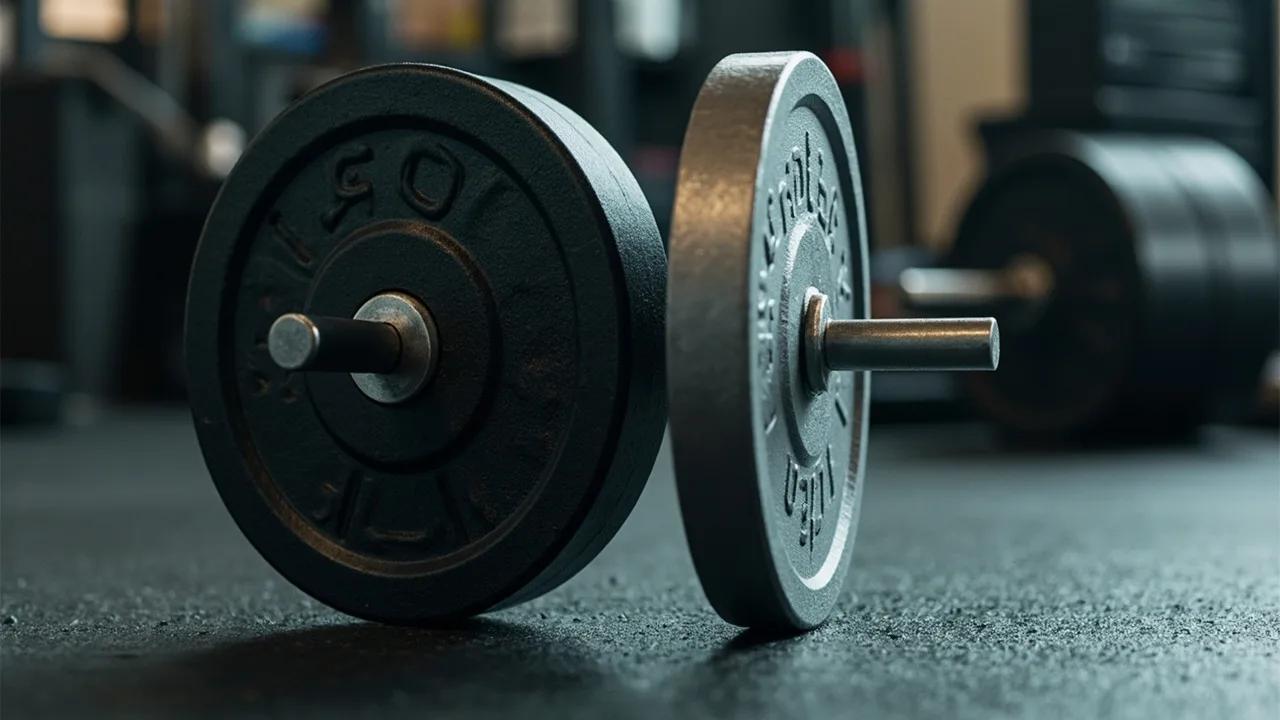
A 45 lb bumper is roughly 75–85 mm thick. A 45 lb iron plate is roughly 25–33 mm. Same weight, about a third of the space.
Do the arithmetic and the ceiling appears:
- Five 45 lb bumpers per side at 80 mm each = 400 mm. That fills the sleeve.
- That is 450 lb of plates plus a 45 lb bar = 495 lb, with no room left for change plates or a collar.
- The same sleeve takes twelve or more iron 45s.
So a bumper-only home gym has a hard stop somewhere around 450–500 lb on the bar. If you never plan to deadlift 500, that ceiling is irrelevant and you can stop reading this section. If you might, it matters more than the price difference — because the fix is buying a second set of plates.
This is why lifters chasing heavy deadlifts at home almost always run a hybrid: bumpers on the outside where drops happen, thin iron or calibrated steel behind them.
Cost: the gap is about 2x
Iron runs $0.80–1.50 per pound for quality cast iron, dipping under $0.70 on sale. Bumpers run $1.50–2.50 per pound, and specialty competition plates go to $4.
On a 300 lb set that is roughly $150–300 for iron against $300–600 for bumpers — a few hundred dollars, which in a home gym budget is a bench, or most of a budget power rack.
Worth knowing before you spend it: plates are the single best thing to buy used. They are almost impossible to damage in a way that matters, and rust on a cast iron plate is cosmetic. Our used equipment guide covers what to check.
Browse iron Olympic plates · Browse bumper plates
Noise, floors, and the neighbour problem
This is where bumpers earn their price, and it is not really about protecting the plates.
Iron on concrete is loud and percussive — the kind of noise that travels through a building rather than around a room. Bumpers absorb most of that, which matters enormously if you are in an apartment, over a bedroom, or sharing a wall.
But the honest version is that flooring solves more of this than plate choice does. A dropped iron plate onto bare concrete will chip the plate and mark the slab. The same plate set down on rubber matting is fine. If your budget only stretches to one of the two, buy the flooring:
- Horse stall mats — the standard answer, about $50 per 4×6 ft mat
- Cheap home gym flooring ideas — what works below that
- How to soundproof a home gym — for the apartment case specifically
Which to buy
Buy iron if you train squats, bench, press and deadlift; you lower the bar under control rather than dropping it; you have rubber flooring; and you would rather put the saved money into the rack or bench. This is most home lifters.
Buy bumpers if you do Olympic lifts (snatch, clean and jerk — these end with the bar being dropped), you train without a rack and need to bail safely, you are above someone else's living space, or you are teaching a beginner who will occasionally lose a rep.
Buy hybrid if you can see yourself getting strong. One pair of 45 lb bumpers on the outside gives you drop protection and the correct 450 mm pull height for deadlifts; iron behind them gives you the loading capacity. This is the setup most people end up with anyway, usually after buying the wrong thing first.
What about rubber-coated iron?
They are iron plates with a rubber shell. They are quieter than bare iron and gentler on floors, they are not droppable, and they are thicker than bare iron so they eat sleeve space without buying you drop safety. Reasonable middle option, commonly oversold as "bumpers."
One more space consideration
Every bumper plate is 450 mm in diameter regardless of weight — a 10 lb bumper is the same size as a 45. That is deliberate: it puts the bar at the correct height off the floor for pulling.
Iron plates shrink as they get lighter. That is more compact to store, but it means a bar loaded with small iron plates sits low, and your deadlift starts from a different height than it would in a gym. If you train the deadlift seriously and buy iron, get one pair of 45s so the bar sits right.
For storage, thin iron wins comfortably — a full iron set takes up far less wall than the bumper equivalent. Our vertical storage guide covers plate racks and wall pegs.
What to skip
- A full bumper set as your first purchase. It is the most expensive way to buy weight and you will likely want iron later anyway.
- Sand-filled or plastic-shell "bumpers." They crack, they are wildly inaccurate on weight, and they bounce unpredictably.
- Buying all 45s. Progress needs small jumps. Get 2.5s and 5s before you get a fourth pair of 45s.
Frequently asked questions
Are bumper plates worth it for a home gym?
If you drop the bar, train without a rack, or lift above someone else's ceiling — yes. If you squat, press and deadlift under control on rubber flooring, iron does the same job for about half the price.
Can you drop iron plates?
No. Dropping cast iron chips the plate, can crack it, and will mark a concrete slab. Iron is for lifts you lower under control.
How much weight fits on a barbell with bumper plates?
About 450–500 lb. A standard sleeve holds roughly 419 mm per side and a 45 lb bumper is about 80 mm thick, so five per side fills it. Iron plates are about a third as thick, so far more fits.
Do bumper plates damage the bar?
No more than iron does. The wear point is the sleeve, and any plate slides on the same sleeve.
Are bumper plates quieter than iron?
Yes, noticeably — the rubber absorbs most of the impact. But rubber flooring makes a bigger difference to what your neighbours hear than plate choice does.
Should I buy plates used?
Plates are the best used buy in a home gym. Iron is nearly indestructible and surface rust is cosmetic. Check bumpers for separation between the rubber and the steel insert — that is the one failure that matters.
What to read next
- What size barbell do you need — size the bar before you load it
- What order to buy home gym equipment — where plates sit in the build
- Horse stall mats for a home gym — the flooring that makes iron viable
- Used home gym equipment guide — plates are the best thing to buy secondhand
- DIY concrete weight plates — if you would rather build them
Sources
Thickness, diameter and sleeve-capacity figures are drawn from published specs and reference guides — BarBend on bumper vs metal plates, Two Rep Cave on 45 lb plate dimensions, and Horton Barbell's bumper plate pricing survey. Price ranges are 2026 retail and move with steel and freight costs.