Table of Contents
DIY projects hub: Build your own home gym equipment → — power racks, sandbags, plyo boxes, and more.
Key takeaways
Buying iron plates, barbells, racks, and benches used saves 40–70% with no performance trade-off, while cables, bands, and electronics should always be purchased new.
- Used iron plates run $0.50–$1.00/lb versus $1.50–$2.50/lb new; used barbells sell for 40–60% of retail.
- Best buying windows are January–February, May–June, and the week around Black Friday.
- Start negotiations 20–30% below asking price; budget $20–$40 for a rental truck on heavy loads.
- Red flags include cash-only night meetups, stock photos, and pressure for remote payment.
The fastest way to build a home gym on a budget is to let someone else take the depreciation hit. Used gym equipment is everywhere — garages, basements, storage units — and most of it is perfectly fine. Iron does not expire.
But not everything is safe to buy secondhand. Some items degrade in ways you cannot see, and some deals are not deals at all.
This guide breaks down exactly what to buy used (and save 40-70%), what to always buy new, where to shop, how to inspect gear, and how to negotiate like someone who has done this a hundred times.
Where to Shop for Used Equipment
Facebook Marketplace (The King)
Facebook Marketplace has replaced Craigslist as the primary marketplace for used gym equipment. Here is why:
- Seller profiles are public. You can see their name, friends, and history. Scammers are easier to spot.
- Messaging is instant. No waiting for email replies.
- Local search radius. Filter by distance — 10, 25, or 50 miles.
- Price drops. Sellers get notified when their listing sits, so they often drop prices after a week.
Search terms that work: "weight set," "barbell," "squat rack," "home gym," "Olympic plates," "dumbbells," "bench press." Search broad first, then narrow.
Craigslist (Still Alive)
Craigslist skews older (the sellers, not the equipment). You will find estate sales, garage cleanouts, and people who do not know what they have.
- Pro: Less competition than Facebook. Items sit longer.
- Con: More spam and scams. Always meet in public or bring a friend.
OfferUp and Letgo
Mobile-first apps with decent inventory. OfferUp has buyer/seller ratings, which adds accountability. Worth checking alongside Facebook.
Other Sources
- Garage sales and estate sales — The holy grail. People price gym equipment to get rid of it, not to profit.
- Gym liquidations — When commercial gyms close, they dump equipment fast. Follow local gym news and watch for "everything must go" posts.
- Play It Again Sports — Brick-and-mortar used sporting goods. Prices are higher than private sellers but equipment is inspected.
- Moving sales — People relocating long-distance will practically give away heavy items. Search "moving sale" on Marketplace.
What is SAFE to Buy Used
These items are built to last decades. Condition is easy to verify visually, and there is very little that can go wrong:
Iron Plates
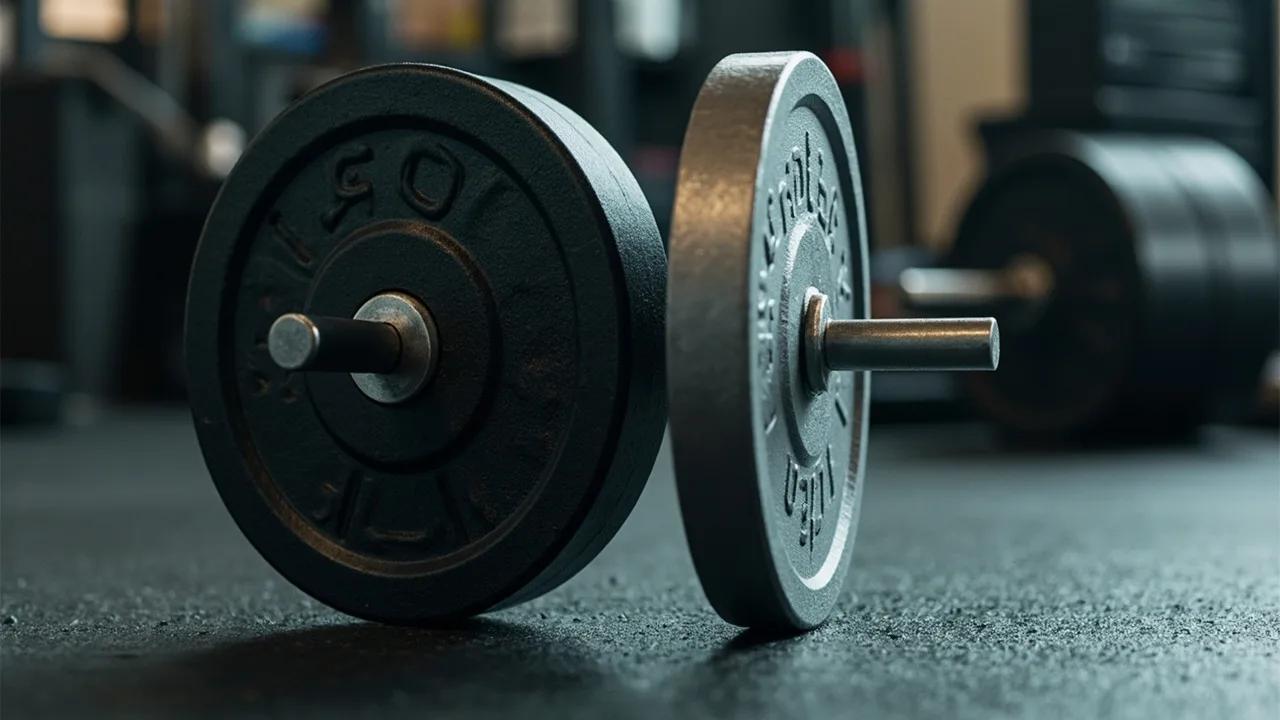
Cast iron does not degrade. A rusty plate cleans up with a wire brush and spray paint. Olympic plates (2-inch hole) hold value better than standard plates (1-inch hole), but both are fine used. Check for cracks on the edges of cheap plates — this is rare but possible with concrete-filled plastic plates.
Barbells
A quality barbell is a lifetime purchase. Spin the sleeves — they should rotate smoothly. Check the shaft for bends by rolling it on a flat surface. Minor surface rust is cosmetic and cleans up with steel wool and 3-in-1 oil. Avoid bars with deep pitting (small craters in the steel), as this indicates structural compromise.
Dumbbells
Hex dumbbells, round dumbbells, adjustable handles — all safe used. Check that hex dumbbells have not separated from the handles (a common failure on cheap brands). Rubber-coated dumbbells may smell if stored in a hot garage, but they are functionally fine.
Power Racks and Squat Stands
Steel is steel. Check welds for cracks (run your finger along them). Verify the J-hooks and safety bars fit properly. Make sure the holes are not elongated (wallowed out from heavy use). A rack from Rogue, Titan, or REP that is three years old is essentially identical to a new one.
Weight Benches
Inspect the padding for tears and check the frame welds. Sit on it and wobble — it should not flex or creak. The adjustment mechanisms on incline benches are the failure point, so test every angle position. Flat benches are nearly indestructible. If you are handy, you can even build your own.
| Product | Best For | Price Range |
|---|---|---|
| CAP Barbell Olympic Bar | Budget new barbell | $80-$120 |
| HulkFit Power Squat Rack | Affordable new rack | $180-$280 |
| Amazon Basics Flat Bench | Budget flat bench (new) | $45-$60 |
What is RISKY to Buy Used
These items degrade invisibly. Failure can mean injury. Buy these new:
Cables and Pulleys
Steel cables fray internally before showing visible damage. A cable that looks fine can snap under load. If you buy a cable machine secondhand, budget for new cables immediately. Pulleys wear out bearings that you cannot see. This is different from a DIY cable system where you control every component.
Resistance Bands
Latex and rubber degrade with UV exposure, heat, and time. A band that has been sitting in a hot garage for two years can snap mid-rep and hit you in the face. Buy new bands every time. They are cheap enough that it is not worth the risk.
Foam Items (Pads, Rollers, Yoga Mats)
Foam absorbs sweat, develops mold, and breaks down structurally. Bench pads flatten out. Foam rollers lose density. These are hygiene items — buy them new.
Anything with Electronics
Treadmill motors burn out. Elliptical consoles glitch. Rower monitors die. Unless you can test the machine fully before paying, electronics are a gamble. And good luck finding replacement parts for a three-year-old NordicTrack model.
Weight Belts and Lifting Straps
Leather cracks. Stitching weakens. Velcro loses grip. A belt that fails mid-squat is a back injury waiting to happen. New belts are $30-$60. Not worth the risk.
How to Inspect Used Equipment
Before you hand over cash, run through this checklist:
For Barbells
- Roll test: Place the bar on a flat surface and roll it. It should roll smoothly without wobbling (indicates a bend).
- Sleeve spin: Grab the sleeve and spin it. It should rotate freely. Grinding or catching means bad bearings.
- Knurl check: Run your hands over the knurling. It should feel grippy, not smooth. Worn knurling means heavy use.
- Rust assessment: Surface rust is cosmetic. Deep pitting (small craters) is structural — walk away.
For Racks and Stands
- Weld inspection: Run your finger along every weld. Feel for cracks, gaps, or cold spots.
- Hole check: Look at the pin holes. They should be round, not elongated from heavy loading.
- Shake test: Grab the rack and try to wobble it. Some movement is normal on tall racks, but excessive play indicates loose bolts or damaged joints.
- Hardware: Count the J-hooks, safety bars, and pins. Replacement hardware is expensive.
For Benches
- Sit and press: Sit on the bench and press down hard with your hands next to your hips. The frame should not flex or creak.
- Padding: Check for tears, indentations, and smell. Sweat-soaked padding cannot be fixed.
- Adjustment mechanisms: If it is an adjustable bench, test every position. The ladder or pin system should lock firmly at each angle.
Negotiation Tips and Fair Pricing
The Price Guide
Used equipment in good condition typically sells for:
- Iron plates: $0.50-$1.00 per pound (new is $1.50-$2.50/lb)
- Barbells: 40-60% of retail
- Racks: 50-70% of retail
- Benches: 40-60% of retail
- Dumbbells: $0.50-$1.25 per pound
Negotiation Tactics
- Always offer 20-30% below asking. Most sellers price high expecting negotiation.
- Bundle. "I will take the rack, bench, and plates for $X." Sellers love clearing everything at once.
- Point out flaws. Rust, missing hardware, and scratches are leverage — but be respectful.
- Bring exact cash. Nothing motivates a seller like a fan of twenties in your hand.
- Be ready to walk. The best deals come to patient buyers. There is always another listing.
Best Times to Buy
- January-February: New Year's resolutions die. Equipment listed by quitters who bought in November/December.
- May-June: Moving season. People relocate and dump heavy items.
- Black Friday week: People replace old gear with new purchases and list the old stuff.
- Post-pandemic market: The 2020-2021 gym equipment bubble has burst. Prices are back to pre-pandemic levels. If you are on a tight budget, now is the time.
| Product | Best For | Price Range |
|---|---|---|
| 3-in-1 Oil | Barbell maintenance | $5-$8 |
| Wire Brush Set | Cleaning rust off plates | $6-$10 |
| Rust-Oleum Spray Paint | Restoring plates/bars | $5-$10 |
Red Flags and Scams to Avoid
- "Cash only, meet at my house at night." Always meet in a public, well-lit location during the day. Bring a friend.
- Prices too good to be true. A full Rogue setup for $200 is stolen or fake.
- No photos of the actual item. Stock photos mean the seller does not have the item (or it does not look like the listing).
- Pressure to pay via Venmo/Zelle before seeing the item. Never send money before inspecting in person.
- "I am shipping it." Used gym equipment is a local, in-person transaction. Period. Nobody is shipping a 300 lb squat rack to you for $50.
- Incomplete sets. A barbell without clips, a rack without J-hooks, or plates in non-matching sizes. Factor in the cost of replacements before agreeing to a price.
The Used Equipment Shopping Checklist
Before you head out:
- Know exactly what you need (measure your gym space first)
- Research retail prices so you know what 50% off looks like
- Bring a tape measure, a flashlight, and cash in small bills
- Test everything before paying
- Have a truck or trailer ready — you are not fitting plates in a Civic
- Check that all hardware and accessories are included
The used market is how most great home gyms are built. Patience and persistence will save you hundreds — sometimes thousands — compared to buying retail. Pair your finds with some DIY flooring and you are in business.
FAQ
Is it safe to buy a used barbell?
Yes, barbells are one of the safest items to buy used. Steel does not degrade with age. Roll it on a flat surface to check for bends, spin the sleeves to verify smooth rotation, and inspect for deep pitting (small craters that indicate structural compromise). Surface rust is purely cosmetic and cleans up with steel wool and 3-in-1 oil. Avoid bars with visible bends or non-spinning sleeves.
How much should I pay for used weight plates?
The standard going rate for used iron plates in good condition is $0.50 to $1.00 per pound. Olympic plates (2-inch hole) hold value better than standard plates (1-inch hole). Rubber-coated bumper plates sell closer to $1.00-$1.50 per pound used. If a seller is asking above $1.00 per pound for bare iron plates, they are overpriced — keep looking.
Where can I find gym equipment liquidation sales?
Follow local gym social media accounts and Google "gym closing near me" periodically. Commercial gyms that shut down often sell equipment through auction houses, Craigslist, or direct contact. Fitness equipment dealers sometimes buy liquidation lots and resell at modest markups. You can also check GovDeals.com for government and institutional gym equipment auctions.
Should I buy a used treadmill?
Generally, no. Treadmill motors, belts, and electronics are the most failure-prone components, and repairs often cost more than the treadmill is worth. If you must buy used, test it at full speed for at least five minutes and listen for grinding, squealing, or belt slipping. Get the model number and verify that replacement parts are still available. Budget treadmills under $500 new are almost never worth buying used.
How do I transport heavy gym equipment?
Rent or borrow a pickup truck or trailer. Bring ratchet straps, moving blankets, and at least one friend. Disassemble racks and machines before transport — never transport a fully assembled rack standing upright (it will tip). For plates and dumbbells, use five-gallon buckets or heavy-duty tote bins to organize and prevent rolling. Most rental trucks from U-Haul or Home Depot cost $20-$40 for a few hours.
Specifically using Marketplace to find used gear? How to Buy Used Home Gym Equipment on Facebook Marketplace — the seven pre-drive questions, the five-minute on-site checklist, and the equipment never to buy used.
Some things aren't worth buying used. For small accessories, new is often the same price without the wear — the best home gym equipment under $100 shows where a new purchase beats the used market.
Plates are the best used buy. Bumper vs iron — what each type costs new, and the one bumper failure worth checking for secondhand.