Table of Contents
Key takeaways
Resistance bands are the cheapest strength equipment that works, and the most confusingly labelled.
- A band's rating is a range, not a weight. The pull depends on how far the band is stretched: THERABAND sells its yellow band as 3–4.3 lb, and LEEKEY's heaviest loop as 50–125 lb.
- A set's headline total is every band stacked at full stretch. Bodylastics' 280 lb is all six bands clipped to one handle and pulled to their limit. No single band, and no normal rep, comes close.
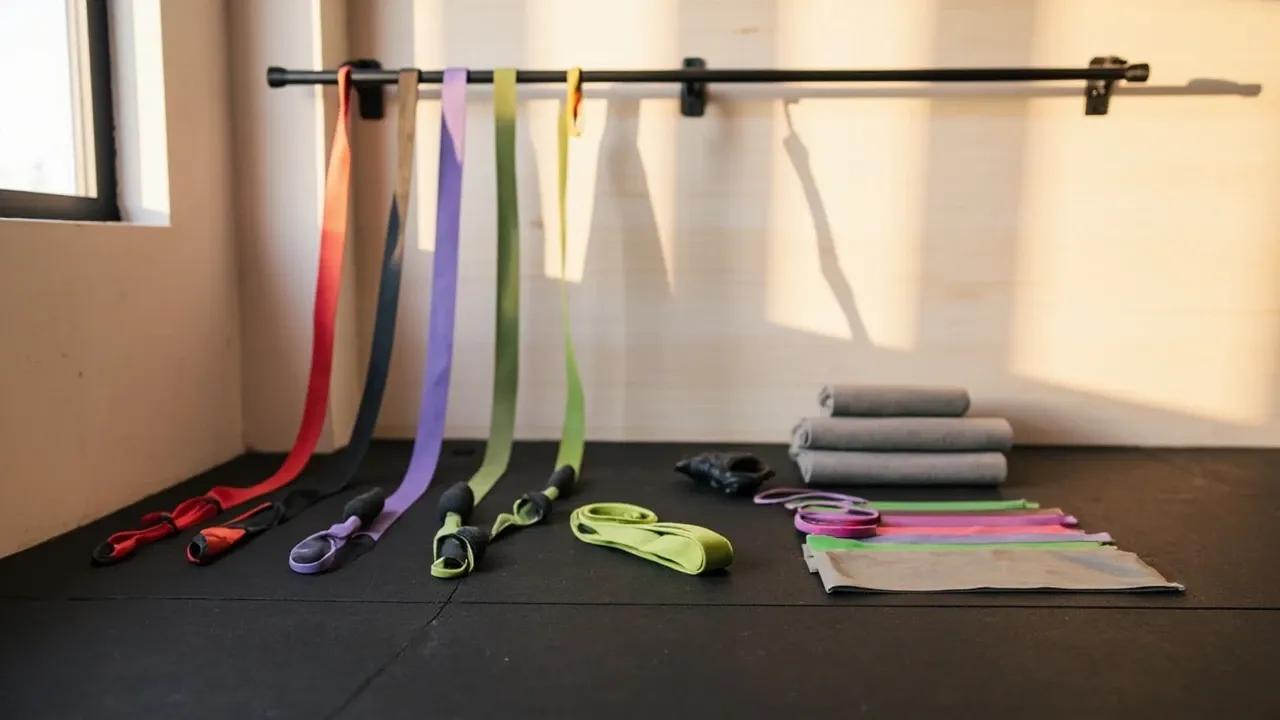
- Buy by type, not by total. Long loops for squats, deadlifts and pull-up assistance. Tube sets with handles for presses and rows off a door. Mini loops and fabric bands for hips and warm-ups. Flat bands for rehab.
- The best single set for most homes is the Bodylastics six-band set at $62. On a budget, the WHATAFIT tube set at $28 plus the LEEKEY loops at $25 cover nearly everything.
A good set of bands costs a fraction of a pair of adjustable dumbbells, fits in a drawer, and builds strength. The research on that is better than most people expect, and it is covered below. What it will not do is tell you what you are buying, because the numbers on the packaging describe something other than what you will feel.
This guide sorts bands by what each type is actually for, explains the two numbers that mislead buyers, and picks the set worth buying in each category. If you are buying for someone over 60 or for rehab, the resistance band guide for seniors starts lighter and covers that ground in more depth.
Quick Answer
The best resistance bands for home in 2026, one per job:
- Bodylastics Six-Band Tube Set ($62) — best overall set. Six stackable tubes from 3–10 lb up to 23–90 lb, with an internal safety cord, two handles, two ankle straps and a door anchor. The set to buy if you are buying one.
- WHATAFIT Tube Set ($28) — best budget set with handles. Five tubes in clean 10 lb steps from 10 to 50 lb, a door anchor and two handles. Half the price of the Bodylastics, for most of what it does.
- LEEKEY Long Loop Bands ($25) — best loop bands for strength and pull-ups. Four loops from 15–35 lb to 50–125 lb, made of synthetic rubber and latex-free. These are the bands for banded squats, deadlifts and assisted pull-ups.
- Serious Steel Mini Loop Bands ($15) — best mini loops. Five 2 × 12 in latex loops from very light to extra heavy, from a strength-equipment brand rather than a generic seller.
- Tribe Lifting Fabric Hip Bands ($20) — best for glutes and hips. Three 3 in wide fabric loops that do not roll up your legs or pinch bare skin.
- THERABAND Professional Flat Bands ($19) — best for rehab and mobility. Seven 6 ft latex bands in THERABAND's graded colours, a common reference in physical therapy. The non-latex THERABAND kit ($12) is the alternative if latex is a problem.
Most homes need two of these, not six. A tube set for pressing and pulling, and the LEEKEY loops for legs and pull-ups. Add mini or fabric bands if hip work is part of your training.
Can Resistance Bands Build Muscle?
Yes. It is the question rising fastest in band searches, usually phrased as "are resistance bands better than weights", and the research answer is more interesting than either camp admits.
For strength, bands hold up in the trials that exist. A 2019 meta-analysis in SAGE Open Medicine (Lopes et al.) pooled seven small randomised trials, 224 people aged 15 to 88, from students and footballers to cardiac and COPD patients, training for 4 to 12 weeks. It concluded that elastic training "is able to promote similar strength gains to conventional resistance training", which in those trials mostly meant machines. That is a finding of no difference in short trials, not proof the two are equal over years of training. It is still a better result than most band sceptics expect.
For muscle size, the evidence is thinner. The American College of Sports Medicine's 2026 position stand (Currier et al.) says elastic band training "has been shown to increase strength, hypertrophy, and certain components of physical function", measured against doing nothing. No review has yet compared bands with weights head to head for muscle growth.
In older adults, weights still edge it. A 2025 network meta-analysis of 102 trials in adults averaging 70 (Wiedenmann et al.) found every kind of resistance training beat no exercise, with machines producing the largest average strength gains, then free weights, then bands, then bodyweight alone.
Where bands fall short is in the curve and the count.
- The resistance rises through the rep. A band is slack at the bottom of a squat and tightest at the top. That roughly matches where you are strongest, which is why powerlifters add bands to the barbell, but on its own a band leaves the bottom of the rep lightly loaded.
- The load is hard to measure. A dumbbell weighs 25 lb on every rep. A band's pull changes with where you stand, how far you stretch it and how worn it is. Progress is real but fuzzy.
- Legs outgrow them first. Trained legs squat and deadlift well past what a set of bands can deliver at a comfortable stretch. Bands become the assistance, not the main work.
Are resistance bands better than weights?
No — and weights are not better than bands either. They do different jobs.
| Bands | Dumbbells and kettlebells | |
|---|---|---|
| Cost for a full range | $25–62 | $160–380 for an adjustable pair |
| Space | A drawer | A rack or a corner |
| Measurable progress | Fuzzy | Exact, to the pound |
| Resistance through the rep | Rises as the band stretches | The same weight throughout |
| Heavy legs | Tops out | Keeps going |
| Pull-up assistance | Yes | No |
| Travel | Yes | No |
The strongest home setup uses both. Bands cover rows, presses, pull-up assistance and warm-ups for very little money. A pair of adjustable dumbbells carries the heavy lower-body work bands cannot. If the budget only covers one, start with bands and buy the dumbbells when the bands stop being hard.
How to progress with bands: stand further from the anchor, move up a colour, double two bands together, slow the lowering phase to three seconds, or add reps. Write down the band and the foot position, not just the reps. It is the only way to know you are actually progressing.
What the Number on the Package Means
Two numbers on band packaging mislead people, and both are true.
The first is the range. An elastic band does not have a weight. It pulls harder the further it is stretched, which THERABAND states plainly: the force "depends on the percent elongation". THERABAND publishes its bands' pull at two points, stretched to twice resting length and to three times, which is why its beginner kit lists yellow as 3–4.3 lb, red as 3.7–5.5 lb and green as 4.6–6.7 lb. LEEKEY rates its loops as red 15–35 lb, black 25–65 lb, purple 35–85 lb and green 50–125 lb, for the same reason. You will feel the low number near the start of a rep and the high number only at a long stretch. Most reps live in between.
Treat every printed number as approximate. An independent lab test of THERABAND bands (Uchida et al., 2016) confirmed that tension rises with stretch for every colour, and measured forces that did not match the published reference figures.
The second is the total. Tube sets advertise a combined figure: Bodylastics says 280 lb, WHATAFIT says 150 lb, and no-name sets on Amazon say 300, 350 or 450 lb. That figure is every band in the box clipped to one handle and stretched to its maximum. Bodylastics lists its six bands individually as 3–10, 5–20, 8–30, 13–50, 19–80 and 23–90 lb, and adding the top of every range gets you to 280. You will never use all six at full stretch on one rep. Compare sets by their single bands and the steps between them, never by the total. A set whose heaviest single band is 50 lb is a 50 lb set for most exercises, whatever the box says.
The Five Band Types, and What Each One Is For
| Type | What it is | Typical pull | Price | Best for | Skip it if |
|---|---|---|---|---|---|
| Long loop (power) bands | Continuous flat loops, long enough to stand on and press overhead | 15–125 lb per band | $25–40 a set | Squats, deadlifts, presses, pull-up assistance | You want handles |
| Tube bands with handles | Rubber tubes that clip to handles, with a door anchor | 3–90 lb per tube, stackable | $28–62 | Gym-style presses, rows, curls, chest flys | There is no solid door you can close |
| Mini loops | Short 12 in latex loops | Very light to extra heavy | $10–15 | Hip and shoulder activation, warm-ups, rehab | You want heavy leg work |
| Fabric hip bands | Wide cloth loops with latex threads | Light, medium, heavy | $20 | Glute bridges, squats, lateral walks | You need latex-free |
| Flat therapy bands | 5–6 ft sheets, cut to length | 3–7 lb on the beginner colours | $12–20 | Rehab, mobility, light shoulder work | You want to load big muscles |
The pattern: long loops and tube sets build strength; mini loops, fabric bands and flat bands prepare for it. Buy one from the first group before anything from the second.
The 6 Worth Buying
1. Bodylastics Six-Band Tube Set — Best Overall Set
- Bands: six stackable tubes, 3–10, 5–20, 8–30, 13–50, 19–80 and 23–90 lb. That is 280 lb if you stack all six at full stretch.
- In the box: two handles, two ankle straps, a door anchor and a carry bag.
- Material: natural rubber latex, with an internal safety cord that Bodylastics calls snap reduction.
- What sets it apart: the spread. Six bands with small steps at the light end mean you can match a band to a lateral raise and another to a row without guessing, and the stacking clips let you build heavier combinations in between.
The safety cord is the other reason. A stretched tube stores energy, and a tube that fails under load whips. Bodylastics describes the reinforced inner cord as "helping to prevent overstretching and snapping". Treat that as a margin, not a licence: a nicked band still gets replaced.
One listing quirk: Amazon titles this item "Basic Series" while the bullets and the selected variant say Pro Series, 280 lb. The variant to make sure you are looking at is the six-band, 280 lb set.
Check the Bodylastics six-band set on Amazon — $62, and the set this site already recommends in its seniors and home-equipment guides.
2. WHATAFIT Tube Set — Best Budget Set with Handles
- Bands: five tubes at 10, 20, 30, 40 and 50 lb, stackable to 150 lb.
- In the box: two cushioned handles, a door anchor, a carry case and a manual.
- Material: natural latex, with metal clips.
- What sets it apart: clean 10 lb steps. The labels are round numbers rather than ranges, which makes picking a band for each exercise easier than with most sets.
Read those round numbers the same way as every other band's: they are a point on the stretch, not a constant weight. The WHATAFIT does most of what the Bodylastics does for less than half the price. You give up the lightest bands (Bodylastics starts at 3–10 lb, WHATAFIT at 10 lb), which matter for shoulder work, and the ankle straps.
Check the WHATAFIT tube set on Amazon — $28.
3. LEEKEY Long Loop Bands — Best Loop Bands for Strength and Pull-Ups
- Bands: four loops: red 15–35 lb, black 25–65 lb, purple 35–85 lb, green 50–125 lb.
- Material: layered synthetic rubber, and latex-free per the listing.
- In the box: carry bag and an exercise guide.
- What sets it apart: these are the heavy bands. Step on one and loop it over your shoulders and it is a squat. Stand on it with a hip hinge and it is a deadlift. Loop it over a pull-up bar and kneel in it, and it takes 15 to 125 lb off your bodyweight, by the listing's own figures.
That last use is the one most people buy loops for. The band is stretched furthest at the bottom of a pull-up, so it helps most where the rep is hardest to start and less near the bar. Move to a lighter band as you get stronger. If you do not have a bar yet, the pull-up bar guide covers which ones your door frame or wall can actually hold.
Check the LEEKEY loop bands on Amazon — $25, and the same loops the under-$50 equipment guide recommends.
4. Serious Steel Mini Loop Bands — Best Mini Loops
- Bands: five loops, 2 × 12 in, very light to extra heavy.
- Material: natural rubber latex.
- In the box: a mesh bag and a quick-start guide.
- What sets it apart: the source. Serious Steel makes strength equipment, and sells these for rehab, prehab and warm-ups rather than as a generic five-pack.
Mini loops do warm-ups and accessory work: lateral walks, clamshells, monster walks, shoulder external rotations, glute bridges with a knee push. They are not a way to load a squat. Serious Steel's own listing warns against using them under shoes on concrete or asphalt, which wears them out fast. Use them on a mat, or barefoot.
Check the Serious Steel mini loops on Amazon — $15.
5. Tribe Lifting Fabric Hip Bands — Best for Glutes and Hips
- Bands: three loops, light, medium and heavy, all 3 in wide and the same length.
- Material: a cotton and latex blend with a textured inside.
- What sets it apart: they stay where you put them. Latex minis roll up your thighs and pinch bare skin. Fabric bands sit flat over leggings or skin and stay put through a set.
Two details from the listing worth knowing: Tribe recommends stretching them to less than twice their resting length, and they are a cotton-latex blend, so fabric does not mean latex-free. Keep them out of direct sun and away from detergents.
Check the Tribe Lifting fabric bands on Amazon — $20.
6. THERABAND Professional Flat Bands — Best for Rehab and Mobility
- Bands: seven 6 ft latex bands in THERABAND's graded colour sequence.
- Material: natural latex, cut to whatever length the exercise needs.
- What sets it apart: THERABAND's colour scale is a common reference in physical therapy, so if a therapist tells you to use green, this is very likely the green they mean.
Flat bands are the lightest category here, and they are for rehab, mobility, shoulder health and warm-ups rather than building strength in big muscles. If latex is a problem, the THERABAND non-latex beginner kit ($12) has the yellow, red and green bands in a synthetic material. Its listing is where the 3–4.3 lb figures above come from.
Check the THERABAND Professional set on Amazon — $19.
What to Skip
- "300 lb", "350 lb" and "450 lb" sets from brands you cannot find anywhere else. The total is every band stacked at full stretch. Look up the single bands; a set whose heaviest band is 50 lb is a 50 lb set, whatever the box says.
- Latex bands if you have a latex allergy. Reactions to natural latex range from itching to anaphylaxis (ACAAI). Most bands are natural latex, including most fabric bands. The latex-free options here are the LEEKEY loops and the THERABAND non-latex kit.
- Latex mini loops for heavy squats. They roll and pinch, and they are not made for the stretch a loaded squat needs. Use fabric bands for hip work and long loops for loading.
- Anchoring a band to anything but a solid closed door or a fixed post. Not a door handle, not furniture. The anchor goes on the hinge side, and you stand so the door opens away from you, so that pulling pulls it shut. Anchor makers' instructions say the same, and Lifeline's adds: never under a door.
- A band with a nick, a tear or a puncture. Bands fail where they are damaged, and they fail suddenly. Replace it; a new band costs less than a trip to urgent care.
A 20-Minute Full-Body Band Workout
The ACSM's 2026 position stand asks for every major muscle group at least twice a week, with high effort: close to failure, or stopping two or three reps short. It sets no rep range. A practical way to apply that with bands: two or three sessions a week on non-consecutive days, one to three rounds, 8–15 reps per exercise, with a band that leaves you two or three reps short of failure on the last set.
- Banded squat — long loop under both feet, the other end over your shoulders.
- Romanian deadlift — long loop under both feet, held in both hands, hinge at the hips.
- Banded push-up — long loop across your upper back, ends under your hands.
- Standing row — tube band anchored at chest height, pull the handles to your ribs.
- Overhead press — tube or long loop under your feet, press straight up.
- Band pull-apart — light long loop or flat band held at shoulder height, pull it to your chest.
- Glute bridge — fabric band just above the knees, push the knees out as you lift.
- Lateral walk — mini loop or fabric band around the ankles or above the knees, ten steps each way.
That covers legs, hips, push, pull and shoulders with $50–75 of bands. When the heaviest band stops being hard on the squat and the deadlift, that is the signal to add dumbbells, not more bands. Older beginners should start with the program in the strength training after 60 guide, which ramps up more gradually.
Keeping Bands Safe, and Making Them Last
- Inspect before and after every session. Run each band through your fingers looking for nicks, tears and thin spots, especially where it meets a handle, clip or anchor. THERABAND's care guidance is blunt: discard any band that is torn, punctured or nicked. Check the clips too. In 2019 about 95,000 SPRI bands were recalled because they could separate from the handle and strike the user.
- Protect your eyes. Snapping bands cause real eye injuries; emergency physicians have published case series of them (Al-Khersan et al., 2021), and THERABAND's own guidance says to wear eye protection. At the very least, point the stretch away from your face.
- Keep them out of the sun and the heat. THERABAND says to store bands in a cool, dry place, out of direct sunlight, away from extreme temperatures. A garage gym in summer is hard on latex; a closet is easier.
- Avoid rough surfaces. Concrete and asphalt under a band wear it through, which is why Serious Steel and Tribe both warn against it.
- Never stretch past what the maker allows. THERABAND says no more than three times resting length; Tribe says under twice for its fabric bands. If a band needs more stretch than that to feel hard, you need a heavier band.
Bands also lose pull with use. One small lab study (de Paula et al., 2017) found exercise tubing lost roughly 10–15% of its resistance after 1,000–3,000 stretches.
A band that lives on a sunny windowsill or under shoes on concrete wears out far sooner than one kept in a drawer. There is no honest mileage figure for any of them, so inspect each band and replace it when it shows damage.
Frequently Asked Questions
Which resistance level should I buy? Buy a set rather than a single band. Legs need far more resistance than shoulders, and one band cannot cover both. In the LEEKEY set, the 25–65 lb loop is a sensible everyday band for most adults; in a tube set, the 20–30 lb tubes cover most upper-body work.
Are loop bands or tube bands with handles better? Neither. Tube bands with handles feel like a cable machine and are best for presses, rows and curls off a door anchor. Long loops are heavier, need no anchor for squats and deadlifts, and double as pull-up assistance. If you only buy one, the LEEKEY loops do more of the heavy work and the Bodylastics set does more exercises.
Can resistance bands replace weights? Partly. A 2019 meta-analysis of short trials found elastic training produced strength gains similar to weights and machines, and a 2025 analysis in older adults ranked bands behind machines and free weights. In practice, bands replace weights well for upper-body and accessory work and run out on heavy legs, which is why most home gyms end up with both.
Are fabric resistance bands latex-free? Usually not. Most fabric hip bands, Tribe's included, weave latex threads into the cotton. If you have a latex allergy, choose bands sold as latex-free, such as the LEEKEY loops or the THERABAND non-latex kit.
How long do resistance bands last? It depends far more on care than on time. Sun, heat, rough floors and overstretching wear them out. Inspect them before each session and replace any band with a nick or tear, whatever its age.
Are resistance bands good for seniors? Yes, and the lighter end of the range is where to start. The resistance band guide for seniors covers the lighter sets, the safety features that matter most after 60, and a full routine. For a home without anything mounted to the walls, the apartment gym guide covers what else fits a rental.
Buy the type of band the job needs, read the single-band numbers rather than the total, and replace a band the day it shows damage.