Table of Contents
Key takeaways
An indoor gym already has climate control. What it does not have is permission to be loud at 6am.
- Decibels are the spec here, not CFM. A garage fan is sized to fight a 90°F uninsulated box. A spare bedroom needs air moved across one person without waking the house.
- The dB on the box is measured at the lowest speed. A fan advertised at "20 dB" is 20 dB on a setting that moves almost no air. Nobody publishes the number for the speed you will actually use.
- The measurement distance is usually missing too. Sound drops about 6 dB every time you double the distance, so a figure quoted at 6 ft and one quoted at 3 ft are not comparable, and only one of them is usually stated.
- A DC motor is the one specification that reliably means quiet. It is also the reason the $90 pedestal is $90.
- The best default for most indoor gyms is the Vornado 630 at about $68 — it moves a whole room's air from across that room, so it never has to be pointed at you on high.
This is the indoor companion to our garage gym fan guide. If your gym is in a garage, that page is the one you want — the products there are drum fans and 20-inch high-velocity wall mounts, and they are the right answer to a genuinely different problem.
Quick Answer
For most indoor home gyms — spare bedroom, basement, bonus room — the Vornado 630 at about $68 is the one to buy. It is an air circulator rather than a fan pointed at your face: it pushes a column of air that bounces off the far wall and turns the whole room over. Because it cools the room rather than you, it does the job on a low, quiet setting, which is the entire trick.
If the room is small and the budget is tight, the Levoit tower at about $40 takes up a footprint the size of a dinner plate and claims 20 dB at its lowest setting.
If you want the air aimed at you while you lift and you want it quiet at that speed, pay for a DC motor: the Lasko EcoQuiet pedestal at about $90, or the Amazon Basics 16-inch DC at about $71 for the same motor technology in a plainer package.
And if the gym is a corner of a room rather than a room, the DREO 12-inch at about $40 sits on a shelf or the floor and claims 25 dB.
Prices checked September 2026.
Why an Indoor Gym Is a Different Problem From a Garage
A garage gym in July is a heat problem. The building has no insulation, the door faces the sun, and the air inside can sit 10-20°F above outside. You solve that with volume: a lot of air, moved fast, and you accept the noise because there is nobody on the other side of the wall.
An indoor gym has none of that. The room is already conditioned. What you are fixing is narrower and more personal — the pocket of still, humid air that forms around you when you are working hard and not moving through space. A rower or a set of squats produces that in any room, at any temperature.
That changes what you are buying in three specific ways:
- You need far less air. Moving the air immediately around one person is a fraction of the job of turning over a two-car garage.
- Noise becomes the binding constraint. The fan shares a wall with a bedroom, sits under a floor somebody sleeps on, or runs at 5:30am before work.
- Footprint matters. A spare-bedroom gym is usually tight enough that the equipment already competes for floor space. A 20-inch drum fan is a piece of furniture.
If noise is the reason you are here — a downstairs neighbour, a light sleeper — the fan is the smaller half of the problem. Dropped weights and a treadmill deck transmit far more than a fan does, and our soundproofing guide covers the part that actually travels through a floor.
Decibels Are the Spec — and the Number on the Box Is Measured at Low Speed
Every quiet fan is advertised with a decibel figure. Almost none of them tell you the two things that make it meaningful.
It is the lowest speed. A fan listed at 20 dB is 20 dB on setting 1 of 4 or 1 of 12. That setting exists to make the number, and it moves very little air. The speed you will actually run while working is two or three notches up, and that figure is not published by anyone. Assume a real working noise well above the advertised one.
The distance is usually unstated. Sound falls off with distance — roughly 6 dB each time you double it. A figure measured at 6 feet and one measured at 3 feet describe very different experiences of the same fan, and product pages routinely omit which was used. Two fans quoting "24 dB" are not necessarily comparable at all.
Some rough anchors, so the numbers mean something: a quiet library is about 30 dB, a refrigerator hum about 40, normal conversation about 60. A fan you can genuinely run beside a sleeping household sits in the 30s at working speed — which is well above what the marketing figures suggest.
There is one specification that is more trustworthy than the dB claim, because it describes the mechanism rather than the result:
A DC motor. Brushless DC motors run quieter than the AC motors in cheap fans, offer finer speed steps so you can find a setting that is enough rather than too much, and draw substantially less power. When a fan costs $90 instead of $30 and the listing says "DC motor", that is mostly what you are paying for. Both pedestal picks below have one.
The Picks
Vornado 630 — about $68. Best overall for an indoor gym. An air circulator rather than a personal fan. It throws a focused column of air across the room, which bounces off the far wall and sets the whole volume moving. The practical consequence is that it does not need to be aimed at you or run on high — you place it in a corner, run it low, and the room stops being still. That is why it ends up quieter in use than a louder-on-paper fan you have to point at yourself. It is the smaller sibling of the Vornado 660 we recommend for garages, which is the same idea sized for a much bigger box.
Levoit tower — about $40. Best for a tight room. A tower's whole argument is floor space: it occupies roughly the footprint of a dinner plate and puts the air up where you are standing rather than at your ankles. Levoit claims 20 dB at its lowest setting, which is the marketing number rather than the working one, but the class is genuinely quiet. The trade is reach — a tower moves a modest amount of air a modest distance, so it works as a personal fan in a small room and not as a room-turning-over fan in a big one.
Lasko EcoQuiet pedestal — about $90. Best if you want it aimed at you. The DC motor is the reason to choose this over a $30 pedestal that looks identical. You get a wide speed range with usable steps at the bottom, oscillation, and adjustable height so the air arrives at torso level rather than shin level while you are standing under a bar. This is the pick if your objection to fans is that the quiet ones do not move enough air and the ones that do are too loud.
Amazon Basics 16-inch DC — about $71. The same motor, less money. The same core decision as the Lasko — brushless DC, standing, oscillating — in a plainer product with a shorter feature list. If the Lasko's remote and preset modes are not worth $19 to you, this is the one. Buy on the motor type, not the badge.
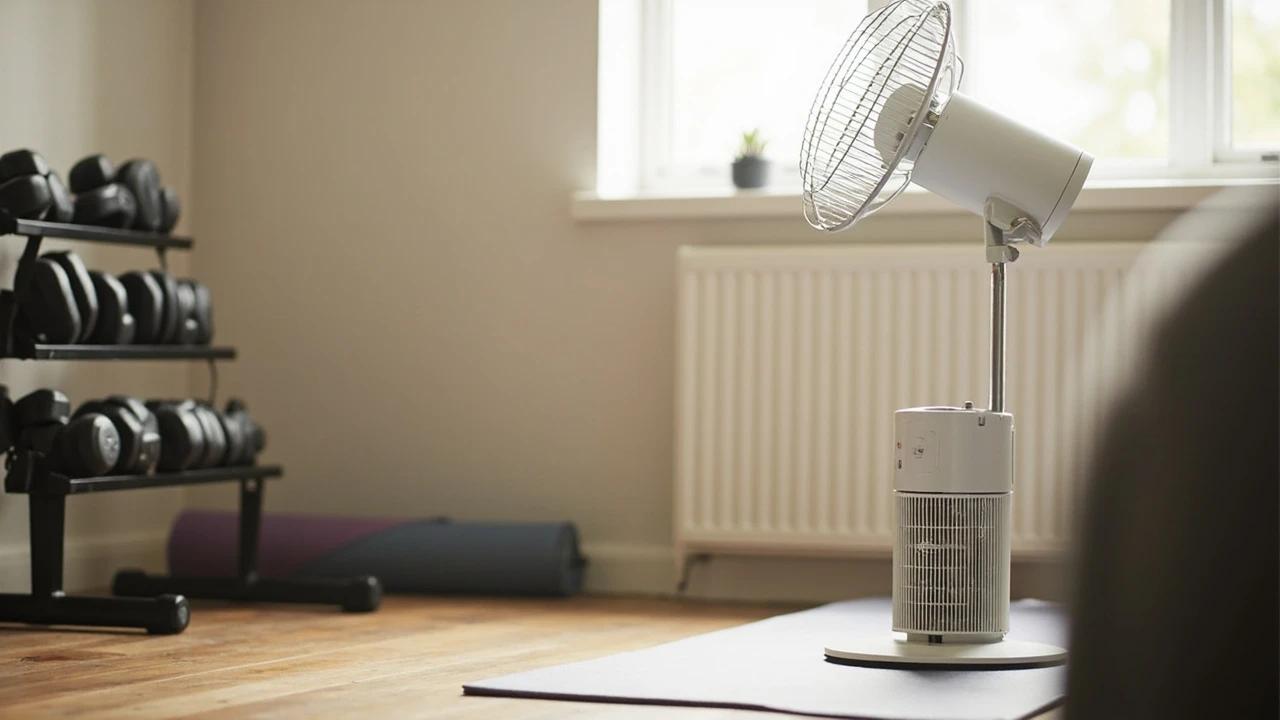
DREO 12-inch — about $40. Best for a corner rather than a room. Small enough to live on a shelf, a bench, or the floor beside a mat, with a claimed 25 dB at its lowest setting. This is the right shape when the "gym" is a corner of a spare bedroom or a 10x10 room and you need air on one training spot rather than circulation through a space.
What About a Ceiling Fan?
If your gym is a permanent room rather than a corner, a ceiling fan is genuinely the quietest way to move air, because it moves a lot of it slowly across a large area instead of a little quickly across a small one. It also takes up no floor space at all, which matters more indoors than any of the specs above.
Two honest caveats. It is an electrical install, not a purchase — which puts it outside what this guide can responsibly recommend a specific product for, since the right fan depends on ceiling height, box rating and blade span for the room. And it is bad at the thing a gym fan is often bought for: directed air onto one person. A ceiling fan makes a room comfortable; it does not cool you down mid-set. Most indoor gyms end up wanting both, and the portable fan is the half you can buy today.
For a basement conversion the ceiling is often too low for one at all — our basement layout guide covers the height constraints that decide it.
What to Skip
- Anything sold on CFM alone for an indoor room. CFM is the garage metric. Indoors it mostly tells you how loud the thing will be.
- A drum fan. They are superb at what they do and completely wrong here: loud, heavy, and sized for a space with a roller door.
- A misting fan. Adding humidity indoors is the opposite of the fix — and in a basement it is actively a bad idea.
- The cheapest pedestal on the page. A $25 AC-motor pedestal has three speeds of which two are unusable at night. This is the category where the DC motor premium is real.
- Buying on the advertised dB figure alone. It is the lowest-speed number, usually at an unstated distance. Use it to compare products within a class, never as a promise.
- A second fan before you have tried repositioning the first. An air circulator aimed at a wall often solves what a second fan pointed at you does not.
Frequently Asked Questions
How many decibels is actually quiet for a home gym? For context: a library is around 30 dB, a fridge hum around 40, conversation around 60. A fan that will not carry through a wall at night is in the 30s at the speed you actually run it — which is usually well above its advertised figure, because that figure is taken at the lowest setting.
Is a tower fan or a pedestal fan better for a home gym? A tower for floor space, a pedestal for reach and for aiming air at you while you train. Towers move less air a shorter distance; pedestals put more air where you want it and adjust to torso height. In a small room the tower usually wins, because the space it saves is worth more than the airflow it gives up.
Do I need a fan if the room is air conditioned? Usually yes, and for a different reason. Air conditioning sets the room's temperature; it does not break up the still, humid pocket that forms around a person working hard in one spot. That is what a fan fixes, and why people with perfectly cool rooms still want one.
Can I just use the garage gym fan picks indoors? The Vornado on that list would be fine — it is the larger version of the one recommended here. The rest would not: two are 20-inch high-velocity wall mounts, one is a drum fan, and one adds mist. All are built for a volume and a noise tolerance an indoor room does not have. See Best Fans for a Garage Gym for when those are the right call.
Will a fan help with the smell in a closed room? It moves air but does not exchange it. Circulation stops the stale pocket forming; it does not remove humidity or odour from a sealed room. For that you need a window open, an extractor, or a dehumidifier — which is a common finding in apartment setups where opening a window is not always an option.
What about winter? Indoors, you mostly stop using it. In a garage the same question becomes a heating problem instead, which we cover in heating a garage gym in winter.
Buy the quiet one you will actually run, not the powerful one you will turn off.