Table of Contents
Key takeaways
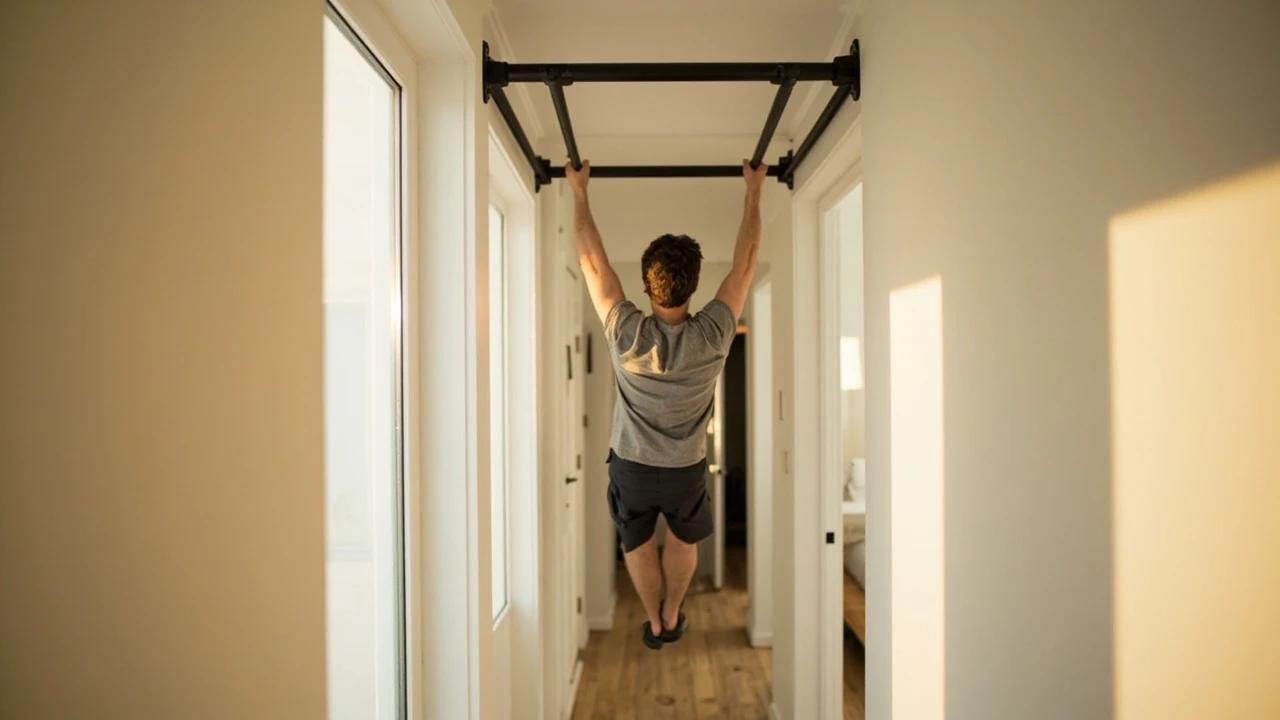
A pull-up bar is the cheapest piece of equipment that trains your whole back, and the one most often bought for a door frame that cannot hold it.
- The frame is the rating, not the bar. A doorway bar's "440 lb" is the steel's number. Your door frame has no number printed on it, and it is the weaker of the two.
- At the bottom of a rep the bar sees roughly 1.5–2 times your bodyweight, more if you kip. A 200 lb lifter loads the frame to 300–400 lb on every rep.
- Three ways to mount one: over the door frame ($28–55), into wall or ceiling studs ($40–229), or a freestanding tower that touches nothing ($140). Renters get the first and the third.
- The best doorway bar for most homes is the Ally Peaks at $28. The best bar full stop is the Titan wall/ceiling mount at $90, if you own the wall.
A pull-up bar costs less than a month of gym membership and covers the one movement almost nothing else at home does: pulling your own weight against gravity. Rows with bands or dumbbells get close. Nothing matches it.
The problem is not choosing a bar. Every pull-up bar on Amazon is a steel tube that will hold you. The problem is that most people buy one for a door frame they have never looked at, and the bar's rating tells them nothing about whether the frame will. That is why "are doorway pull-up bars safe" is one of the fastest-rising questions in the category, and it is the question this guide actually answers.
Quick Answer
The best pull-up bars for home in 2026, by how they attach to your house — because that, not price, is the decision:
- Ally Peaks Doorway Pull-Up Bar ($28) — best doorway bar for most homes. Hooks over the top of the frame, no tools, silicone pads where it touches the trim. Fits 24–32 in doorways with trim up to 3.75 in tall. This is the bar to buy if you rent and your frame is solid wood.
- Sportneer No-Drill Telescopic Bar ($40) — best for wide or trimless doorways. Expands between the jambs, 29.5–37 in, with a gear lock and a spirit level on each end. Its own listing rates it at 297 lb in the manual despite the 440 lb headline — read that section below before buying any bar.
- Maximiza Plus Screw-In Bar ($55) — best doorway bar if you can put in screws. Anchored, not wedged, so nothing can slip. It fits 36–50 in openings only — a standard 30–32 in bedroom door will not take it. Cased openings, hallways and double doors will.
- Yes4All Wall-Mount Pull-Up Bar ($40) — best budget wall mount. Multi-grip, rated 300 lb, drilled into 16 or 24 in studs. For a garage or basement wall you own.
- Titan Fitness Ceiling & Wall-Mount Bar ($90) — best pull-up bar overall. 11-gauge steel, 500 lb rating, 52 in wide, mounts to wall or ceiling. Once it is in, it is the last one you buy.
- Sportsroyals Power Tower ($140) — best if you cannot mount anything. Freestanding, 360 lb rating, adjustable 57–83 in, and it adds dips and leg raises. The renter's answer when the door frame fails the check.
- Stud Bar ($229) — best if it has to outlast the house. 14-gauge welded steel, 600 lb rating, lifetime warranty, built for 9 ft ceilings. Most people do not need this. The people who do already know.
Start with the 60-second frame check further down. If your frame passes, buy the Ally Peaks. If it fails and you rent, buy the power tower. If you own the wall, skip the doorway category entirely and put the Titan into the studs.
Are Doorway Pull-Up Bars Safe?
Yes — on the right frame, used the right way. The reason the question keeps being asked is that three different numbers get confused, and only one of them is about you.
The number on the box is the steel's rating. Ally Peaks says 440 lb. Sportneer says 440 lb. Both are describing what the tube and the welds can hold. That has almost nothing to do with your house.
The number in the manual is usually lower. The Sportneer listing is unusually honest about this: the headline says 440 lb, and the bullet points then say "the manual specifies a maximum load of 297 lbs" — and add that testing shows it can handle 744 lb of instantaneous load, a 2.5× safety factor on that 297. So one listing gives three numbers: 440 in the headline, 297 in the manual and 744 in the test rig. That is not a scandal; it is how safety factors work. But the number to plan around is the manual's 297, not 440, and most listings never tell you which of their numbers you are looking at.
The number that actually matters has never been printed anywhere: what your door frame can take. A door frame is two vertical jambs and a head, nailed into the rough opening, with decorative trim nailed over the gap. The trim — the moulding you see — is cosmetic. It carries the door's weight zero percent of the time. A leverage bar hooks over that trim and asks it to carry all of yours.
And it is not just your bodyweight. At the bottom of a pull-up, as you decelerate and reverse, the bar sees roughly 1.5 to 2 times what you weigh. Kipping — swinging into the rep — pushes it higher, which is why every doorway bar's fine print prohibits it. A 200 lb lifter is loading the frame to 300–400 lb, dozens of times a session.
The three doorway designs load the frame differently
- Leverage (hook-over) bars like the Ally Peaks hang on the top trim on one side and press a padded bar against the wall above the door on the other. Your weight pulls down on the trim and levers the pad into the wall. The trim must be solid wood, properly nailed, and thick enough to grip — Ally Peaks specifies trim up to 3.75 in tall on a 4.7–8.27 in deep frame. Thin, glued-on or MDF trim is where these fail.
- Telescopic (tension) bars like the Sportneer expand sideways between the two jambs and hold by friction plus outward pressure. They do not touch the trim at all, which is their advantage. Their failure mode is different: friction loosens over time, and a bar that was tight in March can drop you in June. That is why the Sportneer ships with a gear lock and spirit levels, and why its listing says solid wood frames only.
- Screw-in bars like the Maximiza put brackets into the jambs with wood screws. Nothing relies on friction or on trim. This is the safest doorway design by a wide margin, at the cost of six small holes and the fact that the Maximiza only fits openings 36 in and wider.
The 60-second frame check
Do this before you order, not after:
- Knock on the jamb. Solid wood sounds dull and dense. A hollow, metal-clad or plaster-over-lath frame rings or feels thin. If it is not solid wood, stop — buy the power tower or a wall mount instead. No doorway bar is rated for a hollow frame, and the listings say so.
- Push up on the top trim. It should not flex, click or move. If it does, it is held by a few finish nails and a leverage bar will pull it off the wall.
- Measure the opening between the jambs. Ally Peaks needs 24–32 in. Sportneer needs 29.5–37 in. Maximiza needs 36–50 in. These do not overlap much, and a bar that does not fit is a bar that is not seated.
- Look at the wall above the door. A leverage bar presses a pad there. Drywall over studs is fine. Plaster that is already cracked, or a wall with a thermostat or switch in that spot, is not.
If all four pass, a doorway bar is safe for you. If any one fails, the frame is telling you which of the other two mount types to buy.
The Three Mount Types, and Which Home Each One Suits
| Mount type | Cost | Tools | Leaves marks? | Who it is for | Who should skip it |
|---|---|---|---|---|---|
| Doorway — leverage | $22–35 | None | Rarely, on good trim | Renters with solid wood frames | Hollow, thin or MDF trim |
| Doorway — telescopic | $35–45 | None | No | Renters with wide or trimless frames | Anyone who will not re-check it |
| Doorway — screw-in | $50–60 | Drill | Six small holes | Owners with a 36 in+ opening | Standard 30–32 in doors |
| Wall or ceiling mount | $40–229 | Drill, stud finder | Permanent | Anyone who owns a stud wall or joists | Renters, drywall-only walls |
| Freestanding tower | $100–180 | Assembly only | No | Renters who failed the frame check | Rooms under about 4 × 5 ft of clear floor |
The pattern is simple. Own the wall: mount to it. A wall or ceiling bar is cheaper than the mid-range doorway bars, holds two to three times as much, and never has to be re-checked. Rent, with a good frame: doorway. Rent, with a bad frame: tower. The tower is the most expensive option and the least elegant, and it is also the only one that cannot damage anything.
The 7 Worth Buying
1. Ally Peaks Doorway Pull-Up Bar — Best Doorway Bar for Most Homes
- Type: leverage, hook-over. No tools, no holes.
- Fits: 24–32 in doorways, frame depth 4.7–8.27 in, trim height up to 3.75 in.
- Rated: 440 lb (steel). 1.7 mm tube wall, powder coated.
- What sets it apart: the pads that touch the frame are silicone rather than the foam most competitors use, so they compress less, grip better and do not leave the dark smudge cheap foam does on white trim.
It also lifts off the frame in two seconds and drops into a closet, which matters more than it sounds in an apartment where the doorway is also a doorway. Its limitation is the same as every leverage bar's: it needs proper trim. Pass the knock test and the push test first.
Check the Ally Peaks bar on Amazon — $28, and the doorway bar this site already recommends in its budget builds.
2. Sportneer No-Drill Telescopic Bar — Best for Wide or Trimless Doorways
- Type: telescopic, tension-mounted between the jambs.
- Fits: 29.5–37 in openings. Solid wood frames only, per its own listing.
- Rated: 297 lb in the manual — the number to plan around. The listing also quotes 440 lb in its headline and 744 lb as an instantaneous test load.
- What sets it apart: a 360° dual gear lock on each end, so the bar cannot unscrew itself under load the way plain twist bars do, and a spirit level built into each end so you can see it is seated square.
Buy this when a leverage bar will not work: a frame with no trim, trim too thin to grip, or an opening wider than 32 in. Then treat it like a tension rod with your life on it. Retighten before every session, and do the hanging test below the first time and any time it has been moved.
Check the Sportneer telescopic bar on Amazon — $40, the one doorway listing that publishes its real rating.
3. Maximiza Plus Screw-In Doorway Bar — Best Doorway Bar If You Can Drill
- Type: screw-in. Three sets of mounts included, so it moves between doorways once the mounts are in.
- Fits: 36–50 in openings only. Standard bedroom doors are 30–32 in. This is for cased openings, hallway arches and double-door frames. Its own listing says it does not fit standard doorways.
- Rated: 330 lb once seated and clamped. Needs solid wood trim at least 1 in thick.
- What sets it apart: it is anchored. Nothing about it depends on friction or on the trim's nails.
For the right opening this is the safest thing you can hang from a door frame, and the holes fill with a dab of wood filler when you leave. For the wrong opening it does not fit at all, so measure first — this bar gets returned by people who did not.
Check the Maximiza Plus on Amazon — $55, and only after you have measured a 36 in opening.
4. Yes4All Wall-Mount Pull-Up Bar — Best Budget Wall Mount
- Type: wall mount, into studs.
- Fits: 16 or 24 in stud spacing. Hardware included.
- Rated: 300 lb. Heavy-gauge steel, powder coated.
- What sets it apart: at the price of a mid-range doorway bar it removes the door frame from the equation entirely, and it gives you neutral, wide and narrow grips.
This is the right first wall mount for a garage or basement, and the one to buy if 300 lb clears your bodyweight with the 1.5–2× margin. If it does not, spend the extra $50 on the Titan.
Check the Yes4All wall mount on Amazon — $40, and it costs less than the telescopic doorway bar above.
5. Titan Fitness Ceiling & Wall-Mount Bar — Best Pull-Up Bar Overall
- Type: wall or ceiling mount, into wood studs or concrete.
- Fits: standard 16 in stud spacing. 52 in wide, 32 mm grip.
- Rated: 500 lb. 11-gauge steel.
- What sets it apart: the rating. 500 lb is a margin no doorway bar offers, which means it holds a heavy lifter with a weight belt on, and holds a kipping teenager, without you thinking about it. 11-gauge is rack-grade steel.
Ceiling-mounting it puts the bar above head height in a room with an 8 ft ceiling, which frees the wall and gets the bar out of the doorway sightline. Wall-mounting it is the usual choice in a garage. Either way it goes into studs with a stud finder, not into drywall anchors — the wall-mounted equipment guide covers that install in detail.
Check the Titan ceiling/wall bar on Amazon — $90, the last pull-up bar most people buy.
6. Sportsroyals Power Tower — Best If You Cannot Mount Anything
- Type: freestanding. Assembly required, no fixing to the house.
- Fits: rooms with roughly 4 × 5 ft of clear floor and 7 ft of height at the top setting.
- Rated: 360 lb. Eight height positions from 57 to 83 in, five backrest positions.
- What sets it apart: it is the only option here that can go in any rented room regardless of the door frames or the walls, and it adds dips, knee raises and push-up handles.
The trade is floor space and a little wobble at the top of the tallest setting, which is inherent to every tower and not specific to this one. If you failed the frame check and you rent, this is the answer.
Check the Sportsroyals power tower on Amazon — $140.
7. Stud Bar — Best If It Has to Outlast the House
- Type: wall or ceiling mount.
- Fits: 9 ft ceilings, 48 in joist span, 14 or 22 in drop from the ceiling.
- Rated: 600 lb. 14-gauge welded steel with gusseted brackets. Lifetime warranty.
- What sets it apart: it is the original fixed-mount pull-up bar and it is built like a piece of the building.
Be honest about whether you need it. The Titan at $90 holds 500 lb. The Stud Bar buys you a 600 lb rating, a lifetime warranty and a 1.25 in grip that suits big hands. If you are a heavy lifter doing weighted pull-ups on a 9 ft ceiling, that is worth $139 more. If you are anyone else, it is not.
Check the Stud Bar on Amazon — $229.
What to Skip
- Any doorway bar on a hollow, metal-clad or plaster frame. The listings all say solid wood only. They mean it. The bar will hold; the frame will not.
- Reading the box number as your number. Sportneer's own listing shows a 440 lb headline against a 297 lb manual rating. Assume every doorway bar's true rating is materially lower than its headline, then subtract the 1.5–2× rep load, then see what is left.
- A telescopic bar you never re-check. Friction mounts loosen. A gear lock slows that; nothing stops it. If you are not going to retighten it before each session, buy a leverage bar or a tower instead.
- Unbranded multi-grip wall units with no stated steel gauge. Amazon has dozens at $80–120 with more handles than the Titan and no gauge, no rating and no manufacturer name. Yes4All states 300 lb; Titan states 11-gauge and 500 lb. A listing that states neither is asking you to guess with your spine.
- Any doorway bar for kipping or muscle-ups. Every doorway product prohibits it in the fine print, and the frame physics above explain why. That training belongs on the Titan or the Stud Bar in studs, or in a power rack.
Installing It Without Wrecking the Door or the Wall
Doorway bars. Seat it, then load it in stages. Hang with both feet on the floor and lift them for a second. Then hang fully for ten seconds and watch the trim and the pads. Then do one slow, controlled rep. Only then train. Do the ten-second hang again any time the bar has been moved.
Wall and ceiling mounts. Use a stud finder, then confirm with a finishing nail before you drill the real hole — stud finders lie on textured walls. Lag screws go into the centre of the stud, not its edge. If the wall is concrete, the Titan mounts to it with the right anchors; the Yes4All is specified for wood studs. Drywall anchors of any kind are not a mounting surface for a pull-up bar, no matter what the packaging claims.
Towers. Put it on a mat, not on tile, and set the height so your feet clear the floor on a dead hang by an inch or two rather than a foot. Every inch above that adds wobble at the top.
The apartment gym guide covers the wider question of what else can go in a rental without a drill, and if you would rather build a bar than buy one, the DIY pull-up bar guide uses pipe and floor flanges into studs for about the price of the Yes4All.
If You Cannot Do a Pull-Up Yet
Buy the bar anyway. It is the only piece of equipment that gets you there.
- Dead hangs build grip and shoulder tolerance. Start at ten seconds, work to a minute.
- Negatives: jump or step to the top, lower yourself over five seconds. Three to five per set. This is the single fastest route to a first pull-up.
- Band-assisted reps: loop a resistance band over the bar and stand or kneel in it. The thick loop bands in the under-$50 equipment guide are the right kind; thin therapy bands are not.
- Inverted rows on the tower's dip handles, or under a sturdy table, build the same muscles from an easier angle.
Two or three short sessions a week and most adults get a first strict pull-up in six to twelve weeks. The bar you are hanging from costs $28.
Frequently Asked Questions
Will a doorway pull-up bar damage my door frame? On a solid wood frame with properly nailed trim, a leverage bar leaves at most faint pad marks that wipe off. On thin, hollow or MDF trim it will crack the moulding or pull it away from the wall. The frame check above tells you which you have before you find out the expensive way.
What door width do I need? It depends on the bar, and the ranges barely overlap: Ally Peaks 24–32 in, Sportneer 29.5–37 in, Maximiza 36–50 in. Measure between the jambs, not across the trim, before you order.
How much weight can a doorway pull-up bar hold? The steel typically holds 300–440 lb. The frame is the real limit and it has no rating. Plan for the bar to see 1.5–2× your bodyweight per rep, and if the manual's rating minus that margin does not clear your weight comfortably, mount to studs instead.
Can renters mount a pull-up bar? Yes: a leverage or telescopic doorway bar leaves nothing behind, and a power tower touches nothing at all. A screw-in doorway bar leaves six small holes, which fill in a minute — check the lease, but most landlords do not care about filled screw holes in trim.
Is a wall-mounted bar better than a doorway bar? If you own the wall, yes, in every way that matters: higher rating, no trim to worry about, no re-checking, and usually cheaper. The doorway category exists for people who cannot drill.
Should I just buy a power rack instead? If you are going to squat and bench too, a rack with a built-in pull-up bar is the better spend and the budget power rack guide covers it. If you only want to pull, a $90 Titan on the wall does the job in a fraction of the space.
Buy the bar your house can hold, not the one with the biggest number on the box. Then do the negatives.