Table of Contents
Key takeaways
A 10x10 room (100 sq ft) is enough for a complete strength setup when equipment selection prioritizes footprint over feature count.
- A folding or half-rack with a 48"×48" footprint, paired with an 8×8 lifting platform, fills the space efficiently.
- Budget $800–$2,000 for a full build; adjustable dumbbells such as the PowerBlock Pro 100 eliminate a fixed-weight rack.
- Store barbells vertically — 6 inches of wall space versus 7 feet horizontal — to preserve floor area.
- Avoid treadmills, ellipticals, and full fixed dumbbell racks; all exceed the practical footprint budget for this room size.
Quick Answer
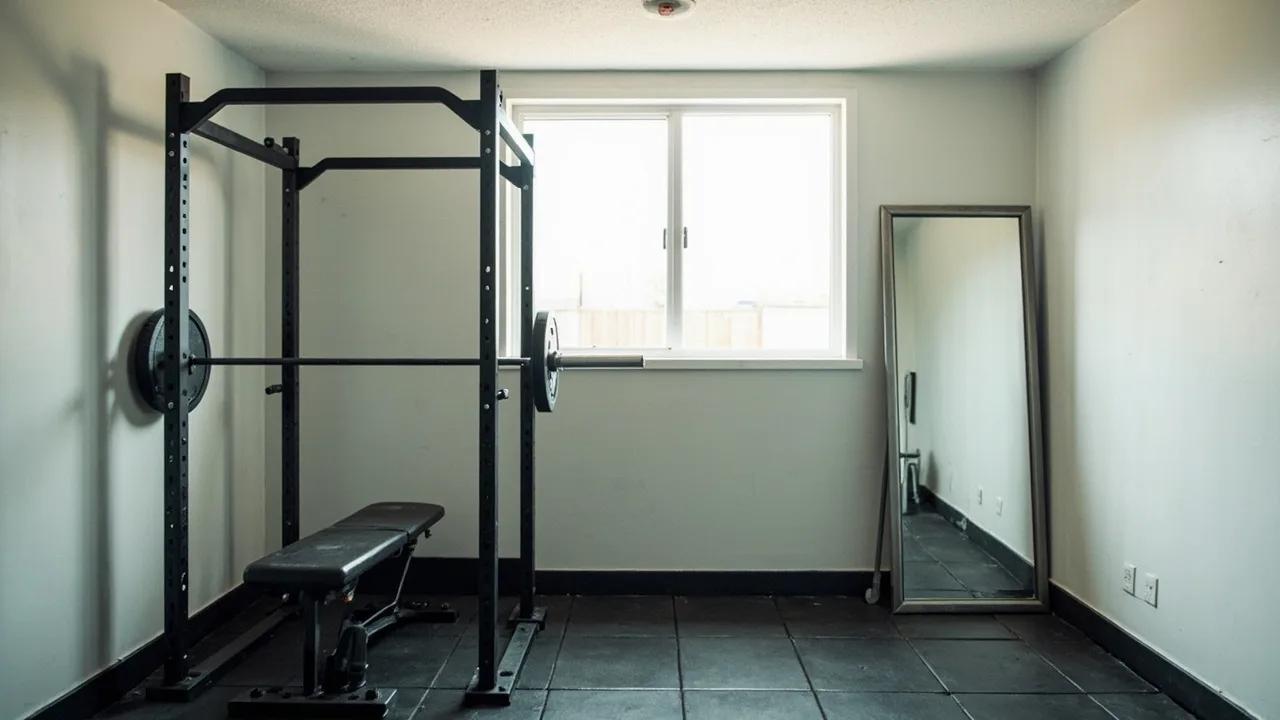
A 10x10 home gym (100 sq ft) fits a full-size power rack, Olympic barbell, adjustable bench, and weight storage with room to squat and deadlift. Budget $800-$2,000 depending on new vs used.
- Minimum equipment: Power rack, 7ft Olympic bar, 300lb plate set, adjustable bench, horse stall mat flooring
- Ceiling: 8ft minimum for overhead press (9ft comfortable for taller lifters)
- Floor: 3/4" horse stall mats over concrete or plywood
Quick Answer: Yes, you can build a complete home gym in a 10x10 room. You need a folding power rack against the back wall, an adjustable bench, a barbell with 300 lbs of plates, adjustable dumbbells, and wall-mounted storage. Budget: $800-$1,500. Use a center-rack layout for powerlifting or a perimeter layout for general fitness. Every piece must fold, stack, or mount to the wall.
A 10x10 foot room—typically a spare bedroom or a home office—is often dismissed as "too small" for a serious home gym. This is a myth. In reality, 100 square feet is the perfect efficiency size. It’s enough room for a full power rack, a barbell, dumbbells, and even a piece of cardio equipment, provided you don’t waste a single inch.
The 10x10 is a useful constraint: it forces you to be intentional. You can't just buy a leg press machine "because it looks cool." Every piece of gear must earn its rent.
In this guide, I will show you the exact layouts, equipment choices, and storage hacks to turn a cramped 10x10 box into a world-class training facility.
In this guide
- Home Gym by Room Size (complete guide)
- Best compact equipment for small home gyms
- Vertical storage solutions
- Cheap DIY home gym flooring
The "Golden Rule" of Small Gyms: Center vs. Wall
When planning a 10x10 gym, you have two main layout philosophies: The Centerpiece vs. The Perimeter.
Layout A: The Centerpiece (Powerlifting Focus)
This layout treats the Power Rack as the throne.
- The Rack: Goes dead center against the back wall.
- The Platform: An 8x8 lifting platform extends from the rack into the center of the room.
- The Sides: Storage for plates and dumbbells lines the left and right walls.
- Pros: Best for serious squatters and deadlifters. You have maximum clearance for the barbell.
- Cons: Leaves very little room for anything else (cardio, yoga).
Layout B: The Perimeter (Cross-Training / General Fitness)
This layout opens up the middle of the room.
- The Rack: A folding rack or slim half-rack mounted to the wall.
- Storage: Vertical wall-mounted storage for everything (bench, bars, plates).
- Center: Completely open 8x8 space for kettlebells, burpees, jump rope, or yoga.
- Pros: Feels bigger. Versatile for HIIT and functional training.
- Cons: Setting up the rack takes 2 minutes.
Essential Equipment Checklist for 10x10
You cannot fit everything. Here is the prioritized list for 2026.
1. The Power Rack (The Anchor)
Do not buy a generic 4-post cage that sits in the middle of the room. It eats too much volume.
- Best Option: PRx Performance Profile Rack or Rogue RML-3W Fold Back. These bolt to the wall and fold inward to stick out less than 5 inches when not in use.
- Runner Up: A "Flat Foot" Squat Stand (like the Rogue SML-1). It has a small footprint (48" x 48") and doesn't need to be bolted down, making it renter-friendly.
2. The Barbell & Plates
- Barbell: Get a standard 7-foot Olympic bar. Do not get a "shorty" bar unless you absolutely cannot fit the 7-footer. Short bars often don't fit standard rack widths.
- Plates: Iron plates are thinner than bumper plates. If you are lifting heavy (400lbs+), thin calibrated plates save literal inches on the bar sleeve and on your storage pegs. If you do CrossFit/Olympic lifting, you need bumpers, but they take up more storage space.
3. Dumbbells: Adjustable is Non-Negotiable
A full rack of fixed dumbbells (5-50lbs) takes up 4-5 feet of wall space. In a 10x10 room, that is a luxury you cannot afford.
- Recommendation: PowerBlock Pro 100 or Nuobell 80lb. These replace 20+ pairs of dumbbells and fit in a 2x2 foot corner. Check the PowerBlock Pro 100 on Amazon.
4. The Bench
You need an adjustable bench (Flat/Incline) to maximize exercise variety.
- Space Hack: Prioritize a compact adjustable bench with a smaller footprint that is easy to move out of the center of the room between sets. The Ironmaster Super Bench and Rep Fitness AB-3000 2.0 are both popular space-conscious picks.
5. Cardio (The Space Killer)
Cardio machines are the enemy of small rooms. A treadmill is a 7-foot long unmovable object.
- Best Option: A Fan Bike (Assault Bike / Echo Bike). It has a small footprint (~4ft x 2ft) and delivers a brutal workout.
- Runner Up: A Concept2 Rower stored upright. It touches the ceiling but takes up almost no floor space.
- Avoid: Ellipticals and large treadmills. If you must run, get a folding "walking pad" to slide under the bed or couch when not in use.
Storage: Up, Not Out
In a 10x10 room, the floor is lava. Everything must go on the wall.
Wall-Mounted Storage
Forget random nails. Install metal pegboards (like Wall Control) or purpose-built wall-mounted gym equipment. They can hold:
- Resistance bands
- Belts
- Collars
- Chains
- Fractional plates
- Foam rollers
Barbell Gun Rack
Mount a vertical 3-bar holder on the wall. Storing bars horizontally takes up 7 feet of wall width. Vertical storage takes up 6 inches.
Weight Plate Tree vs. Wall Storage
- Wall Storage: Wall-mounted weight pegs (4-post stringers) look amazing and keep the floor clear. Warning: You must hit the studs perfectly. 300lbs of plates ripping out of drywall is a disaster.
- Plate Tree: If you rent, get a wheelable plate tree. You can roll it into a corner or out of the way as needed.
Ventilation and Lighting
Small rooms turn into saunas and caves.
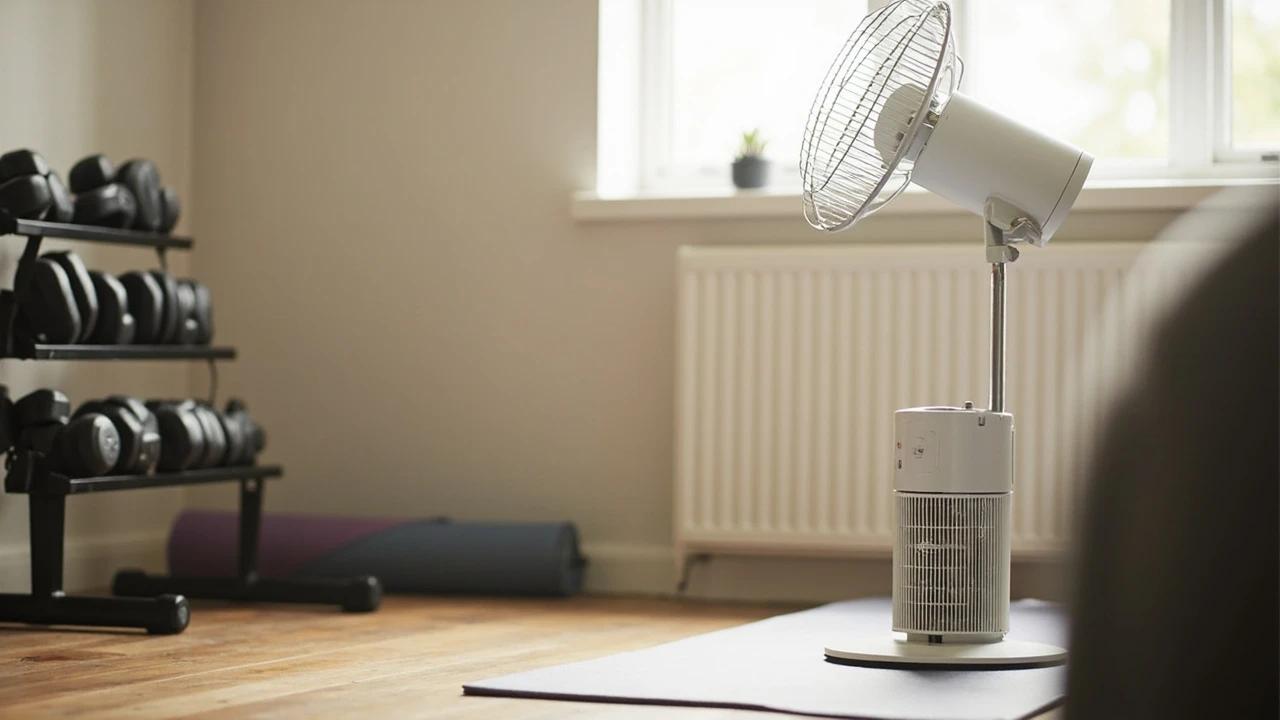
- Airflow: Do not use a floor fan (wasted space). Mount an oscillating fan in the top corner of the room looking down. If you're choosing one, our pick for the best fan for a garage gym suits a 10x10 room too, and the guide shows how to size CFM to the space.
- Lighting: Most bedrooms have a single dim central light. Replace it with a bright LED fixture (5000K daylight color). Bright light makes small spaces feel larger.
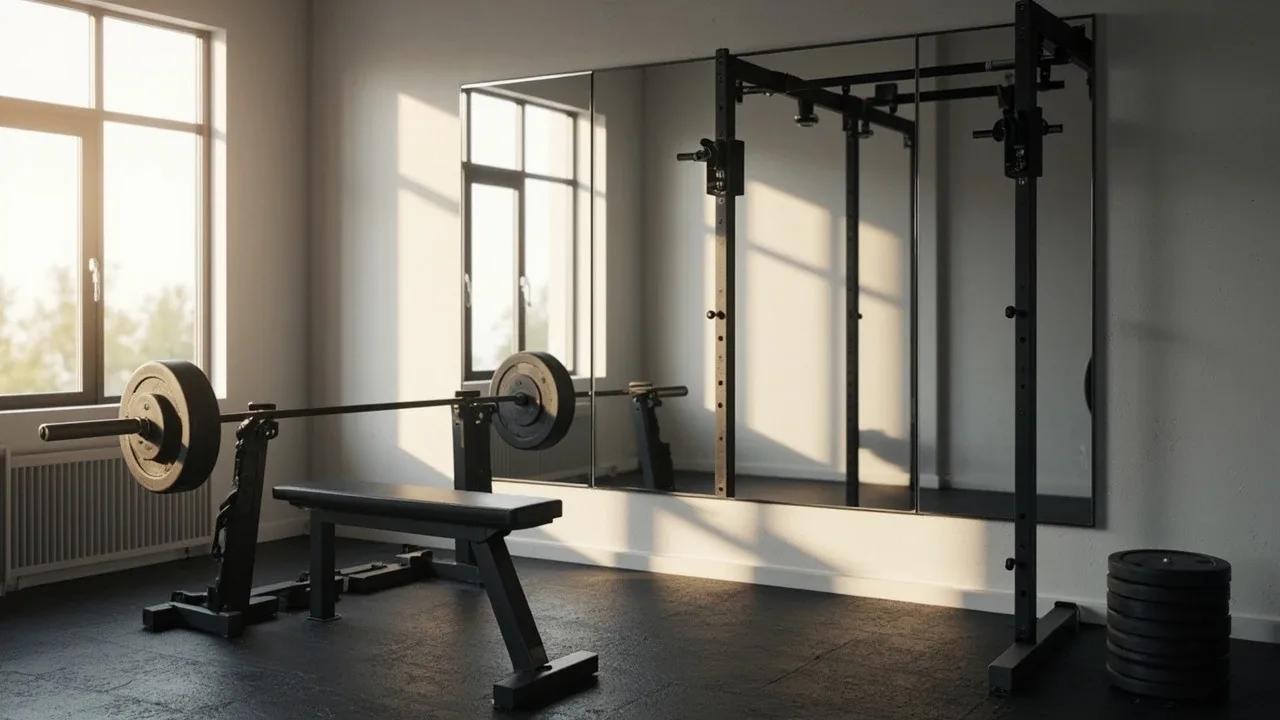
- Mirrors: Mirroring one entire wall (or using 3-4 frameless IKEA mirrors) functionally doubles the visual size of the room. It also helps you check form without needing a coach.
Sample 10x10 Layouts
The "Power Cube" (Review)
- North Wall: Half Rack with plate storage on the rack.
- East Wall: Mirror.
- South Wall: Adjustable dumbbells on stand.
- West Wall: Doorway and light switch.
- Center: Bench (movable).
The "Yoga & Strength" (Dual Use)
- North Wall: Folding Rack (folded away).
- East Wall: Window.
- South Wall: Storage closet for yoga mats, blocks, bells.
- Center: Completely open for Yoga/Pilates until heavy lifting starts.
FAQ
Can I deadlift in a second-floor 10x10 bedroom?
Technically, yes, but proceed with caution.
- Structure: Residential floors are designed for ~40lbs per square foot (live load), but that's an average over the whole floor. A 500lb deadlift sitting on two square feet is a point load. Most modern houses can handle it, but the impact is the issue.
- The Drop: If you drop 300lbs from the hip, you might crack the ceiling drywall below or damage the joists.
- Solution: Always use Crash Pads (Drop Pads). They absorb the shock and sound. Never deadlift directly on bare floor or thin carpet upstairs.
How much clearance do I need for a barbell?
A standard Olympic bar is 7.2 feet (86 inches) long. A 10ft room is 120 inches wide.
- You have 17 inches of clearance on each side if centered.
- That is tight but doable. You must be careful when loading plates not to smash the drywall.
- Tip: Put a strip of rubber or wood on the walls at "plate height" to protect the drywall from accidental bumps.
Is it too loud for a bedroom?
Iron plates clanking is loud.
- Fix: Buy Bumper Plates (rubber). They are silent when they touch.
- Fix: Use strap safeties on your rack instead of pin pipes. Metal-on-metal racking noise is gone.
A 10x10 home gym is not minimal—it’s optimal. With the right gear selection, it outperforms typical commercial gyms because it is yours, it is private, and it is 10 seconds away. Not sure if it’s worth it vs. a gym membership? Run the numbers—you’ll be surprised. If you’re working with a tight budget, see our complete home gym setup under $200.
Also see: Want to save on the rack? See our DIY power rack plans.
Budget check: How much does a home gym cost? See the full tier-by-tier breakdown — from $100 minimalist to $5,000+ premium builds.
Worried about noise? Soundproof your home gym — apartment-safe methods including the floor stack, plate dampeners, and budget tiers.
Building for the first time? How to Build a Home Gym: The Complete 5-Step Guide — start with the cornerstone walkthrough, then come back here for the 10×10-specific layout.
Building in a basement instead of a bedroom? The basement home gym layout guide — same 10×10 footprint, very different constraints (ceiling height, moisture, structural posts).
Adjustable dumbbells save 25+ square feet vs a fixed set. Best Budget Adjustable Dumbbells — the picks that actually fit a 10×10 room without crowding the lifting zone.
Picking the rack itself? Best Budget Power Racks — the 5 picks that actually fit a 10×10 layout, the foldable upgrade, and the tier to skip.
Adding cardio to a 10×10 build? Best Compact Cardio Machines — the 6 picks that fit alongside a rack and bench, with storage and noise breakdowns for tight rooms.
Working with a spare bedroom instead of a dedicated 10×10? Best Home Gym Equipment for a Spare Bedroom — the ranked equipment picks and layouts for turning an unused bedroom into a complete gym.
Have a bit more room than 10×10? 12x12 Home Gym Layout: Complete Setup Guide — what the extra 44 square feet unlocks: full rack clearance, a cardio corner, and a real walking lane.
Furnishing a 10×10 on a tight budget? Best Home Gym Equipment Under $50 — the 10 highest-value pieces to buy before spending on anything bigger.
Outfitting a 10×10 for around $100? Best Home Gym Equipment Under $100 — the 8 items that build a real, complete gym at the $100 tier.
Outfitting that 10×10 for $500? Best Home Gym Under $500 — the complete builds that fit the room and the budget at once.
See this 10x10 layout in 3D before you commit. Plan your gym in the 3D planner — drop a rack, bench, and cardio into a to-scale 10x10 room and check the clearances yourself.
Setting up in the garage instead? Garage Gym Layout Ideas — bay-by-bay floor plans, rack placement under door tracks, and slope fixes.
Working with a garage instead of a spare room? A single-car garage gives you roughly 12×20 ft — double a 10×10 room — but parking and storage change the layout logic. The single-car garage gym layout guide maps the same zone-based approach to that footprint.
Sharing the space with a car? The Garage Gym Gap — we ran every standard US garage size against the average American vehicle. A two-car garage leaves a 37.8-inch strip once both drivers can still open a door.
How much room the bar really needs: barbell size and clearance — 86.6 in of bar, about 9 ft of clear wall to load it, and a 7 × 7 ft zone to train around it.
Adding a mirror to the 10x10? Home Gym Mirrors: What Size, How High, What It Costs — which wall it can go on once the rack is placed, and why the bottom edge belongs 6-12 inches off the floor.
The recovery tool that costs no floor space: Best Massage Guns for Home Gyms: Amplitude & Stall Force — a massage gun lives in a drawer, which is the whole argument for it in a 100 sq ft room.
Air in 100 sq ft. Best Fans for a Home Gym: 5 Quiet Picks by Decibel — an air circulator aimed at the wall beats a fan pointed at you in a room this size, and it does it on a quieter setting.