Table of Contents
- Quick Answer
- Related guides
- Safety Disclaimer (Do Not Skip This)
- Materials List
- Tools Needed
- Target Dimensions
- Step 1: Cut the Lumber
- Step 2: Mark the J-Cup and Safety Bar Holes
- Step 3: Assemble the Base Rectangle
- Step 4: Stand Up the Uprights
- Step 5: Add Top and Mid Horizontal Beams
- Step 6: Install Safety Bars (Steel Pipe)
- Step 7: Install J-Cups (Pipe + Wood Assembly)
- Step 8: Wall-Anchor (Strongly Recommended)
- Step 9: Sand, Finish, and Test
- Maintenance and Replacement
- Frequently Asked Questions
Key takeaways
A wooden power rack rated to 400 lbs can be built cheaply in 6–8 hours using pine studs, lag bolts, and steel pipe safety bars.
- Uprights: four 2×6×8 pine boards; safety bars: 3/4" steel pipe cut to 40" each — never wood, which snaps under drop loads.
- Space J-cup holes at 2" intervals; overall frame is 48" wide × 36" deep × 84" tall.
- Anchor to wall studs, or add 200+ lbs of ballast to the base — an unanchored rack is a tip hazard.
- Do not use for Olympic lifting and never exceed the 400 lb rated maximum.
Read this first: A DIY wooden power rack is not a substitute for a quality steel rack if you're squatting or benching heavy. A budget steel rack costs more than this build. If you can afford one, buy it. This guide exists for people who genuinely can't, and who are willing to follow the safety rules below.
With that said — a well-built wooden rack handles 300-400 lb safely for years. Here's how.
Quick Answer
Build a cheap DIY wooden power rack using 2x4 and 2x6 lumber, lag bolts, and standard hardware. The build takes a full day. The resulting rack is rated for 400 lb squat and bench work when assembled correctly with the reinforcements covered in Step 4.
- Cost: lumber and hardware, itemized in the materials list
- Time: 6-8 hours (cutting + assembly + first lift)
- Critical upgrade: steel pipe safety bars (not wooden — wood snaps under drop loads)
- Rated capacity: 400 lb with proper reinforcement; do NOT exceed
Related guides
Safety Disclaimer (Do Not Skip This)
Wood is not steel. A wooden rack:
- Cannot take the impact of a failed squat bailing into safety bars — you MUST use steel pipe safety bars (not wood)
- Will develop cracks if screwed instead of bolted — use lag bolts with washers, not deck screws
- Requires monthly inspection for split boards, loosened bolts, and compromised joints
- Should NOT be used for Olympic lifting (snatches/cleans with rapid loading cycles)
If you're squatting or benching at 1RM, you need safety bars that will stop the barbell. This guide specifies steel pipe safety bars for that reason.
Prefer to buy instead of build? A welded steel cage removes every failure mode this build has to engineer around, and the budget tier starts near what the materials cost once you add tools:
It is rated well beyond what a bolted 2x4 frame should be trusted with. Best Budget Power Racks compares it with the alternatives.
Materials List
| Item | Qty | Cost |
|---|---|---|
| 2x4x8 pine studs | 10 | $45 |
| 2x6x8 pine boards (uprights) | 4 | $28 |
| 3/4" steel pipe (5 ft, for safety bars) | 2 | $18 |
| 1" steel pipe (j-cups, for bar holders) | 2 | $12 |
| Lag bolts (3/8" x 4") | 30 | $20 |
| Washers (3/8") | 60 | $6 |
| Carriage bolts (3/8" x 6") | 8 | $8 |
| Wood glue (Titebond III) | 1 bottle | Check price on Amazon |
| Sandpaper | 1 pack | $5 |
Tools Needed
- Circular saw or miter saw
- Drill with a 3/8" bit and a bit wide enough for the 1" pipe
- Socket wrench (for lag bolts)
- Stud finder (for wall bolting)
- 4-foot level
- Measuring tape
Target Dimensions
- Outer width: 48" (standard barbell clearance)
- Outer depth: 36" (compact — expand to 48" if you have space)
- Height: 84" (7 feet — fits 8-foot ceilings with clearance)
- Hole spacing: 2" between safety pin positions
Step 1: Cut the Lumber
Cut list (from 10x 2x4x8 studs and 4x 2x6x8 boards):
- Uprights (2x6): 4 pieces x 84" long — these are the corner posts
- Top horizontal beams (2x4): 2 pieces x 48" + 2 pieces x 36"
- Bottom horizontal beams (2x4): 2 pieces x 48" + 2 pieces x 36"
- Mid horizontal reinforcers (2x4): 2 pieces x 48" + 2 pieces x 36"
- Diagonal braces (2x4): 4 pieces x 34" (cut at 45 degrees each end)
Label each piece with a Sharpie as you cut. Organized cuts = clean assembly.
Step 2: Mark the J-Cup and Safety Bar Holes
On each upright, measure from the bottom and mark hole positions at every 2 inches, starting 28 inches from the ground and continuing up to 72 inches. These will become the J-cup and safety pin positions.
Drill through each upright with a bit wide enough for the 1" pipe to pass through. Drill carefully — holes at different positions on opposing uprights mean the bar sits crooked.
Tip: Clamp the two front uprights together and drill through both at once. This guarantees the holes match.
Step 3: Assemble the Base Rectangle
Lay the four bottom horizontal beams in a rectangle: two 48" pieces as front/back, two 36" pieces as sides. Connect with lag bolts at each corner. Pre-drill pilot holes to prevent splitting.
This is your base. It should be dead square before proceeding.
Step 4: Stand Up the Uprights
Attach each 84" upright to the base rectangle at the corners using lag bolts. Drive 2 lag bolts per corner, staggered so they don't split the grain.
Critical reinforcement: Add a diagonal 2x4 brace from the upright base to ~24 inches up, anchored into both the upright and the base beam. This is what gives the rack its lateral stability. Without diagonal bracing, the rack will rock under heavy squats.
Step 5: Add Top and Mid Horizontal Beams
Install the top horizontal beams (2x4 x 48" and x 36") connecting all four uprights at the top. Use lag bolts with washers.
Install the mid reinforcers about 45" from the base — these cross the uprights at bar-height and add enormous rigidity.
Step 6: Install Safety Bars (Steel Pipe)
Cut the 5 ft steel pipes to 40" each (a bit wider than the rack's 36" depth). Drop them through paired holes in the uprights at your desired safety height (typically 12-14" below your squat depth).
Steel pipe is non-negotiable here. Wooden safety bars WILL snap under a failed squat and drop the bar on you.
Step 7: Install J-Cups (Pipe + Wood Assembly)
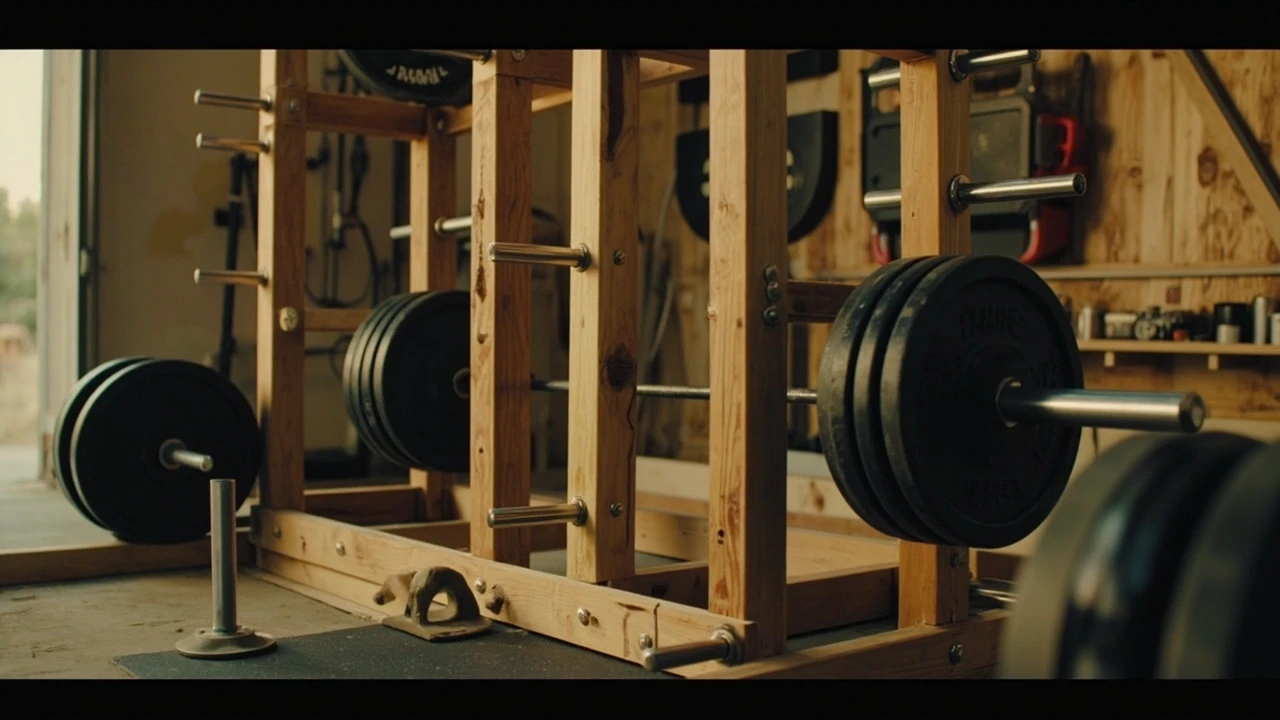
J-cups are removable U-shaped holders that cradle the barbell when racked. The DIY version: short sections of 1" steel pipe (3" long) through the upright holes, with a wood cradle wrapped around each pipe to hold the bar.
Wrap the cradle wood in rubber or duct tape to prevent bar knurl wear.
Step 8: Wall-Anchor (Strongly Recommended)
Anchor the top back corners of the rack to wall studs using lag bolts. This prevents tip-over during sprawl exits from failed squats — the single most common DIY rack failure mode.
If wall anchoring isn't possible, add 200+ lb of ballast weight to the base rectangle (sandbags, plates, whatever). A free-standing rack without ballast or wall anchor is unsafe.
Step 9: Sand, Finish, and Test
Sand all edges with 80-grit then 120-grit. Optionally apply polyurethane for moisture resistance in humid garages.
First lift test: Load the bar to 135 lb. Squat. Rack. Repeat 5 times. Inspect every joint for movement, creaking, or cracks. If anything is off, do NOT proceed to heavier weights — debug first.
Work up to your training weight only after the rack has passed 10+ sessions at lower weight without issue.
Maintenance and Replacement
Monthly check:
- Tighten all lag bolts (wood shrinks over seasons)
- Inspect uprights and diagonal braces for cracks
- Check wall anchor bolts
Annual replacement:
- Uprights: replace if any visible cracking appears
- Hardware: replace lag bolts if corrosion visible
After 3-5 years, retire the whole rack. Wood weakens over time even under normal use. If you've saved up for a steel rack by then, upgrade. If not, build the next one from the same plan.
Planning the full build? How much does a home gym cost? breaks down every budget tier, and our cost calculator picks equipment that fits your space and spend.
Frequently Asked Questions
Is a DIY power rack safe?
Yes, when built to spec and used within its rated capacity (~400 lb). The failure modes are predictable (wood cracks, bolts loosen) and preventable with monthly inspection. It is NOT as safe as a commercial steel rack — make that tradeoff consciously.
What wood can hold a squat?
Pine 2x6 uprights with 2x4 horizontal bracing hold 400+ lb when assembled with lag bolts (not deck screws). Oak or maple uprights are better but 3x the cost. Plywood uprights are a bad idea — they delaminate under dynamic loads.
DIY vs a cheap steel rack?
If you can afford it, buy the steel rack. The Sunny cage above is genuinely safer. DIY is for the tightest budgets, not for buyers who can afford steel.
How much weight can this hold?
400 lb is the tested safe limit with proper reinforcement and wall anchoring. Past 400 lb, the dynamic loads on wood get real — specifically, bar-path deviations during heavy squats put lateral force on uprights that wood handles poorly.
Can I skip the wall anchor?
Only if you add 200+ lb of ballast inside the base and commit to never doing anything that might cause a forward sprawl (like a failed squat). In practice, wall-anchor it. The cost is 10 minutes and two bolts.
Want to compare buying to building? cheap squat racks worth buying — the 5 commercial options. Build the DIY version if you'll save and use the budget elsewhere; buy if the extra cost is worth the time savings.
Not sure a full cage is even what you need? Squat Rack vs Power Rack — compare stands, half racks, and cages before you build or buy anything.