Table of Contents
Key takeaways
The best compact cardio machines for small home gyms fold or store in under 30 seconds and occupy 2–4 sq ft, making the Concept2 Model D rower and walking pad the top space-efficient picks.
- The Concept2 Model D rower costs $900–1,000 and stores vertically; the Marcy NS-1000 fan bike runs $230–280 with a 45×26.75 in footprint.
- Air bikes reach 140–160 bpm heart rate and produce 70+ dB of noise — a meaningful consideration for shared spaces.
- Budget fan bikes under $100 from unknown brands typically last only 18–24 months; brand-name models ($300+) average 3–5 years.
- A mini stepper ($60–90) has the smallest footprint (16×16 in) but becomes tedious beyond 15-minute sessions.
Cardio equipment is the #1 reason home gyms get abandoned. Not because cardio is unpopular — because cardio machines are big. A full-size commercial treadmill needs 75 sq ft of clearance. A magnetic rower without folding capability is 90 inches long and lives wherever you put it. A spin bike fits a 3×2 area but lives there permanently.
For most home gyms — basements, garages, apartments, spare bedrooms — there isn't 30+ sq ft for a single cardio machine that gets used 3 hours a week. The result: people buy the big machine, hate the footprint, and stop using it inside 12 months.
The compact cardio category exists to solve this. These are machines that take up under 12 sq ft when in use, fold or roll out of the way in 30 seconds, and deliver real cardio loads (not just "movement"). Some are obvious — walking pads belong in this category and are covered in their own guide (see Best Walking Pads for Seniors). Others are less obvious — a $300 fan bike does air-bike intervals comparable to a $2,500 Echo Bike if you're not training competitively.
This guide covers the six compact cardio machines worth buying for a small-space home gym. Three are versatile primary cardio. Two are interval-training specialists. One is for very small spaces (under 8 sq ft total). All fold or store vertically.
Quick Answer
The best compact cardio machines for small spaces in 2026 are: (1) Marcy NS-1000 Fan Bike — best compact air bike under $300 with full-body conditioning and a small footprint; (2) Concept2 Model D Rower — best foldable rower that splits in half for under-bed storage; (3) WalkingPad / Sperax 2-in-1 walking pad — best space-saving treadmill, see Best Walking Pads for Seniors for the seniors-specific picks; (4) Sunny Health Mini Stepper with Resistance Bands — best ultra-compact at 18×16" footprint; (5) Stamina InMotion Elliptical — best under-desk option for sedentary jobs; (6) Maxi-Climber Vertical Climber — best HIIT specialist for vertical-fold storage. Total: $150-1,200 depending on selection. Skip mini ellipticals from no-name brands and any "fitness app + tablet stand" rebrand of an older machine.
Why Compact Cardio Specifically (Not Just "Buy a Smaller Machine")
There's a sneaky thing about cardio machines in small spaces. A "small machine" used 1× per week is worse than a big machine used 5× per week. The folding/storage question isn't about saving floor space — it's about whether the machine gets used at all.
In practice, machines that fold and roll into a closet or under a bed in under 30 seconds get used 4-6× per week. Machines that "fold" but require 5 minutes of disassembly get used 1-2× per week. Machines with no folding capability either dominate the room or get pushed against a wall and ignored.
Of the six picks below, all six pass the "30 seconds from in-use to out-of-the-way" test. That's what separates this list from generic "best compact cardio" listicles.
What Matters for Small-Space Cardio
1. Footprint when stored (not when in use)
Manufacturers list "footprint" as the in-use number. For small spaces, the stored footprint matters more:
| Machine type | In-use footprint | Stored footprint |
|---|---|---|
| Foldable treadmill / walking pad | 5-6 sq ft | 2-3 sq ft (folded, vertical or under bed) |
| Air bike (Marcy NS-1000) | 8.4 sq ft | 8.4 sq ft (doesn't fold) |
| Foldable rower (Concept2) | 12 sq ft | 4 sq ft (splits in half, leans against wall) |
| Mini stepper | 2 sq ft | 2 sq ft (doesn't fold, but small) |
| Vertical climber | 3 sq ft | 3 sq ft (folds flat against wall, 4" deep) |
| Under-desk elliptical | 2 sq ft | 2 sq ft (stays under desk) |
The walking pad's 2-3 sq ft stored footprint is unbeatable. Behind that, the vertical climber's 4-inch wall-fold and the rower's split-storage are the next best.
2. Noise
Cardio machines generate noise three ways: motor, friction, and impact. Apartment dwellers should especially weigh this.
- Quietest: Magnetic rowers, magnetic resistance bikes, mini steppers. <40 dB at use.
- Medium: Walking pads (motor + belt noise, 50-55 dB). Vertical climbers (mechanical, 55-60 dB).
- Loud: Air bikes (the fan literally makes wind noise, 70+ dB at high effort). Full-size treadmills (impact + motor, 65-75 dB).
For apartments above the first floor, avoid air bikes unless you have garage access. For townhomes with shared walls, magnetic rowers and walking pads are the safest noise profile.
3. Real cardio capacity vs marketing
"Burns 800 calories per hour!" is marketing. What matters: can you reach a heart rate of 140-160 bpm on this machine and maintain it for 20+ minutes? If yes, it's real cardio. If you have to fight the machine to get there, it's not.
Of the six picks:
- Fan/air bike: yes — easily reaches 160+ bpm at moderate effort.
- Concept2 rower: yes — best calorie-burning machine on the list at high effort.
- Walking pads: yes for steady-state, no for intervals (max speed ~6 mph caps intensity).
- Sunny mini stepper: yes for HIIT intervals, no for steady-state (the small range of motion makes 30-minute sessions tedious).
- Stamina InMotion elliptical: no for serious cardio, yes for "background movement during desk work."
- Maxi-Climber: yes for short HIIT sessions, no for hour-long workouts (the awkward grip position limits duration).
4. Durability vs price
Compact cardio gets used hard relative to its construction. The $150 machines on Amazon almost universally fail within 18-24 months under daily use. The $300-500 brand-name machines (Schwinn, Concept2, Stamina) last 5-10 years.
If you'll use a cardio machine 3+ times per week long-term, spend the $300+. The $150 budget tier is acceptable for 1-2× weekly use or for a 6-month commitment.
The 6 Worth Buying
Listed in order of versatility — the air bike works for the most users, the under-desk elliptical works for the most specific use case.
1. Marcy Fan Bike NS-1000 — Best Compact Air Bike ($230-280)
Changed August 2026. This pick used to be the Schwinn AD2. Schwinn has discontinued it — it is gone from schwinnfitness.com and has no seller on Amazon — so the old recommendation sent readers after a bike they could not buy. Schwinn's Airdyne line now starts at the AD6 ($799) and AD7 ($1,099), which is a different budget entirely.
The Marcy NS-1000 is the entry-level air bike with an actual track record — thousands of reviews accumulated over years, rather than a listing that appeared last quarter. Fan-resistance front wheel, dual-action arms, tension knob, basic LCD. 14-gauge powder-coated steel, 250 lb user capacity, 2-year warranty. Footprint 45×26.75" (about 8.4 sq ft).
Why it's the compact pick: Air bikes deliver the most full-body cardio per square foot of any machine. The arm action means your upper body works too — useful when you're not running it.
Trade-offs:
- 70+ dB at high effort. Not apartment-friendly.
- The console is basic — time, distance, speed, calories, scan. No power output, no intervals.
- 250 lb user capacity, which is lower than the commercial air bikes.
- Doesn't fold. The 8.4 sq ft footprint is permanent.
Best for: Garage gyms, basements with reasonable noise tolerance, anyone doing HIIT intervals on a budget. Be clear about the tier, though: with the AD2 gone, everything under about $300 is entry-level equipment. If you will use it hard several times a week for years, price the Schwinn AD6 or an Assault Classic instead — the step up is real.
Search Marcy fan bikes on Amazon
Availability, September 2026. The NS-1000 itself no longer has a seller on Amazon. Marcy still sells a fan bike, but the live one is around $400 rather than the $230-280 this section was written around — which moves the whole entry-level air-bike tier up with it. Treat the prices below as the historical floor, not today's, until this pick is redone.
2. Concept2 Model D Rower — Best Foldable Rower ($900-1,000)
The gold-standard home rower. Air-resistance flywheel, robust performance monitor (PM5), splits in half for storage. Used everywhere from home gyms to Olympic training centers.
Why it's the compact pick: When split in half, each piece is 4 ft long and stores upright against a wall taking up about 4 sq ft of floor space. Reassembly is 30 seconds. The most space-efficient way to add real rowing to a small-space gym.
Trade-offs:
- $900-1,000 is the high-end of this list. Worth it because Concept2 rowers last 20+ years.
- 9 ft of clearance needed when assembled — small rooms feel cramped during use.
- Slightly noisy (60-65 dB at moderate effort) due to the flywheel. Less than an air bike but more than a magnetic rower.
- No magnetic resistance, so the resistance scales with how hard you pull — easier for beginners but feels different from gym rowers if you're used to magnetic.
Best for: Anyone serious about cardio. The Concept2 is the rower most home gym owners eventually upgrade to anyway — buying it first saves the upgrade churn. See Best Foldable Gym Equipment for the broader foldable equipment context.
Search Concept2 Model D rower on Amazon
3. Walking Pad / Sperax 2-in-1 — Best Space-Saving Treadmill ($230-330)
Walking pads — slim foldable treadmills with max speed 4-6 mph — are covered in detail in Best Walking Pads for Seniors. The seniors-focused picks there also apply to general small-space cardio.
Why it's the compact pick: The 2-in-1 design with foldable handrail gives you treadmill-style cardio when needed and slides under a bed when not (4-5 inches tall folded). Smallest stored footprint of any cardio machine on this list.
Trade-offs:
- Max speed 4-6 mph — no running. Walking and jogging only.
- Belt durability is mid-tier; expect 3-5 years of daily use before motor or belt replacement.
- No incline on most models. Flat walking only.
Best for: Apartment dwellers, mixed-use rooms, anyone who walks for primary cardio. Pairs well with the air bike or rower for HIIT sessions on alternate days.
Check the UREVO 2-in-1 walking pad on Amazon
4. Sunny Health Mini Stepper with Resistance Bands ($40-60)
Sunny's mini stepper is a 16×16" steel base with two foot pedals on hydraulic resistance. Includes resistance bands for arm work. Adjustable resistance.
Why it's the compact pick: Smallest functional cardio machine on this list. Stores in a closet. Costs under $100. Excellent for ultra-small apartments (closets, studio apartments, RV gyms).
Trade-offs:
- Limited range of motion. 4-6 inch step height. After 15-20 minutes, mentally tedious.
- HIIT intervals work great; steady-state cardio gets repetitive.
- The included resistance bands are mediocre (use your own from Best Resistance Bands for Seniors if you have a quality set).
- Plastic parts will wear out within 24 months of daily use. Treat as a 1-2 year purchase.
Best for: Studios, RVs, hotel rooms, ultra-small apartments. Also great as a "stand at the desk" auxiliary cardio tool for sedentary jobs.
Search Sunny Health mini stepper bands on Amazon
5. Stamina InMotion E1000 Elliptical — Best Under-Desk ($120-180)
The InMotion is a strider-style elliptical with no console and a 22×17" footprint. Pedal-only motion — no arm handles, no console, no power. Adjustable resistance via knob.
Why it's the compact pick: The only machine on this list that lives permanently under a desk and gets used during work hours. Average user logs 90+ min/day at low effort over a typical 8-hour desk work day.
Trade-offs:
- Not "real" cardio at high effort — most users top out at 60-70% max heart rate.
- Pedal motion can be awkward initially. Takes a week to feel natural.
- Lightweight ($120 model) versions slide on hard floors. Use on a rug or buy the heavier $180 version.
- The Cubii is a higher-end competitor at $250-300 — quieter and smoother but with the same use case.
Best for: Desk workers wanting to add background cardio during work hours. Also useful for older adults wanting low-impact movement while watching TV. See Best Recumbent Bikes for Seniors for the next tier up in seated cardio.
Search Stamina InMotion elliptical on Amazon
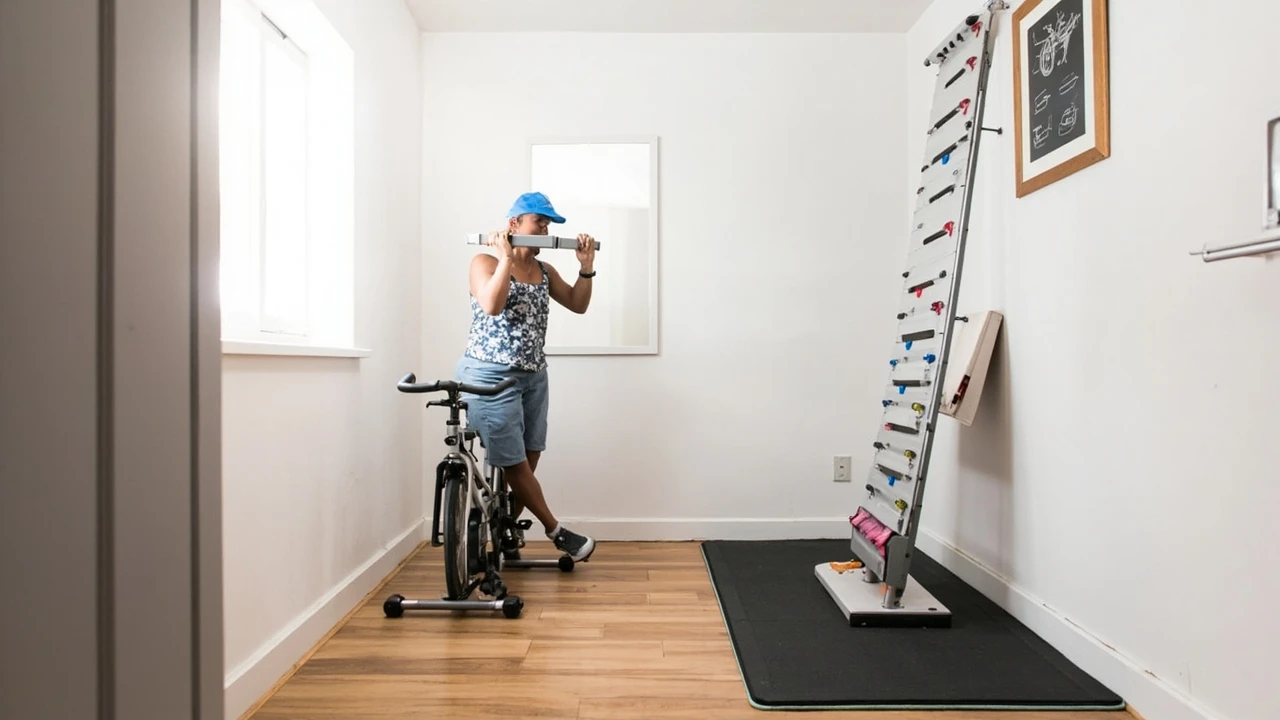
6. Maxi-Climber Vertical Climber — Best HIIT Specialist ($150-220)
The Maxi-Climber is a vertical climber — a stationary climber pole with handles and foot pedals that you climb in place. Folds flat against a wall (about 15 inches deep).
Why it's the compact pick: Vertical climbers are the most space-efficient HIIT machine. The vertical motion engages quads, glutes, core, lats, and shoulders simultaneously. 10-minute interval sessions reach heart rates comparable to 30-minute jogs.
Trade-offs:
- Awkward grip position. Hands above heart for the entire workout — can be uncomfortable past 15 min.
- Tall users (over 6'2") may find the handle range limiting.
- Cheap Maxi-Climbers (under $100) wobble at full effort. The $150-220 versions are sturdy.
- Loud during use (mechanical clicking, 55-60 dB).
Best for: Apartments with limited floor space who want short, intense HIIT sessions. The vertical fold is the unbeatable storage advantage — disappears against any wall.
Search Maxi-Climber vertical climber on Amazon
What to Skip
These show up in "compact cardio" listicles. Don't buy them:
- Under-$100 fan bikes from no-name brands. Fans wobble, frames flex, the resistance scales unpredictably. The Marcy NS-1000 at $230-280 is about the floor for "buy a fan bike" — and even that is entry-level now that Schwinn's own Airdyne line starts at $799.
- Magnetic mini bikes (no resistance arms). Too easy — most users top out at 90 bpm. Marketing claims it's "calorie burning" — it's not.
- Fitness app tablet bikes (Peloton clones under $400). Most are mediocre bikes plus an app. The app is the actual purchase — and the bike costs another $30/month subscription. Skip the rebrand and buy a normal bike + free YouTube workouts.
- Most "compact" treadmills (3-5 ft footprint). Below the walking pad tier in safety; above it in price. The walking pad is the right choice for under-$500 compact treadmill.
- Wall-mounted boxing reflex balls / cardio toys. Genuinely fun but not cardio. Skip if cardio is the goal.
- Steppers without resistance bands. Sunny's mini stepper at $60-90 with bands is the floor. Anything cheaper or band-less wears out faster and offers less workout.
Build Combinations
$400-600 small-space cardio kit: Marcy NS-1000 fan bike ($250) + Sunny mini stepper ($75) = $325. Air bike for primary cardio, mini stepper for when the air bike noise is unwanted.
$1,100-1,300 premium small-space kit: Concept2 rower ($950) + Sperax 2-in-1 walking pad ($280) = $1,230. Rower for hard sessions, walking pad for daily steady-state and recovery walks.
$300-400 apartment-friendly kit: Sperax 2-in-1 walking pad ($280) + Stamina InMotion ($150) = $430. Walking pad for primary cardio, InMotion for desk-work background movement. Both fold/store easily.
$200 absolute-minimum kit: Maxi-Climber ($170) alone. HIIT only, but it folds against a wall and fits anywhere.
Where to Put It
Compact cardio works best in three places:
- Closet-corner home gym — vertical climber or walking pad. See Closet Corner Home Gym for the small-space layout.
- Bedroom corner — walking pad under bed, foldable rower against wall.
- Garage / basement — air bike permanently mounted, walking pad as secondary.
For 10×10 rooms specifically, see Home Gym Setup for a 10×10 Room for the layout pattern that accommodates a cardio machine plus a rack and bench. For apartment-specific considerations, see Apartment Home Gym No Drilling.
Pairing with Strength Training
Compact cardio works best as part of a balanced program. The complete picture:
- 2-3 strength sessions/week — see How to Build a Home Gym: The Complete 5-Step Guide and affordable power racks.
- 3-5 cardio sessions/week — the machines above. Mix steady-state and HIIT.
- Daily movement / walking — even 15 min of walking pad use on rest days reduces stiffness.
- Equipment storage that doesn't conflict — see Best Foldable Gym Equipment for the storage-priority picks.
Frequently Asked Questions
Air bike vs rower for small spaces?
Rower wins on storage (splits in half), air bike wins on footprint when assembled (8.4 vs 12 sq ft). Pick rower if you can store it disassembled; pick air bike if it'll stay assembled in a garage or basement. For full-body conditioning, both are excellent — the air bike has slightly more arm engagement, the rower has slightly more back/lat engagement.
Walking pad vs treadmill for cardio?
Walking pad if you walk for cardio. Treadmill if you run. Walking pads max at 4-6 mph (running pace is 6+ mph). Most home gym users only need walking-pad speeds — the smaller footprint and quieter motor are the major wins.
Is HIIT on a vertical climber as effective as HIIT on an air bike?
For heart rate response, yes. For total caloric burn per session, slightly less (the climber engages slightly less total muscle mass). For storage and noise, the climber wins. Pick based on space constraint and noise budget.
Are under-desk ellipticals "real" cardio?
Not at high intensity. At 60-70% max heart rate (which is where most people use them), they provide meaningful background cardio — useful for sedentary jobs but not a replacement for 20-30 min of harder dedicated sessions. Pair with one of the higher-intensity options for serious cardio.
Best machine for apartments above floor 1?
Magnetic rowers (Concept2 with magnetic damper add-on, or a fully magnetic rower like the Hydrow). Walking pads are second — quiet motor + slow walking + thick mat underneath. Avoid air bikes, vertical climbers, and full treadmills.
Do I need a heart rate monitor with these machines?
Not strictly. A $25 chest strap (Polar H9 or Wahoo Tickr) connects to most fitness apps and dramatically improves cardio workout quality. Use it to confirm you're actually hitting target heart rate zones — easy to fool yourself otherwise.
Compact rower vs compact bike for back pain?
Bike, in most cases. Rowers can aggravate lower back pain in users with poor form or weak core. Bikes (especially recumbent — see Best Recumbent Bikes for Seniors) keep the spine in neutral. If you have low back pain and want to row, get PT-guided form coaching first.
Closing
Compact cardio is solved if you pick the right machine for your storage and noise constraints. The Marcy NS-1000 is the all-purpose pick for garages and basements. The Concept2 rower is the splurge that lasts decades. The walking pad is the apartment-friendly default. And the Maxi-Climber + mini stepper exist for studios and ultra-tight spaces.
For the broader compact-equipment picture, Best Foldable Gym Equipment covers the storage-priority equipment across categories. For layout patterns that incorporate the machines above, Home Gym Setup for a 10×10 Room and Closet Corner Home Gym walk through the spatial planning. And for the walking pad specifically, Best Walking Pads for Seniors covers the senior-specific safety considerations that apply to that subset.
The right compact cardio machine adds 3-6 hours of weekly cardio to your home gym life without dominating the room. Pick by storage, pick by noise, and buy the brand-name version — the $150 knockoffs save money on day one and cost more by month 18 when they fail.
Cardio heats a small room faster than anything else. If summer sessions are turning brutal, the best fans for a garage gym breaks down how much airflow you actually need — a 95°F room with strong CFM across you feels like 82°F.
Cardio burns calories; the deficit is what changes the scale. A machine makes the deficit easier to hit, not automatic — check what your maintenance actually is with the calorie calculator before deciding how much cardio you need.
Pair cardio with strength. Affordable adjustable dumbbells — the compact strength counterpart to everything on this page.
Why cardio survives the car and barbells don't: The Garage Gym Gap — a treadmill is 36 inches wide and slips into the strip beside a parked car. A barbell needs 86.6 inches and does not.
Rowing, but you're over 60? Best Rowing Machines for Seniors: Seat Height First — why the seat's height off the floor matters more than the resistance type, and which machines clear 15 inches.