Table of Contents
Key takeaways
The best pedal exerciser for seniors clears your knees, stays put on the floor and starts easy. It turns sitting time into light exercise. It doesn't replace walking, strength work or balance training.
- What it does: in a study of adults with an average age of 68, pedaling at their own pace burned about 1.4 more calories a minute than sitting still.
- What it isn't: balance training, or a proven way to change your circulation. In a lab study that checked leg arteries, short pedaling breaks didn't stop four hours of sitting from lowering leg-artery function.
- Which type: bike-style for most people (the low DeskCycle 2 is built for use under a desk), an under-desk elliptical if you prefer a gliding motion, and motorized only for someone who can't pedal unaided. When the motor turns the pedals, it does most of the work.
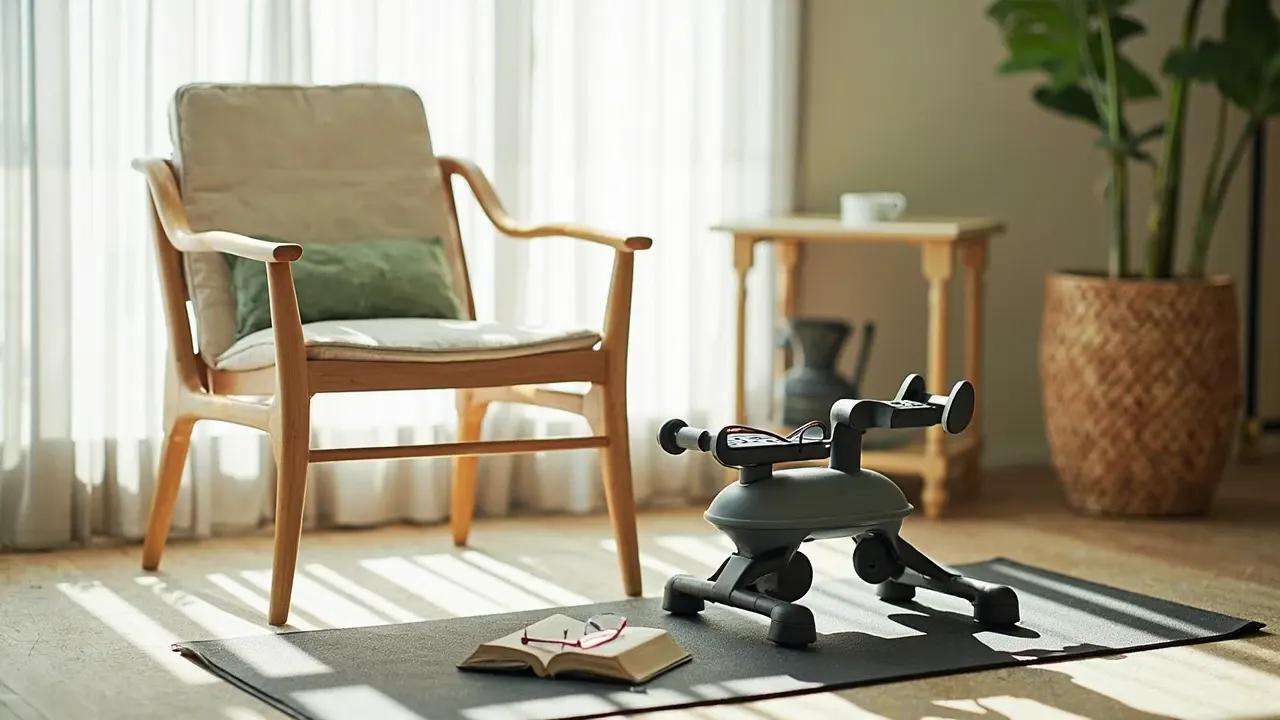
- Before you buy: check how high the pedals rise against the underside of your desk, use a sturdy chair that doesn't roll, and put the machine on a rubber mat or strap it to the chair.
- The picks: DeskCycle 2 (best overall), Vive Folding Pedal Exerciser (budget and lightest), Cubii Move (under-desk elliptical), Sunny Health & Fitness Smart Motorized 2-in-1 (motorized, and pedals unplugged too) and DeskCycle MagneTrainer-ER (arms and legs).
Pedal exercisers are sold to older adults with big promises: better circulation, weight loss, stronger knees. The research behind those promises is thin. What one can do is more modest and still worth having: add gentle movement to hours you would spend sitting anyway, from a chair you already own.
This guide covers the three types, what the studies found, how to set one up so it doesn't slide or knock your knees, and the five worth buying.
Quick Answer
The best pedal exerciser for most seniors is the DeskCycle 2. VIVO lists its height as 9 to 10 inches from the floor, adjustable, so it is built for pedaling under a desk or table as well as in front of an armchair. Its magnetic resistance has eight settings, and the pedals have adjustable straps.
If you want light and simple, the Vive Folding Pedal Exerciser weighs under 7 pounds, folds flat for storage and works your arms on a tabletop. For a gliding motion under a desk, the Cubii Move is the under-desk elliptical, 9.7 inches tall with six resistance levels.
If someone can't yet turn the pedals on their own, the Sunny Health & Fitness Smart Motorized 2-in-1 turns them at any of 18 speeds and can also be pedaled with the power off, so the user can take over the work. For arms as well as legs, the DeskCycle MagneTrainer-ER moves from the floor to a table and pedals forward or backward.
Picks checked against their Amazon listings in November 2026.
Bike, Elliptical or Motorized: Which Type Fits?
All three work from a chair. They differ in how your feet move, how high your knees rise, and who does the work.
| Type | How your feet move | Best for | Watch for |
|---|---|---|---|
| Bike-style | Round in a circle, like a bicycle | Most people; arm work on a table | Knees rise at the top of each turn |
| Under-desk elliptical | Back and forth on flat foot plates | A gliding motion at a desk or table | Weight to carry; legs only |
| Motorized | A motor turns the pedals for you | Someone who can't pedal unaided | The motor does most of the work; needs an outlet |
Bike-style: the flexible default
The classic design: two pedals on cranks and a knob or dial for resistance. Several can sit on a table for arm work, which makes this the most flexible type. The trade-off is knee lift. Each pedal climbs to the top of its circle, and on Vive's folding model that is about 14 inches off the floor. The DeskCycle 2 is built low for that reason.
Under-desk elliptical: low and gliding
Your feet stay on flat plates that glide back and forth instead of going round. The Cubii Move stands 9.7 inches tall, which suits a desk or table, but it weighs more than the lighter bike-style units and works the legs only. The study below that measured older adults used a portable elliptical.
Motorized: for when pedaling isn't possible yet
A motor turns the pedals, so the legs move even when the person can't push. When the motor does the turning, the muscles do little of the work (see the tandem-bike study below), so buy one that can also be pedaled with the power off, for whenever the user can pedal for themselves. Whether passive movement helps a particular condition is a question for a doctor or physical therapist, and Sunny's own manual says "The equipment is not suitable for therapeutic use."
What a Pedal Exerciser Can and Can't Do
The research on pedal exercisers is small, and most of it was done with office workers rather than retirees. Here is what it shows.
It adds a little energy to time spent sitting
The study closest to this reader measured 20 adults with an average age of 68 as they used a computer, read and watched TV while pedaling a portable elliptical. Pedaling at their own pace with no added resistance, they burned about 1.4 more calories a minute than sitting still. At a set pace with added resistance, they burned about 2.2 more (Lerma et al., 2017). The authors worked out that an hour at their own pace would use the same net energy as walking about 1.6 miles. Each bout in the study lasted five minutes, so the hour is their extrapolation, not something the volunteers did.
At the easy pace that works out to roughly 85 calories an hour more than sitting still: small, but real.
It breaks up long sitting, and you can do it while doing something else
In a study of 15 middle-aged office workers, randomized to three four-hour conditions (sitting straight through, standing 10 minutes each hour, or pedaling 10 minutes each hour), discomfort rose with uninterrupted sitting and was lower when they stood or pedaled (Benzo et al., 2018).
In a second study, 96 inactive adults aged 20 to 65 typed, read, solved logic problems and handled phone tasks while pedaling lightly, and scored about the same as when they sat still. They found the lighter of the two pedaling rates more comfortable (Rovniak et al., 2023). Both studies were of working-age adults, but the point carries: you can pedal through a TV program, a phone call or the crossword.
Owning one isn't the same as using it
In a 12-week trial that gave sedentary office workers a portable pedal machine at work, along with a website and a pedometer, participants used the machine on 37.7% of workdays, for an average of 31.1 minutes a day (Carr et al., 2013). That is better than nothing and well short of every day. The lesson for home: put the machine where you already sit, in front of the TV chair, rather than in a spare room.
Circulation claims aren't proven
Circulation is a common promise on pedal exerciser listings. Pedaling does move blood while you do it: in the tandem-bike study below, the heart pumped more blood during both kinds of pedaling. Whether that adds up to anything lasting is another matter. In a lab study of 13 sedentary adults with an average age of 38, four hours of sitting reduced how well the main artery behind the knee could widen, and four 10-minute bouts of light desk pedaling did not prevent it (Kruse et al., 2018). It was a small study of younger adults, so it doesn't settle the question. None of the studies here show a lasting circulation benefit, so this guide doesn't claim one.
It isn't balance training
No pedal exerciser trains balance. You're seated, and the chair and the frame do the steadying. The CDC's weekly guideline for adults 65 and older has three parts (CDC):
- Aerobic activity: At least 150 minutes at moderate intensity, such as 30 minutes a day, 5 days a week.
- Muscle strengthening: at least 2 days a week.
- Balance activities.
A pedal exerciser counts toward the first part only, and only when you pedal hard enough for moderate effort (see the talk test below). For the other two, see the guides to strength training after 60 and balance training equipment for seniors. If the full guideline is out of reach, the CDC's advice is to "be as physically active as your abilities and conditions allow", and that is where a pedal exerciser earns its place.
When a motor turns the pedals
In a 1994 lab study, ten healthy adults pedaled a tandem bicycle themselves, then relaxed while a second rider turned the pedals for them. Their heart rate rose only when they pedaled for themselves, and their oxygen use, leg muscle activity and sense of effort were all higher when they did the work (Nóbrega et al., 1994). The passive pedaling wasn't nothing: their blood pressure rose, and only when the pedals were turned for them. No study here tested a motorized pedal exerciser, but its motor does the second rider's job, so expect your muscles to do little of the work. If you have a heart or blood pressure condition, ask your doctor before using one, even on the motor.
What about knee arthritis?
A 2021 review gathered 11 randomized trials of stationary cycling in 724 people with knee osteoarthritis, and pooled eight of them. Compared with no exercise, cycling reduced pain and improved sport function. The changes in stiffness, daily activities and quality of life were too small to count as clinically meaningful (Luan et al., 2021). That review covered stationary cycling in general, not pedal exercisers specifically. So a pedal exerciser is a reasonable way to keep sore knees moving, not a proven treatment. Start at the lowest resistance, and see the guides to home exercises for bad knees and home gym equipment for arthritis.
Before You Buy: Knee Room, Sliding and the Chair
Knee room
If you'll pedal at a desk or table, the number that matters is how high the pedals rise, not how tall the machine is. Here is what each maker publishes:
| Pick | What the maker lists |
|---|---|
| DeskCycle 2 | A height of 9 to 10 inches from the floor, adjustable |
| Vive Folding | 9 inches tall; pedals about 14 inches off the floor at their highest |
| Cubii Move | 9.7 inches tall |
| Sunny Motorized 2-in-1 | 10.2 inches tall |
| MagneTrainer-ER | 16 inches tall |
Only the DeskCycle 2's and Vive's figures are pedal heights, and Vive's show why that matters: a 9-inch machine with pedals that reach 14 inches. A quick test before you buy: sit at the desk in the chair you'll use, and lift one foot about as high as the pedal will go. If your knee hits the desk, pedal in front of an armchair instead, or choose a lower machine.
Sliding
On a hard floor, a pedal exerciser tends to creep away from the chair as you push, and the makers plan for it. VIVO's quick-start guide for the DeskCycle 2 says to fit the included Velcro strap "If your chair and the DeskCycle slide away from each other due to a slick floor." The MagneTrainer comes with a tether that loops around the chair. Vive recommends a small mat or rug if its folding model moves, and Cubii says not to set its machine on a loose rug. A rubber equipment mat under the machine, and a strap to the chair, solve most of it.
The chair
Use a sturdy chair that doesn't roll, swivel or rock, ideally with armrests to push up from. Every maker here says to use its machine seated, and Vive's instructions start with sitting in "a sturdy chair." Sit far enough back that your knee stays slightly bent when the pedal is at its farthest point, and keep the floor clear: Sunny's manual asks for at least 2 feet of free space all around its machine. A motorized machine adds a power cord, so route it away from where anyone walks; the fall-proof home gym guide covers the rest of the room.
The 5 Best Pedal Exercisers for Seniors
Every pick starts at low effort and is meant to be used from a chair. The comparison first, then each machine.
| Pick | Type | Resistance | Arms on a table | Weight | User weight limit |
|---|---|---|---|---|---|
| DeskCycle 2 | Bike-style | Magnetic, 8 settings | Not listed | Not listed | 270 lb (listing) |
| Vive Folding Pedal Exerciser | Bike-style | One knob | Yes | Under 7 lb | 350 lb (listing) |
| Cubii Move | Elliptical | 6 levels | Not listed | 17.6 lb | 300 lb |
| Sunny Motorized 2-in-1 | Motorized bike, plugs in | 18 motor speeds, or pedal it unplugged | Yes | 12.3 lb | 250 lb (listing) |
| DeskCycle MagneTrainer-ER | Bike-style, pedals both ways | Dial | Yes | 23 lb (listing) | Not listed |
Figures marked "listing" come from the Amazon listing; the rest are from the maker's own page or manual.
1. Best Overall: DeskCycle 2
The DeskCycle 2 gets the two hardest things right for this reader: it sits low and it starts easy. VIVO lists an adjustable height of 9 to 10 inches from the floor, which its Amazon listing calls the pedal height. That makes it built for pedaling at a desk or table as well as in front of an armchair. Magnetic resistance comes in eight settings, the pedals have adjustable straps, and the display shows your speed alongside RPM, distance, time or calories.
It also deals with sliding. VIVO's quick-start guide says to fit the included Velcro strap between the bike and the chair base if the two slide apart on a slick floor.
Watch out for: it's for legs only; VIVO doesn't list arm use. VIVO's own page and manual give no weight limit, unit weight or warranty term, though the Amazon listing gives a 270-pound weight limit.
Buy it if: you want to pedal at a desk or table, or want the most adjustable all-rounder.
2. Best Budget and Lightest: Vive Folding Pedal Exerciser
The Vive Folding Pedal Exerciser is the simplest machine here and the easiest to move. Vive says it weighs under 7 pounds and folds flat for storage. A single knob sets the resistance, the display tracks calories, RPM, time and speed, and the toe straps adjust to six settings. Set it on a table and you can turn the pedals with your hands for an arm workout. Vive backs it with a one-year guarantee.
Watch out for: the pedals rise to about 14 inches off the floor at their highest point, so it's better in front of a chair than under a desk. Being light, it can move on a hard floor; Vive recommends a small mat or rug underneath if it does.
Buy it if: you want a light, simple unit for legs and arms, used in front of a chair.
3. Best Under-Desk Elliptical: Cubii Move
The Cubii Move is the pick if you want the gliding motion of an elliptical. Your feet stay flat on the plates, it stands 9.7 inches tall, and it has six resistance levels, with Cubii advising you to begin at level 1 and build up gradually. The display tracks strides, calories, distance, time and RPM. Cubii gives a maximum recommended user weight of 300 pounds, and a one-year warranty that grows by another year if you register the machine within 90 days of purchase.
Watch out for: it weighs 17.6 pounds, so it isn't one to carry from room to room every day, and it works the legs only. Cubii's manual says to use it only while sitting and not to set it on a loose rug.
Buy it if: you want to pedal under a desk or table with a smooth, gliding motion.
4. Best Motorized: Sunny Health & Fitness Smart Motorized 2-in-1
The Sunny Health & Fitness Smart Motorized 2-in-1 (model SF-B024041) is the motorized pick because it doesn't lock you into passive movement. Plugged in, its motor turns the pedals at any of 18 speeds, forward or backward, with six preset programs and a remote, so there's no bending down to change settings. Unplugged, Sunny says you can pedal it yourself, so the same machine works whether the motor or the user does the turning. It weighs 12.3 pounds, has anti-slip foot straps, connects to Sunny's SunnyFit app, and can sit on a table for arm work.
Watch out for: Sunny's manual says "The equipment is not suitable for therapeutic use," so if a doctor or therapist has prescribed passive leg movement, ask which machine they want used. The manual also says it "should never be left unattended when plugged in." The warranty is one year on the frame and 180 days on other parts. And remember the tandem study: when the motor turns the pedals, your muscles do little of the work.
Buy it if: someone can't turn the pedals on their own, and you want a machine they can also pedal themselves.
5. Best for Arms and Legs: DeskCycle MagneTrainer-ER
The DeskCycle MagneTrainer-ER is the pick for working the arms as well as the legs. VIVO's manual says to place it on a table top to exercise your arms, and it pedals forward or backward to work different muscles. Resistance is set with a dial that takes more than five full turns from minimum to maximum, which allows fine adjustments. The display shows RPM, distance, time and calories, and a tether loops around the chair to keep the bike from creeping away on the floor. VIVO gives it a one-year warranty.
Watch out for: it stands 16 inches tall, so check your knee clearance before using it under a desk. VIVO's own page and manual give neither its weight (the Amazon listing says 23 pounds) nor a weight limit. On the floor, the manual says to press down while you pedal to keep it in place, so use the tether and a mat.
Buy it if: you want one machine for arm work at a table and leg work on the floor.
How to Start Safely
- Ask your doctor or physical therapist first if you have a heart or blood pressure condition, have had a joint replaced or other recent surgery, or have been told to limit activity. Both VIVO manuals add that people with physical disabilities should use the machine only under supervision.
- Set up before you sit: a sturdy chair that doesn't roll, the machine on a rubber mat, and the strap or tether on if it came with one.
- Start at the lowest resistance for 5 to 10 minutes. The studies above used five- and 10-minute bouts, so short sessions spread through the day are a good place to begin.
- Add minutes before resistance. Once 10 minutes feels easy, add a few more, and only then turn the resistance up.
- Use the talk test. The CDC describes moderate activity as the point where you "can talk, but not sing" (CDC). Lighter pedaling still counts for something: the CDC also says "some physical activity is better than none at all" (CDC).
- Never stand on the pedals. VIVO's manuals put it in capitals: "DO NOT STAND ON THE PEDALS."
- With a motorized machine, start at the slowest speed, stay with it while it's plugged in, and keep the cord out of the walking path.
- Stop if you feel faint, dizzy or short of breath, or have any pain, and check with your doctor before the next session; Cubii's manual gives the same advice. Chest pain or pressure that lasts more than a few minutes, or goes away and comes back, can be a heart attack, and the CDC says to "call 9-1-1 immediately" (CDC).
What to Skip
- Listings that promise better circulation or weight loss. The studies above don't support either promise.
- A motorized unit you can't pedal with the power off, if exercise is the goal.
- Rolling, swivel or rocking chairs. Each push on the pedals pushes the chair away.
- Standing on any pedal exerciser, or using one as a stepper. The manuals forbid it.
- A pedal exerciser as your only exercise. It doesn't cover the strength and balance work the CDC lists separately.
- Machines whose maker publishes no manual or safety warnings.
Where a Pedal Exerciser Fits in a Home Gym
A pedal exerciser is a starting point or a top-up, not a whole program. If there's room for a bigger machine, a recumbent bike gives a seat with back support and a harder workout. For more ways to exercise from a chair, see the chair exercise equipment guide. If you're setting one up for a parent, the guide to helping a parent set up a home gym covers the room, and the home gym equipment guide for seniors puts everything in one place. For walking indoors, there's the walking pad guide for seniors.
How We Picked
We started from what this reader needs: a machine that clears the knees, stays put, starts at low effort and, for some, works the arms or runs on a motor. Then we read each maker's own product page and manual, not just the Amazon listing, for pedal height, resistance, weight, warnings and warranty, and checked each pick against its Amazon listing in November 2026.
The DeskCycle and MagneTrainer began as 3D Innovations brands; VIVO now sells both as "DeskCycle by VIVO", and their manuals list VIVO's support line.
We searched the U.S. Consumer Product Safety Commission's site for each brand (VIVO, DeskCycle, MagneTrainer, Vive Health, Cubii and Sunny Health & Fitness) and found no recall or warning for a pedal exerciser or under-desk elliptical. The recalls on file are for unrelated products: a VIVO speaker wall mount in 2019, and Vive Health adult bed rails in 2026.
Left out: motorized machines that don't say they can be pedaled unplugged, and machines whose makers publish no manual or safety warnings.
This site does not own or test the equipment it covers; picks are judged on published specs, the research and the makers' own manuals and listings.
Frequently Asked Questions
Are pedal exercisers good for seniors? For adding movement to time spent sitting, yes. In a study of adults with an average age of 68, pedaling at their own pace burned about 1.4 more calories a minute than sitting still. They don't replace walking, strength work or balance training, and anyone with a heart condition or recent surgery should ask a doctor first.
How long should a senior use a pedal exerciser? Start with 5 to 10 minutes at the lowest resistance, once or twice a day, and build up a few minutes at a time. The CDC's target for adults 65 and older is at least 150 minutes a week of moderate activity, and pedaling counts toward it when you can talk but not sing. If that's too much, do what your abilities and conditions allow.
Is an under-desk elliptical better than a pedal exerciser? Neither is better overall. An elliptical keeps your feet flat on gliding plates, and the Cubii Move sits low enough to suit a desk or table. A bike-style unit is often lighter and can work the arms on a table. The energy study of older adults cited here used an elliptical.
Does pedaling while sitting count as exercise? Yes, when you push hard enough. Light pedaling is light activity, and the CDC says some activity is better than none. To count as moderate, you should be able to talk but not sing. A motor turning the pedals is a different matter: in the tandem-bike study, heart rate rose only when people did the pedaling themselves.
Are motorized pedal exercisers worth it? For someone who can't turn the pedals unaided, one keeps the legs moving; whether that helps their condition is a question for their doctor or physical therapist. For anyone who can pedal, pedaling for yourself does more, because in powered mode the motor does the work. If you buy one, choose a model that can also be pedaled with the power off, like the Sunny Motorized 2-in-1, and never leave it unattended while it's plugged in.
Can a pedal exerciser help knee arthritis? Possibly. A 2021 review found that stationary cycling reduced knee arthritis pain compared with no exercise, but it covered stationary cycling in general, not pedal exercisers specifically. Start at the lowest resistance, ease off if your knee hurts more the next day, and see the guide to home exercises for bad knees.
Do pedal exercisers help circulation? Not in any way the studies here have shown. Pedaling moves blood while you do it, but in a lab study that checked leg-artery function, short bouts of desk pedaling during four hours of sitting didn't stop the decline that sitting caused. If one leg is suddenly swollen, red or painful, call a doctor rather than pedaling through it.
What kind of chair should you use with a pedal exerciser? A sturdy one that doesn't roll, swivel or rock, ideally with armrests to push up from. Put the machine on a rubber mat, and strap or tether it to the chair if it came with a strap.
Can you use a pedal exerciser while watching TV? Yes. The older adults in the 2017 energy study pedaled while watching TV, reading and using a computer. In a lab study of working-age adults, scores on typing, reading and reasoning tasks were about the same while pedaling lightly as while sitting still.
The best pedal exerciser for seniors is the one that gets used: put it in front of the chair you already sit in, start with the resistance low, and keep strength and balance work in your week too.