Table of Contents
Medical note. Balance training is broadly safe for older adults. If you have severe balance impairment, recent vertigo, recent fall with injury, or use a walker/cane full-time, train initially with physical therapy supervision before adopting home equipment. The picks below are appropriate for ambulatory adults 60+ working independently in a home setting. See Fall-Proof Home Gym Setup for the safety architecture every senior home gym should have.
Key takeaways
A $250–$390 home kit — foam pad, wobble cushion, half BOSU, grab rail — equips the daily balance practice a 2019 Cochrane review found cuts fall rate 24% in older adults at home.
- The Airex Balance Pad Elite is the recommended starting point; progress to BOSU dome-side only after 6 months.
- Ankle weights top out at 3 lbs per ankle; heavier loads add no documented balance benefit.
- Avoid vibration plates, stability balls, and wobble boards for beginners — no measurable fall-reduction effect.
- The 24% fall-rate reduction is a finding about balance exercise, not about any product.
Falls are the leading cause of injury death in adults 65 and older. One in four seniors falls each year in the US. Of those who fall, one in five suffers a serious injury — hip fracture, head injury, or both. Of those who break a hip, roughly 20-30% die within a year. The numbers are grim, but the intervention is unusually effective: a 2019 Cochrane systematic review of 108 trials found that balance training reduces fall rate by 24% in older adults living at home.
The catch: most "balance equipment" sold to seniors is either useless or actively dangerous. The wobble boards that work great for athletic 25-year-olds will throw a 75-year-old onto the floor on day one. The BOSU ball that physical therapists use professionally requires supervision most home users won't have. And the $90 "senior balance system" sold on TV is, almost universally, two pieces of foam and a vibrating cushion that does nothing useful.
This guide covers the seven balance training tools worth buying for a parent or grandparent. Three are excellent for absolute beginners. Two are progressions for after 4-6 weeks of training. Two are specifically for seniors with diagnosed balance disorders. None require a physical therapist on call to use safely.
Quick Answer
The best balance training equipment for seniors in 2026 is: (1) a foam balance pad ($15-40) — the safest starting point, (2) a sturdy stable chair with high back ($40-60) — for chair-supported single-leg work, (3) a wobble cushion / disc ($15-30) — progression from the foam pad, (4) a half BOSU ball ($140-170) — intermediate-advanced progression, (5) parallel bars or grab-rail system ($80-150) — for high-risk individuals who need hand support, (6) a balance beam (low, 6 inches) ($50-100) — gait training, (7) ankle weights ($15-25) — progressive overload for single-leg standing work. A starter set — foam pad, wobble cushion and a sturdy chair — runs $70-130; the full seven-piece kit is $355-575 and lasts indefinitely. Skip vibrating "balance plates" and wobble boards for beginners.
Why Balance-Specific Equipment Beats "Just Standing on One Foot"
You can train balance with no equipment. Single-leg stands, tandem walks, and heel-to-toe steps all work — and any senior should be doing them daily. So why bother with equipment?
Two reasons:
-
Progressive challenge. Once you can stand on one leg for 30 seconds with eyes open, you stop getting better at it. To keep improving, you need to make the task harder — unstable surface, eyes closed, added load. Equipment gives you those progressions safely.
-
Safety margin. A balance pad gives you something soft to fall onto if you lose balance. A grab rail gives you something to catch yourself with. Hard floor with no support has neither.
A foam balance pad or a grab rail lets an older adult keep making a balance task harder — unstable surface, eyes closed, added load — without the practice session itself becoming the fall. Balance-focused exercise is what a 2019 Cochrane review of 108 trials found cuts fall rate by 24% in older adults living at home. The equipment is not what that review measured; it is what keeps the training progressive once standing on one leg for 30 seconds stops being difficult.
What Actually Reduces Falls (vs Marketing Claims)
Marketing language to ignore:
- "Improves circulation." Most balance equipment doesn't do this in any clinically meaningful way. Walking does.
- "Strengthens core." Balance training does engage core muscles, but for core-specific strength, see Strength Training After 60 for Beginners.
- "Tones lower body." Balance work isn't enough volume or load to tone muscle. Use it for what it's for: balance.
- "Whole-body vibration burns fat." Whole-body vibration plates do not produce meaningful fat loss, and they do not train balance either: standing on a vibrating platform removes the postural challenge that balance work depends on. Skip them.
What actually correlates with reduced fall risk in research:
- Frequency. Balance training daily for ≥10 min/day reduces falls 24%. 2x/week is the minimum to see any effect.
- Progressive difficulty. Same single-leg stand for 6 months doesn't help. Increasing challenge does.
- Multi-directional challenge. Balance perturbations in multiple planes (front-back AND side-to-side) work better than single-plane training.
- Dual-task practice. Standing on one foot while counting backward, naming objects, or reading is the exact condition that real-world balance failures happen in.
Equipment selection should support all four of these. Foam pads, wobble cushions, and BOSU balls all work because they introduce multi-directional instability that the body learns to compensate for.
The 7 Worth Buying
Listed in order of recommendation for an absolute beginner.
1. Foam Balance Pad ($25-45) — The Safest Starting Point
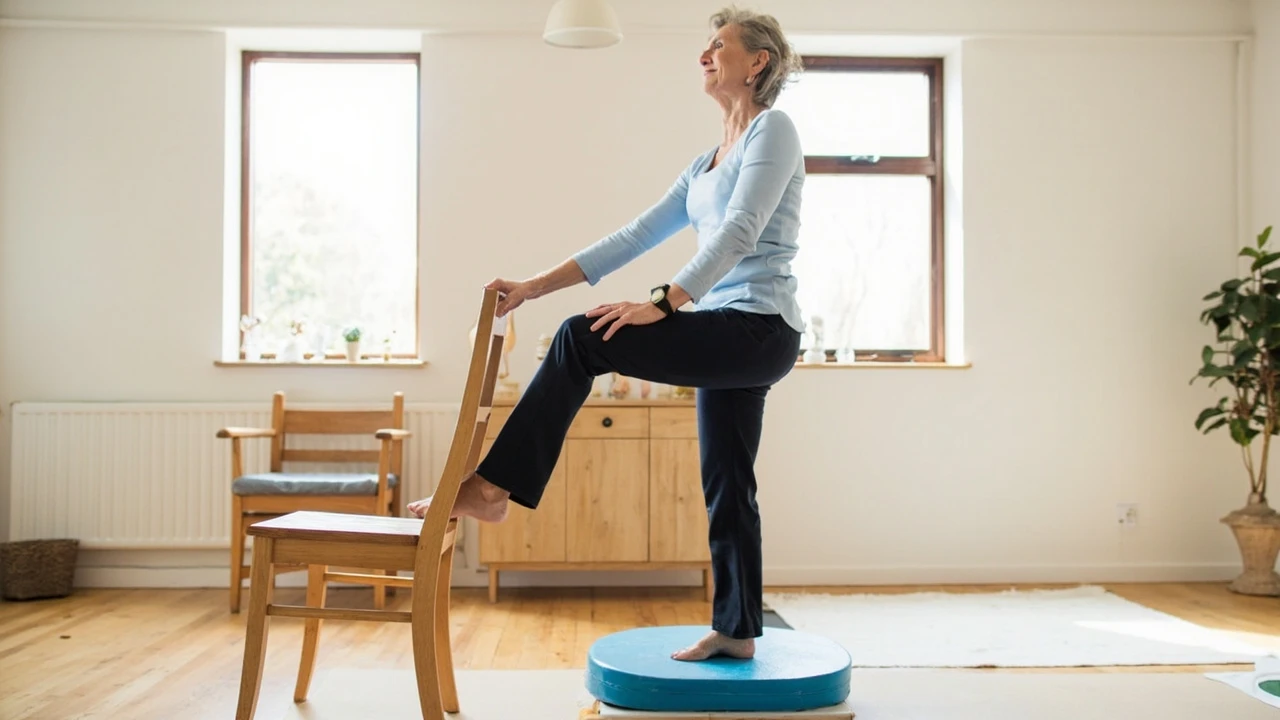
A foam balance pad is a 16×20 inch slab of medium-density foam, about 2.5 inches thick. Standing on it creates 2-3× more instability than standing on the floor. Soft enough to fall onto safely.
Why it's the senior pick: This is the only piece of balance equipment I'd put under any senior, regardless of fitness level. The foam compresses just enough to challenge balance without creating fall risk. If they do lose balance and step off, the foam edge is soft (no twisted ankles).
What to buy: The standard Airex Balance Pad is the gold standard at around $40; the Elite is the same pad in a larger size for roughly $100. The Gaiam version is cheaper and 90% as good. Avoid the ultra-cheap $8 "balance pads" — they're too soft (you sink in) and lack edge rigidity.
Progressions:
- Week 1-2: Single-leg stand on pad, 30 seconds per leg, holding a chair lightly.
- Week 3-4: Same, no chair support.
- Week 5-8: Eyes closed for 15-20 sec.
- Week 9+: Add ankle weights for progressive overload (covered later in this guide).
Best for: Every senior balance program. The single most important purchase on this list.
Check the Airex balance pad on Amazon
2. Sturdy Stable Chair with High Back ($40-60) — The Beginner's Support Anchor
The unsexy hero of senior balance training. A wide, stable, high-backed chair gives you something to grip during 95% of senior balance exercises in the first 6 weeks.
Why it's the senior pick: No senior should attempt unsupported single-leg stands on day one. A chair lets you train the exact same movement pattern with progressive grip release — start with two-handed grip, week 2 use one hand, week 4 use one finger, week 6 release.
What to buy: A wooden or metal-framed dining chair with at least 22-inch seat width, 18 inches of seat depth, and a high back (above hip height when standing). Avoid wheeled chairs, folding chairs, or upholstered chairs with crumbling foam.
Progressions:
- Week 1-2: Two-handed grip during single-leg stand and chair-supported squat (see Strength Training After 60 for Beginners).
- Week 3-4: One-handed grip.
- Week 5-6: One-finger touch.
- Week 7+: No contact (chair is just safety margin).
Best for: Every senior. Most readers already own one — confirm it meets the criteria above.
Search sturdy wood dining chair on Amazon
3. Wobble Cushion / Inflatable Disc ($15-30) — The Foam-Pad Progression
A wobble cushion is a 13-15 inch inflatable disc with a textured surface. Less stable than a foam pad — you can rock it in any direction. Progresses naturally from the foam pad.
Why it's the senior pick: Once foam pad work feels easy (eyes closed, 30+ seconds), the wobble cushion is the natural next progression. It introduces multi-directional instability without the lateral-step risk of a wobble board.
What to buy: Look for a cushion rated to 250+ lbs with a stable rubber base. Adjustable inflation lets you start under-inflated (more stable) and progress to fully inflated (less stable). Skip wobble cushions with bumpy/spiked surfaces — they're sold for "circulation" claims that don't pan out.
Progressions:
- Week 1: Use under-inflated (50% air). Two-handed chair grip.
- Week 2-3: Progressively more air. Reduce chair grip.
- Week 4+: Fully inflated, no chair grip, eyes open.
- Week 8+: Eyes closed, dual-task (counting or naming).
Best for: Seniors who've completed 4-6 weeks of foam pad work and want a progression. Also good for sitting on during desk work — gentle ongoing balance stimulus.
Search wobble cushion balance disc on Amazon
4. Half BOSU Ball ($140-170) — Intermediate Progression
A half BOSU is a 25-inch dome with a flat rubber base. Dome-side up trains balance on a soft, unstable surface; flat-side up creates extreme instability (advanced).
Why it's the senior pick (with caveats): The BOSU is the most studied piece of balance equipment. PT clinics use it daily. It's also the riskiest item on this list for beginners — wide footprint feels stable, but losing balance throws you off in unexpected directions.
Important: Use dome-side up only for the first 6 months. Flat-side up (the unstable side) is for advanced users with supervision.
What to buy: Original BOSU brand. The knockoff "balance domes" at half the price have inconsistent quality control and the rubber bases can tear or de-laminate. The original BOSU lasts indefinitely.
Progressions:
- Months 1-2: Two-foot stand on dome side. Hold chair lightly.
- Months 3-4: Single-leg stand on dome side. Chair grip.
- Months 5-6: Single-leg stand, no chair grip, eyes open.
- Months 7+: Single-leg stand with eyes closed, dual-task practice.
Best for: Active seniors with 3+ months of balance training experience. Skip if you've never used unstable surfaces before — start with the foam pad and wobble cushion instead.
Check the BOSU balance trainer on Amazon
5. Parallel Bars or Grab-Rail System ($80-150) — Safety Support for High Fall Risk
For seniors with diagnosed balance disorders, fall history, or high-fall-risk gait, a parallel bar or grab-rail system is the safety infrastructure that lets balance training happen at all.
Why it's the senior pick: Hand support during balance work isn't a failure — it's how PT clinics train. The parallel bar setup lets you challenge balance to your limit while having immediate two-handed catches available.
What to buy: Two main options: (1) a portable parallel bar set with adjustable-height rails (e.g., 30-36" tall), or (2) a fixed grab-rail system mounted to studs in a hallway. Option 2 is much sturdier; option 1 is portable. Cost is similar.
Progressions:
- Months 1-3: Two-handed grip throughout, walking heel-to-toe down the bars.
- Months 4-6: One-handed grip, return to two-handed if needed.
- Months 7+: Light fingertip contact only; bars are just safety margin.
- Long-term: Continue using as safety margin for advanced single-leg work.
Best for: Seniors with diagnosed balance disorders, history of falls (within last 12 months), Parkinson's, MS, or anyone using a cane or walker outside the home. See Fall-Proof Home Gym Setup for setup considerations.
Search portable parallel bars rehab on Amazon
6. Low Balance Beam (6 Inches Tall) ($50-100) — Gait Training
A low balance beam (6 inches off the floor, 8 feet long, 4-6 inches wide on top) trains gait — the heel-to-toe walking pattern that breaks down with age and contributes to most outdoor falls.
Why it's the senior pick: Beam-walking specifically trains tandem (heel-to-toe) gait, which is what the standardized clinical "Tandem Walk Test" measures. Improving on this test correlates strongly with fall reduction in adults 65+.
What to buy: A wooden balance beam designed for adults (not kids' gymnastics beams, which are usually too narrow). Look for 6-8 inches above floor, 4-6 inch beam width, and 6-8 ft length. The most popular adult beams use solid pine or birch with rubber feet.
Progressions:
- Month 1: Walk forward on beam with arms out for balance. Chair within reach.
- Month 2: Walk forward heel-to-toe (tandem gait).
- Month 3: Walk backward heel-to-toe.
- Month 4+: Add directional changes mid-beam, dual-task (count by 3s while walking).
Best for: Seniors who walk outdoors regularly and want to maintain confident gait on uneven surfaces (sidewalks, hiking trails, grass).
Search adult balance beam wooden on Amazon
7. Ankle Weights ($15-25) — Progressive Overload
Once foam pad single-leg stands feel trivial, adding 1-3 lb ankle weights makes the same exercise meaningfully harder. This is how you keep progressing after the basic exercises feel easy.
Why it's the senior pick: Most senior balance programs plateau at week 8-12 because the exercises stop being challenging. Adding light load keeps the adaptation going.
What to buy: Adjustable ankle weights with 1-5 lb capacity per ankle (most are 5 lb adjustable in 1 lb increments). Velcro closures, not buckle (faster on/off). Avoid 10+ lb weights — overkill for balance work and risk knee strain.
Progressions:
- Foam pad single-leg stand + 1 lb ankle weight: 30 sec per leg, 3 sets.
- Add 1 lb every 2-3 weeks.
- Max useful weight: 3 lb per ankle. Beyond that, the exercise becomes a strength exercise (also valuable, but a different goal).
Best for: Seniors who've completed 8-12 weeks of basic balance work and need a progression. Pairs naturally with the foam pad (item #1) and wobble cushion (item #3).
Search adjustable ankle weights 5 lb on Amazon
What to Skip
These show up in senior balance product roundups. Don't waste money on them:
- Vibration plates / "whole-body vibration." No measurable effect on balance in well-designed studies. Sometimes marketed as "passive" balance training. It's not — it's just standing on a vibrating thing.
- Wobble boards (rocker-style, single-axis). Too aggressive for beginners; advanced trainees will outgrow them in 6 weeks. Skip in favor of the multi-directional wobble cushion.
- Stability balls (Swiss balls). Useful for core strength, not for balance training specifically. Higher fall risk than foam pads for the same training stimulus. Skip for senior balance work.
- "Senior balance systems" on infomercials. Almost universally overpriced foam plus a vibrating cushion. Pay $20 for the Airex foam pad instead.
- Vertigo / inner-ear "therapy devices." Medical-grade vestibular rehab requires a vestibular PT. Home consumer versions don't replicate the actual therapy.
- Bare-floor heel-toe walking lines (taped to floor). Helpful for absolute beginners but provides zero progression. Outgrow within 2 weeks.
The Senior Balance Training Week
Combine the equipment above into a daily 10-15 min routine:
Daily (any time of day):
- Single-leg stand on foam pad, 30 sec per leg × 2 sets. Holding chair lightly first month; reduce contact thereafter.
- Tandem walk down hallway, 10-20 steps. Chair or wall within reach.
3x/week (with strength training, see Strength Training After 60 for Beginners):
- Wobble cushion single-leg stand, 20 sec × 2 per leg (month 2+).
- BOSU two-foot stand or single-leg stand, 30 sec × 2 (month 3+).
- Beam walk forward + backward × 2 passes (month 2+).
Once weekly:
- Eyes-closed single-leg stand on foam pad (advanced).
- Dual-task practice: name 10 fruits while standing on wobble cushion.
The whole routine is 10-15 minutes daily plus 15 minutes 3x/week. Total time investment: ~2 hours/week. Compared to the fall-prevention research's 24% reduction in fall rate, it's the single highest-ROI activity a senior can do.
Setting Up the Home Environment
Balance training equipment is part of the picture. The other part is the home itself. See Fall-Proof Home Gym Setup for the complete checklist, but the highlights:
- Always train near a wall or chair for the first 6-12 months.
- Clear the training area of trip hazards — cords, rugs, pet toys.
- Adequate lighting. Many senior balance failures happen in dim hallways.
- Have someone aware you're training. Same house, ideally same floor.
- Train at the time of day your balance is best — usually morning, after the worst joint stiffness has eased.
Pairing with the Senior Cluster
Balance training is one pillar of senior fitness. The complete picture:
- Strength training (Strength Training After 60 for Beginners) — for lower-body strength that catches stumbles.
- Cardio (Best Walking Pads for Seniors, Best Recumbent Bikes for Seniors) — for heart, lung, and aerobic capacity.
- Flexibility (Daily Stretching Routine for Seniors) — for range of motion that supports balance recovery.
- Bone density (Exercises for Osteoporosis Prevention in Seniors) — because the goal of fall prevention is reducing the consequences of falls.
Together, these four pillars cut fall injury risk by 50-70% in well-conducted studies. Balance training alone is good. All four together is what produces independence into the 80s and 90s.
Frequently Asked Questions
At what age should balance training start?
- The earlier you start, the better the outcome. Adults who start balance training in their 50s maintain near-young-adult balance into their 70s. Starting at 70 still helps — measurable improvements in 8-12 weeks — but the gap to baseline is larger.
How long until I see results?
Functional balance (subjective sense of stability) improves in 2-4 weeks. Objective measures (Tandem Walk Test, single-leg stand time, fall rate) require 8-12 weeks. Continued improvement is possible for years.
Can I balance-train if I've already fallen this year?
Yes — usually. If the fall caused injury or you're afraid to walk independently, see a PT for assessment first. Otherwise, fall history is a reason to balance-train, not a barrier. People who've fallen are the highest-priority population for the 24% fall reduction.
Is BOSU safe for seniors?
For independent seniors who've completed 2-3 months of foam pad and wobble cushion work, yes. For beginners or seniors with diagnosed balance issues, no — start with foam pads only. The BOSU's wide unstable surface can throw the unprepared onto the floor.
Do I need parallel bars at home?
Most seniors don't. If you have no fall history, no diagnosed balance disorder, and can stand on one leg for 10+ seconds, you don't need them. If you fail any of those criteria, parallel bars or a grab-rail system makes the difference between training safely and risking another fall.
Will balance training help with vertigo?
For some types, yes — specifically positional vertigo (BPPV) and mild vestibular dysfunction. For inner-ear disorders (Meniere's, vestibular neuritis), see a vestibular PT for diagnosis-specific therapy. Generic balance training won't fix those.
Can I do this without buying equipment?
Yes, partially. Single-leg stands holding a chair, tandem walking down a hallway, and heel-toe stance practice all work with zero equipment. You'll plateau at week 6-8 without progression. The $20 foam pad is the cheapest way to keep progressing.
Closing
The right balance equipment costs $40-80 to start (foam pad + wobble cushion + sturdy chair you already own) and produces a 24% reduction in fall rate when used 10-15 minutes daily. Few interventions in senior health have evidence this strong.
For absolute beginners, buy the foam pad first. Use it for 4-6 weeks. Add the wobble cushion when foam pad work feels easy. Add the BOSU after 3+ months of consistent training. Skip the marketed-to-seniors junk (vibration plates, infomercial systems).
For broader context, Best Home Gym Equipment for Seniors covers the equipment shortlist beyond balance. Fall-Proof Home Gym Setup walks through the safety architecture every senior gym should have. And Help a Parent Set Up a Home Gym covers the practical setup-and-motivation considerations for getting a parent or grandparent to actually use the equipment after it arrives.
Balance training is the single most underused intervention in senior health. The equipment to do it well costs less than $100. Buy the foam pad this week and start tomorrow.
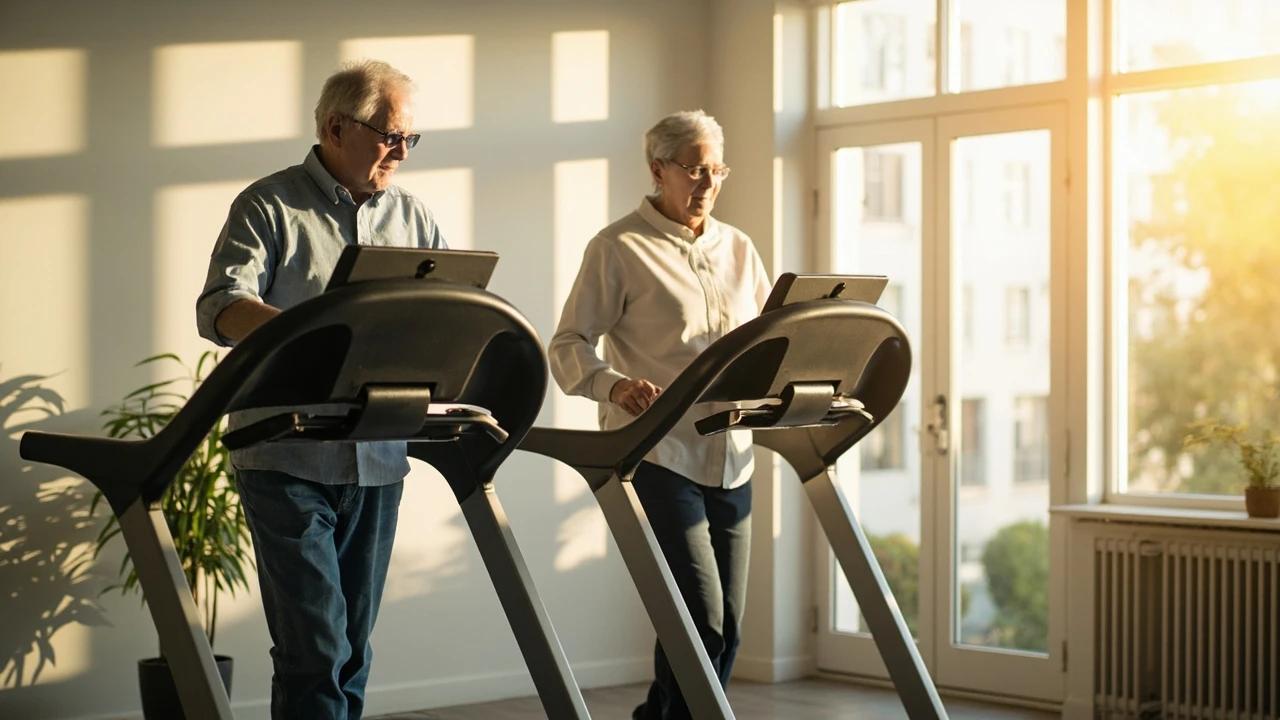
Balance work pairs naturally with walking. If you're adding a treadmill, the features that matter for older adults aren't horsepower or top speed — they're a low step-up height, long sturdy handrails, and a slow start speed. The best treadmills for seniors ranks the current models on exactly those safety criteria.