Table of Contents
- Understanding Which Joints Are Most Affected
- The Best Equipment for Arthritic Joints
- Arthritis-Friendly Equipment by Budget
- Grip Modifications and Adaptive Equipment
- Exercises to Avoid and Safe Alternatives
- The Morning Stiffness Routine
- Temperature and Warm-Up Considerations
- Smart Equipment Choices for Specific Conditions
- Building Your Arthritis-Friendly Home Gym
- FAQ
Key takeaways
Seniors with arthritis can build a functional home gym for under $200 using joint-friendly tools that avoid the high-impact and overhead movements the Arthritis Foundation and CDC flag as harmful.
- The CDC reports more than half of adults over 65 have arthritis; the Arthritis Foundation recommends combining low-impact cardio, gentle strength training, and flexibility work.
- Top picks include Bala Bangles (1 lb wrist weights), Bodylastics Resistance Bands, and Theraputty Hand Exerciser for grip work.
- Thickened grips (adapters that widen handles from 1 inch to about 2 inches) reduce joint stress on standard dumbbells.
- Avoid barbell bench press, deep squats, pull-ups, kettlebell swings, and exercising in rooms below 68°F (20°C).
Arthritis affects about 1 in 5 U.S. adults — and nearly half of adults over 65. If your hands ache when you grip a dumbbell, your knees protest on stairs, or your hips feel like rusty hinges every morning, you know the challenge.
Here's what many people don't realize: exercise is one of the best treatments for arthritis. The Arthritis Foundation, the American College of Rheumatology, and virtually every rheumatologist agrees—movement reduces pain, improves joint function, and slows the progression of the disease.
The trick is choosing the right equipment that works with your joints, not against them.
Understanding Which Joints Are Most Affected
Arthritis doesn't hit every joint equally. Knowing where your pain lives determines which equipment you need—and which to avoid.
Hands and Wrists
Osteoarthritis in the fingers and wrists makes gripping painful. Standard dumbbells, pull-up bars, and thin resistance band tubing become instruments of torture. You need thick-grip modifications or grip-free alternatives like wrist weights.
Knees
The most common complaint. Weight-bearing exercises like lunges and deep squats compress the joint surfaces. You need equipment that lets you strengthen the muscles around the knee without loading it directly.
Hips
Hip arthritis limits range of motion. Getting on and off equipment with high step-overs (like upright bikes) is painful. You need low step-through designs and exercises that move the hip through a comfortable range.
Shoulders
Overhead movements become limited and painful. Equipment that requires reaching above shoulder height—like lat pulldown machines or overhead presses—may need to be modified or replaced with front-raise and lateral-raise alternatives.
The Best Equipment for Arthritic Joints
1. Recumbent Exercise Bike
The single best piece of cardio equipment for arthritis sufferers. The reclined position supports your back and hips while the smooth pedaling motion lubricates the knee joint without impact. Look for models with a walk-through frame so you don't have to swing a stiff leg over a crossbar. See our complete recumbent bike guide for specific recommendations.
2. Resistance Bands with Foam Handles
Bands provide "accommodating resistance"—they're easiest at the start of the movement (where joints are most vulnerable) and hardest at the end (where muscles are strongest). This loading pattern is inherently joint-friendly.
Critical for arthritis: Choose bands with thick, cushioned foam handles. Thin rubber or hard plastic handles are a non-starter for arthritic hands. Our resistance band buying guide covers the best options in detail.
3. Wrist Weights
When gripping hurts too much, wrist weights are the answer. They strap around your forearms with velcro—no grip required. You can do arm circles, seated punches, front raises, and lateral raises without ever closing your fist around a handle.
4. Neoprene Dumbbells with Thick Grips
If you can grip but need a gentler experience, neoprene-coated dumbbells are warmer and softer than bare metal. For extra help, add rubber grip adapters (thick rubber sleeves that slide over the handle). These increase the handle diameter from 1 inch to about 2 inches, which is dramatically easier for arthritic hands to hold.
5. Aquatic Resistance Gloves
If you have access to even a small therapy pool or deep bathtub, aquatic resistance gloves turn water into your gym. The resistance comes from the water itself—no gripping required. Your joints are unloaded by buoyancy while your muscles work against the drag.
Arthritis-Friendly Equipment by Budget
| Product | Best For | Price Range |
|---|---|---|
| Bala Bangles Wrist Weights (1 lb) | Grip-free upper body training | $40-$60 |
| Bodylastics Resistance Bands | Full-body strength with foam grips | $30-$50 |
| Thick Grip Adapters (Fat Bar) | Making any dumbbell arthritis-friendly | $10-$15 |
| Neoprene Dumbbell Set (2-8 lbs) | Warm, soft-grip strength training | $20-$40 |
Grip Modifications and Adaptive Equipment
Arthritis doesn't mean you have to abandon traditional exercises. It means you need to modify the interface between your hands and the equipment.
Thick Grip Adapters
Rubber sleeves that slide over any standard dumbbell handle. The thicker diameter distributes pressure across more of your palm, reducing point-pressure on swollen finger joints. They cost under $15 and transform any dumbbell.
Fingerless Grip Gloves
Padded workout gloves with an open-finger design. The padding on the palm cushions against hard handles while the open fingers allow airflow and don't compress swollen knuckles.
Velcro Wrist Straps
These wrap around both the wrist and the dumbbell handle. Even if your grip fails, the strap holds the weight in your hand. Essential for anyone with severe grip weakness.
Adaptive Handle Tools
Companies like Active Hands make gripping aids specifically for people with limited hand function. These are rigid supports that hold your hand in position around a handle using velcro straps, so your fingers don't have to do the work.
Exercises to Avoid and Safe Alternatives
| Avoid This | Why It Hurts | Do This Instead |
|---|---|---|
| Barbell bench press | Heavy load compresses shoulder and wrist joints | Resistance band chest press |
| Deep squats | Extreme knee flexion grinds joint surfaces | Wall sits at a comfortable angle |
| Pull-ups/chin-ups | Massive grip and shoulder demand | Seated resistance band pulldowns |
| Jumping jacks | Impact forces through ankles, knees, hips | Seated arm-and-leg extensions |
| Kettlebell swings | Explosive load on wrists and lower back | Light dumbbell hip hinges |
The Morning Stiffness Routine
If you have rheumatoid arthritis or inflammatory osteoarthritis, mornings are the worst. Joints are stiff, swollen, and reluctant to move. A gentle warm-up routine can reduce stiffness by 50% or more within 15 minutes.
Step 1: Apply Heat (5 minutes)
Before moving, apply a warm compress or heating pad to your worst joints. Heat increases blood flow and relaxes the tissues around the joint. Microwaveable wheat bags are perfect—drape them over your hands, knees, or shoulders while still in bed.
Step 2: Gentle Range-of-Motion in Bed (3 minutes)
While still lying down:
- Fingers: Open and close your fists slowly, 10 times
- Wrists: Circle each wrist 10 times in each direction
- Ankles: Circle each ankle 10 times
- Knees: Slide your heel toward your buttock and back, 10 times each leg
- Hips: With knees bent, let knees fall gently side to side like a windshield wiper, 10 times
Step 3: Seated Warm-Up (5 minutes)
Sit on the edge of the bed or in a sturdy chair:
- Shoulder rolls: 10 forward, 10 backward
- Seated marching: Lift knees alternately, 20 total
- Seated cat-cow: Arch and round the spine, 10 times
- Arm reaches: Reach both arms overhead (or as high as comfortable), 10 times
Step 4: Light Movement (5-10 minutes)
Now you're ready for gentle exercise. Start with the daily stretching routine, then move to your regular workout if it's a training day.
Temperature and Warm-Up Considerations
Cold is the enemy of arthritic joints. If your home gym is in a garage or basement, temperature matters enormously.
- Keep the room above 68°F (20°C) before exercising. A space heater can warm a small area quickly.
- Wear layers that you can remove as you warm up. Compression sleeves on affected joints retain heat and provide gentle support.
- Never exercise with cold joints. Always do 5-10 minutes of gentle movement before any resistance work.
- After your workout, apply ice only if a joint is visibly swollen or hot to the touch. Otherwise, heat is generally more beneficial for arthritis.
Smart Equipment Choices for Specific Conditions
For Hand Arthritis
| Product | Best For | Price Range |
|---|---|---|
| Bala Bangles Wrist Weights | Grip-free arm exercises | $40-$60 |
| Thick Grip Adapters (Fat Bar) | Making handles easier to hold | $10-$15 |
| Theraputty Hand Exerciser | Gentle grip strengthening | $10-$15 |
For Knee Arthritis
Focus on strengthening the quadriceps and hamstrings without loading the joint directly. A recumbent bike for warm-up, followed by resistance band leg extensions and wall sits, is the ideal combination. Avoid any exercise that involves kneeling or deep bending. Our bad knees exercise guide has a complete routine.
For Hip Arthritis
Prioritize range-of-motion work. Seated hip circles, standing (supported) leg swings, and recumbent cycling keep the hip joint lubricated. Avoid exercises that require crossing one leg over the other or deep lunges.
For Shoulder Arthritis
Stay below shoulder height with most exercises. Resistance band rows, front raises to chin height, and isometric presses against a wall are all safe choices. Avoid overhead presses, lat pulldowns behind the neck, and upright rows.
Building Your Arthritis-Friendly Home Gym
A complete setup doesn't need to be expensive. Here's a starter kit:
- Resistance bands with foam handles ($30-$50)
- Wrist weights, 1-2 lbs ($40-$60)
- Thick grip adapters ($10-$15)
- Heating pad ($15-$25)
- Rubber floor mat ($20-$40)
- Sturdy chair (you probably have one)
Total: Under $200. That's a complete, joint-friendly gym that fits in a closet. If you're on a tight budget, see our full guide to building a home gym under $200.
FAQ
Should I exercise during an arthritis flare-up?
During an active flare (when joints are hot, swollen, and very painful), scale back but don't stop entirely. Switch to gentle range-of-motion exercises only—no resistance. Move the joint slowly through its comfortable range to prevent stiffness. Apply ice after. Resume normal workouts when the flare subsides, usually within a few days.
What type of exercise is best for arthritis?
A combination of low-impact cardio (recumbent bike, swimming), gentle strength training (resistance bands, light dumbbells), and daily flexibility work (stretching, range-of-motion). The Arthritis Foundation specifically recommends this three-part approach. Avoid high-impact activities like running, jumping, and heavy weight lifting.
Are resistance bands or dumbbells better for arthritis?
Resistance bands are generally better for arthritis because they provide variable resistance—lighter at the start of the movement where joints are most vulnerable. They also eliminate the risk of dropping a weight on yourself. However, dumbbells with thick grip adapters can work well for people with mild to moderate arthritis who still have reasonable grip strength.
Does exercise make arthritis worse?
No—this is the most persistent myth about arthritis. Regular, appropriate exercise actually reduces arthritis pain and stiffness over time. The cartilage in your joints has no blood supply; it gets nutrients from joint fluid, and that fluid is pumped through the cartilage by movement. Without exercise, the cartilage literally starves. The key word is "appropriate"—choose low-impact activities and modify exercises that cause pain.
What time of day is best to exercise with arthritis?
Most arthritis sufferers do best exercising in the late morning or early afternoon, after morning stiffness has subsided and joints have been warmed up by daily activities. Avoid exercising first thing in the morning when joints are at their stiffest, and avoid late evening when fatigue increases the risk of poor form and injury.
Walking is the safest cardio for arthritic joints. Best Walking Pads for Seniors — five low-speed walking pads compared, with handrail-equipped picks for arthritic seniors.
Arthritis + balance concerns? Best Balance Training Equipment for Seniors — the foam pad and wobble cushion picks are joint-friendly; parallel bars give the support arthritic knees often need.
Bone density + joint protection? Exercises for Osteoporosis Prevention in Seniors — the weight-bearing exercises that build bone, the spinal-flexion movements to avoid, and the equipment that supports both.
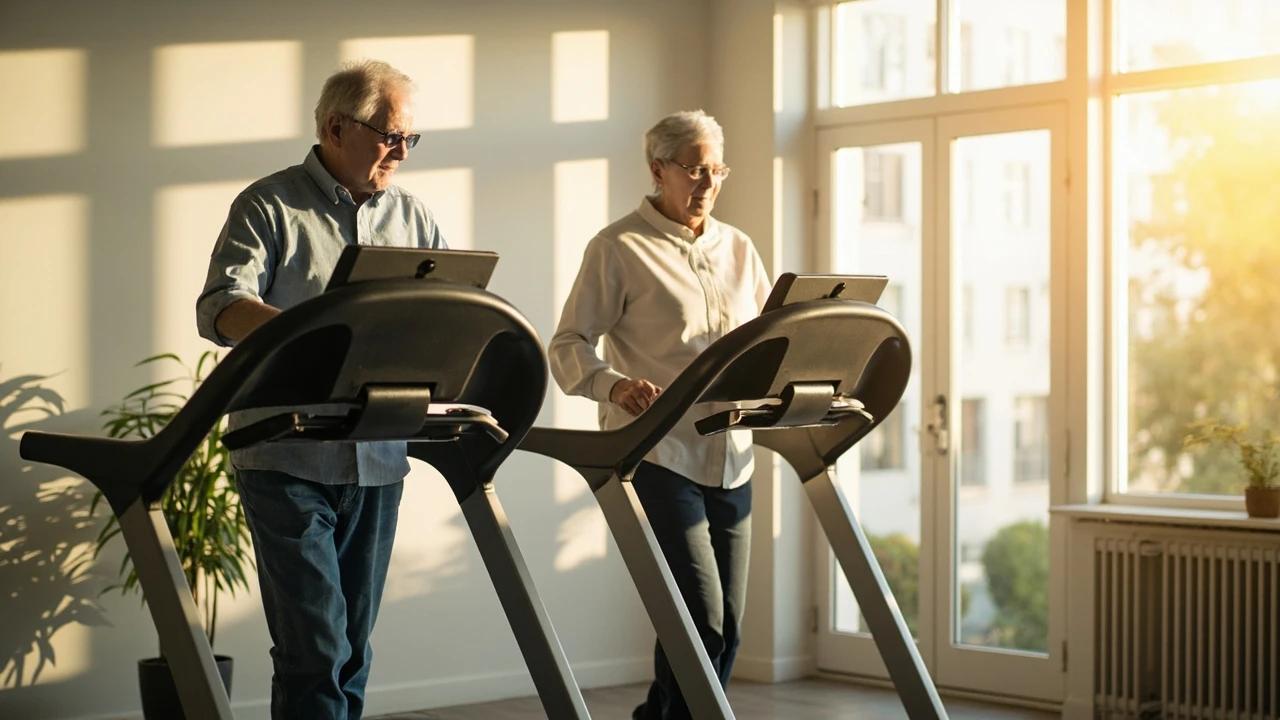
Cushioned walking is gentle on arthritic joints. Best Treadmills for Seniors — the cushioned-deck treadmills that absorb impact, ranked for low step-up height and handrail support.