Table of Contents
Two-thirds of US housing units have a garage or carport — 81% of owner-occupied ones — and the garage is the single most common place people try to put a home gym. So we asked a question the fitness press asks constantly and never actually answers with numbers:
Once the cars are parked, is there enough room left to train?
We modelled it. Not with a tape measure in one garage — with published Census data on the garages US builders actually build, published fleet data on the vehicles Americans actually drive, and the to-scale equipment dimensions from our own 3D gym planner.
The short answer is no, and the margin is smaller than anyone would guess.
The finding
A standard 20 × 20 ft two-car garage — the garage on 65% of new US single-family homes — leaves a usable strip of 37.8 inches once both drivers can still open a door and get out.
That is roughly the width of an interior doorway.
An Olympic barbell is 86.6 inches long. It is not close.
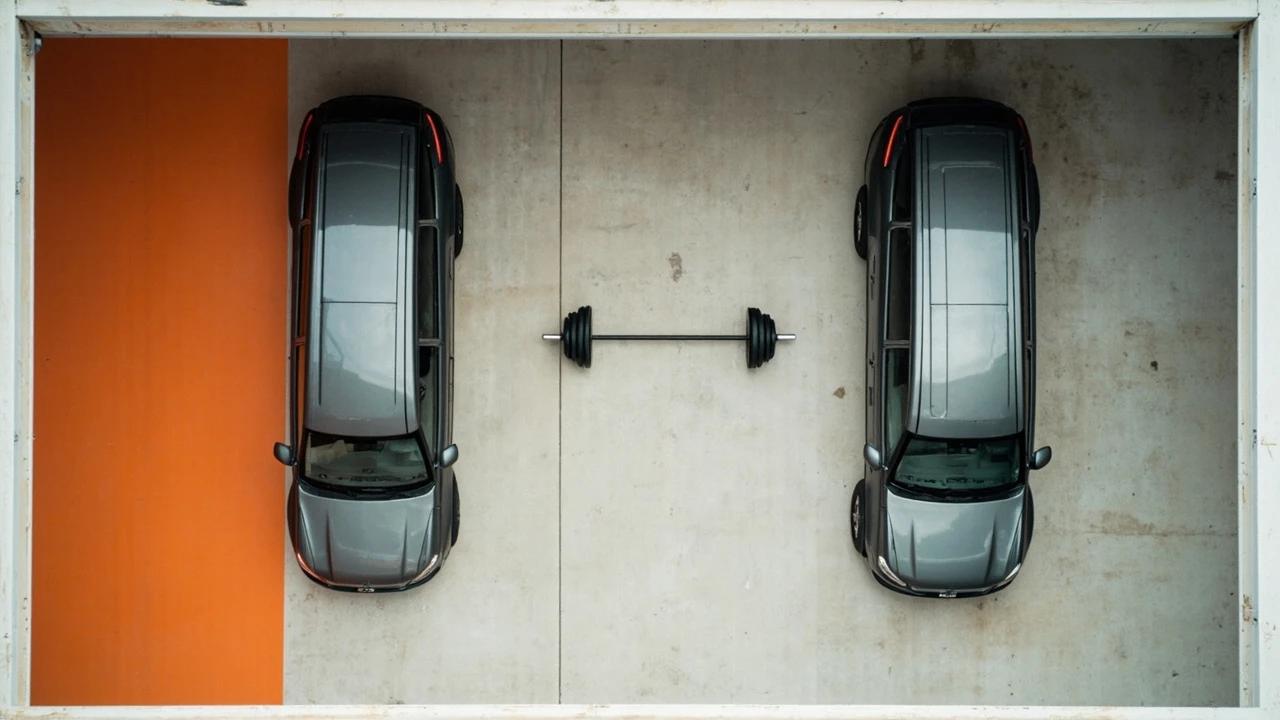
And here is the part that surprised us. Take the most generous reading possible — shove both vehicles hard against one wall, and assume nobody ever needs to open a door:
The gap between two average American vehicles in a standard two-car garage is 85.8 inches. A men's Olympic barbell is 86.6 inches.
It misses by eight tenths of an inch.
This did not used to be true
That near-miss is new.
A 20-foot garage bay clears a barbell between two cars only while the average vehicle stays at or below 76.7 inches wide. Fleet average width was 75.9 inches in 2013 and 77.1 inches in 2023 (JATO Dynamics).
Interpolating between those two published points puts the crossover at roughly 2020.
The garage did not change. The standard two-car bay has been 20 feet wide for decades. What changed is that the average American vehicle grew about an inch and a quarter wider in ten years, and two cars means that growth counts twice.
Somewhere around 2020, the standard American two-car garage quietly stopped fitting a barbell between the cars. Nobody announced it, because nobody was measuring.
Every garage size, run the same way
Using the average 2023 US light-duty vehicle (206.4″ long × 77.1″ wide):
| Garage | Cars | Leftover width | Usable strip | Space in front | Gap per car |
|---|---|---|---|---|---|
| 1-car (12 × 20 ft) | 1 | 66.9″ | 42.9″ | 33.6″ | 33.5″ |
| 2-car (20 × 20 ft) | 2 | 85.8″ | 37.8″ | 33.6″ | 28.6″ |
| 3-car (32 × 22 ft) | 3 | 152.7″ | 80.7″ | 57.6″ | 38.2″ |
"Usable strip" reserves one 24-inch door-opening gap per vehicle, because every driver still has to get out. "Leftover width" is the theoretical ceiling with every car jammed against one wall.
Note the two-car row: at 28.6 inches per gap, the standard two-car garage is already below the 30-inch clearance trade guidance calls comfortable, before a single piece of gym equipment enters the room.
It depends heavily on what you drive
| Vehicle | Usable strip in a 2-car garage |
|---|---|
| Toyota RAV4 (best-selling US vehicle, 2024) | 46.0″ |
| Average US light-duty vehicle (2023) | 37.8″ |
| Ford F-150 SuperCrew | 32.0″ |
The F-150 case has a second problem. At 232 inches long in a 240-inch-deep bay, the truck leaves 8 inches in front of the bumper. Not 8 feet. Eight inches.
What actually fits in the strip
This is the useful part. We ran all 16 items from the planner's catalogue against each garage, testing the space needed to use the equipment rather than merely store it — a rack needs its walk-in space, a treadmill needs run-off behind it, a barbell needs its length plus room to move around it.
In both a one-car and a two-car garage, parking the car costs you exactly four things:
- Power rack — 4 × 4 ft plus 2 ft of walk-in. Needs 48″, the strip has 37.8″.
- Barbell and plates — the 86.6″ span, gone.
- Cable or functional trainer — 4 ft wide plus 3 ft of cable travel.
- A 4 × 6 gym mat — 48″ wide, and the strip is 37.8″.
Everything else still fits: adjustable bench, dumbbells, kettlebells, squat stand, wall-mounted folding rack, plyo box, storage, and — counter-intuitively — a treadmill, which at 36 inches wide slips into a strip that a barbell cannot.
That is the actual shape of the compromise. Park the car and you keep cardio and dumbbells. You lose barbell training entirely.
Does the finding hold up?
A single result that only works under one set of assumptions is not a result. So we moved each assumption independently:
| Change one assumption | Usable strip | Clears a barbell? |
|---|---|---|
| Baseline: 20 × 20 ft, average vehicle, 24″ door clearance | 37.8″ | No |
| Use the smallest common vehicle (RAV4) | 46.0″ | No |
| Use the largest 2-car build size (24 × 24 ft) | 85.8″ | No |
| Require comfortable 30″ door clearance instead of 24″ | 25.8″ | No |
| Park only one car in the two-car bay | 138.9″ | Yes |
| Park two cars in a three-car garage | 181.8″ | Yes |
The finding survives every change to vehicle, garage size and clearance standard. It breaks on exactly one thing: how many cars you park.
The real conclusion
The honest takeaway is not "garages are too small." It is this:
A garage gym is a parking decision, not a space decision.
There is no combination of realistic vehicle, standard garage size and safe clearance where you keep every parking space and still train with a barbell. Give up one space and the problem vanishes instantly — 138.9 inches of clear width, more than enough for a rack, a bar and a platform.
Everyone selling you a folding rack or a compact bar is answering the wrong question. The constraint was never the equipment. It was the second car.
If you want to see this in your own room rather than the average one, the 3D gym planner is free and needs no signup — set your real dimensions and place equipment at true scale.
Method, in brief
- Garage mix: US Census Bureau Survey of Construction, new single-family homes completed 2024, analysed by NAHB — 2-car 65%, 3-or-more 15%, 1-car 9%, carport 1%, no garage 9%.
- Garage dimensions: the standard build size for each class. Published ranges are wider; we used the middle, and the sensitivity table above shows the finding survives the top of the range.
- Vehicles: JATO Dynamics fleet analysis for the 2013 and 2023 averages; manufacturer specifications for the RAV4 and F-150. Body width excluding mirrors, which is the conservative choice.
- Clearances: 24″ minimum and 30″ comfortable for opening a car door, per converged trade guidance.
- Equipment: 16 items with real footprints and clearance requirements, imported directly from the planner rather than re-typed.
- Barbell: 2,200 mm (86.6″), the IWF men's specification.
Every figure on this page is generated by that calculation. None is typed by hand — if the planner's equipment dimensions change, the numbers change with them.
Limitations
We would rather state these than have someone find them.
- This is not a survey. We did not measure anyone's garage. This models the standard sizes US builders build against the average vehicle Americans drive. Quote it as "X% of new US homes are built with a garage that…", never "X% of American garages are…".
- New construction, not the whole housing stock. The Census figures cover homes completed in 2024. Older garages are generally smaller, so applying this to every US home would overstate how good the situation is — but we do not have dimensions by build year, so we do not claim it.
- The model parks the number of cars the bay is named for. Plenty of two-car garages hold one car. That is precisely why occupancy is in the sensitivity table, and why the conclusion is a trade-off rather than an impossibility.
- The 2020 crossover is an interpolation between two published data points, not a measured event. Treat it as an estimate.
- Vehicle widths exclude mirrors. Mirrors add roughly 8–12 inches and fold. Including them would make the gap look worse; we used the conservative number.
- Garage depth is secondary in most cases. The strip width binds first everywhere except the F-150, where the 8-inch clearance in front is reported but not leaned on.
Sources
- US Census Bureau, Survey of Construction — parking facilities of new single-family houses completed 2024, analysed by NAHB (Eye on Housing)
- American Housing Survey, via US Department of Energy — 66% of US housing units have a garage or carport; 81% of owner-occupied units
- JATO Dynamics — average US light-duty vehicle dimensions, 2013 and 2023
- International Weightlifting Federation — men's barbell specification, 2,200 mm
- Manufacturer specifications — Toyota RAV4, Ford F-150 SuperCrew
Citing this study
The figures on this page are published under Creative Commons Attribution 4.0. Reuse them, including commercially — all we ask is a credit, so readers can check the method.
That licence covers the numbers we derived. The inputs behind them belong to the organisations named in the sources below, and several of those set their own terms — go to them directly if you want to republish their underlying data rather than our results.
Suggested citation:
Home Gym Foundry (2026). The Garage Gym Gap: What Fits Once the Cars Are In. https://homegymfoundry.com/blog/garage-gym-space-study
If you need a figure this page does not cover — a different vehicle, a different garage size, a specific piece of equipment — the calculation is scripted and we will run it and send you the number. That is faster and more accurate than estimating from the tables above.