Table of Contents
Key takeaways
Eight items — resistance bands, pull-up bar, one adjustable dumbbell, mat, foam roller, ab wheel, kettlebell, and jump rope — build a complete starter gym for $100–130 new.
- Resistance bands ($20–40) offer 100+ lbs of combined resistance and deliver the highest value of any single purchase; buy them first.
- Three minutes of jump rope equals roughly 10 minutes of jogging in cardiovascular output.
- Used dumbbells and kettlebells (cast iron doesn't degrade) can cut total spend to around $80; never buy used bands or mats.
- Avoid all-in-one home gym towers and single-wheel ab rollers — both are flagged for instability and premature failure.
$100 is the smallest budget that buys a real, complete home gym. Not "real" as in five-station commercial — real as in enough equipment to run a full training program for 6-12 months without ever stepping into a gym.
The trick is buying the right 5-8 items instead of dumping the whole budget on one piece of gear that does 60% of what you need. Most $100-tier listicles get this wrong: they recommend a single foldable bench or a one-size dumbbell and call it a setup. That's not a gym, that's the start of a junk pile.
This guide covers the 8 items worth buying with $100. Each is independently useful, each combines with the others, and together they cover strength, cardio, mobility, and conditioning. Skip the wrong ones and you're back to $0 inside a year.
Quick Answer
The best home gym equipment under $100 in 2026 is: (1) a resistance band set ($25), (2) a doorway pull-up bar ($30), (3) a single 25 lb adjustable dumbbell ($25-40 used), (4) a yoga mat ($15), (5) a foam roller ($15), (6) an ab wheel ($10), (7) a 10-15 lb kettlebell ($15-25), and (8) an adjustable jump rope ($10). Total: ~$100-130 if you buy each new, or ~$80 if you buy half used. For larger budgets, Best Home Gym Equipment Under $50 covers the truly minimal tier; Budget Home Gym Under $200 covers the next step up.
Why $100 (Not $50, Not $200)
The $50 tier forces a single-item choice. You'll buy a bench OR bands OR dumbbells. Whichever you pick, you'll be unable to train two of strength, cardio, and mobility — there isn't enough budget for both ends of a movement (push and pull) plus a recovery tool.
The $200 tier opens up a real adjustable dumbbell, a foldable bench, and a basic rack. Whole different kind of training. See Budget Home Gym Under $200 for that tier.
$100 sits in the sweet spot. Eight light items, each $10-25, cover every major movement pattern: push, pull, hinge, squat, carry, core, jump, recover. You won't squat 315 lbs. You'll train hard enough to add muscle and lose fat for the first 6-12 months, which is exactly the goal at this budget.
What to Ignore at This Budget
A few categories burn $100 in one purchase and lock in regret:
- Cardio machines. Even the cheapest used treadmill is $150+ and you'll spend the rest of the budget on a single piece of dying gear. Use walking and jump rope for cardio at $100 — they're better anyway.
- Power racks or squat stands. Even the lowest-tier rack starts at $150. See affordable power racks once budget allows.
- Olympic barbells. Sub-$80 Olympic bars bend within a month under any real weight. Wait for $150+ to buy a barbell.
- Foldable benches under $50. They wobble, the pads compress, and they max out at 250 lbs of rated load. Save up for a $80-100 bench instead — covered in our DIY Weight Bench Guide if you want to build one for $40.
- "All-in-one home gym towers." The $90 Amazon towers with a pulley + bench + leg curl are universally awful. They flex, they wobble, the pulleys jam. Avoid.
The 8 Items Worth Every Dollar
Listed in our recommended buying order.
1. Resistance Band Set ($20-40)
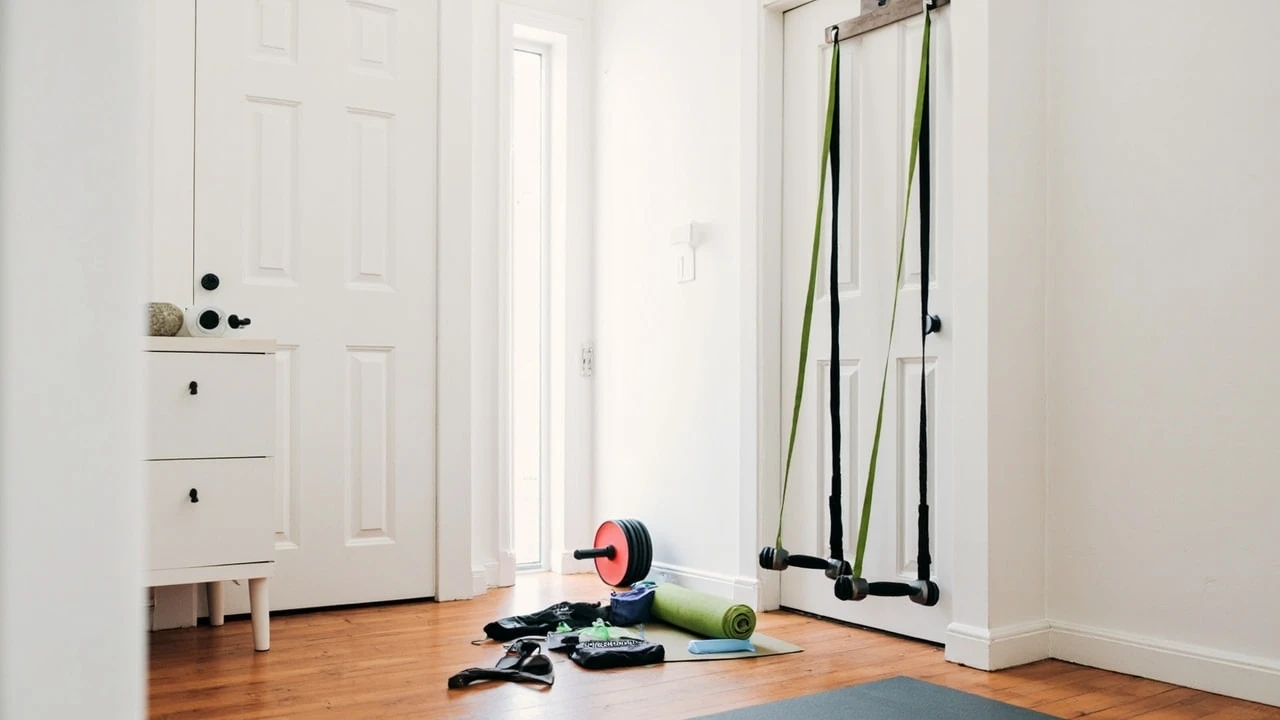
A quality resistance band set is the highest-value first purchase at any budget. Five bands (light to heavy) cover every push and pull movement: chest press, rows, lat pulldowns, face pulls, banded squats, banded glute bridges, banded carries.
What to buy: A 5-band set with door anchor, handles, and ankle straps. Look for fabric-covered or premium latex (not "rubber tube" — they snap). Total resistance combined: 100+ lbs.
Trade-offs:
- Bands stretch and lose tension over 12-18 months of heavy use.
- The light bands wear out first; the heavy bands last 3+ years.
- Resistance isn't linear — bands get harder as you stretch them, which is great for the top of a press but weird for the start of a row.
Best for: Every household at this budget. If you buy nothing else from this list, buy bands. For senior-specific picks, see Best Resistance Bands for Seniors.
Search resistance bands set on Amazon
2. Doorway Pull-Up Bar ($25-50)
A no-screw doorway pull-up bar uses leverage against the door frame to support 200+ lbs. Closes the entire pulling side of training: pull-ups, chin-ups, hanging leg raises, scapular pulls.
What to buy: A multi-grip bar (overhand, neutral, underhand grips). Avoid the "telescoping" bars that just sit on the trim — they tear paint and fall when overloaded. Get the locking type that uses door frame leverage.
Trade-offs:
- Requires a standard door frame (28-36" wide with 4"+ trim).
- Will scuff or compress paint over time. Use a small foam pad if renting.
- Doesn't replace a real pull-up bar with kipping clearance — but for slow strict reps, it's plenty.
Best for: Anyone who can't do pull-ups yet (use it for negatives and assisted reps with a band looped over) and anyone who already can (it's enough to keep progressing for years). For DIY alternatives, see DIY Pull-Up Bar Guide.
Search doorway pull-up bar on Amazon
3. Single 25 lb Adjustable Dumbbell ($25-40 used, $75-90 new)
One adjustable dumbbell — yes, just one — opens up unilateral training: single-arm rows, goblet squats, single-arm presses, suitcase carries, lunges. The non-working side does isometric balance work.
What to buy: A FLYBIRD 25-lb single or a Yes4All spinlock with 25 lbs of plates. Used Marketplace listings under $40 are extremely common — see Buying Used Gym Equipment on Facebook Marketplace for inspection tips.
Trade-offs:
- One dumbbell limits bilateral work (bench press, dumbbell chest fly).
- 25 lbs is a low ceiling — you'll outgrow it for goblet squats and rows within 6 months.
- A real pair (covered in Best Budget Adjustable Dumbbells) is the upgrade once budget grows past $150.
Best for: Apartments, beginners, and people training one limb at a time (rehab, asymmetric strength work). The unilateral pattern also has lower injury risk for new lifters.
Search FLYBIRD 25 lb adjustable dumbbell on Amazon
4. Yoga Mat ($15-30)
Cheap to buy, used every session. A yoga mat protects floor and joints during push-ups, planks, glute bridges, ab wheel rollouts, and stretching. Also doubles as a non-slip surface under your dumbbell or kettlebell during single-leg work.
What to buy: 6mm thick, non-slip top texture. Brand doesn't matter — Amazon Basics is fine. If you'll do heavier work on it, get the 8-10mm thick "exercise mat" instead. For full home gym flooring (the next tier up), see Cheap Home Gym Flooring DIY.
Trade-offs:
- Thin yoga mats (under 5mm) feel hard during kneeling work.
- Thick mats (over 10mm) feel unstable during single-leg balance work.
- Will get torn within 18-24 months under daily use — treat it as a consumable.
Best for: Every household. The single cheapest item on this list and one of the most-used.
5. Foam Roller ($15-25)
A foam roller covers the entire recovery and mobility side of training. Pre-workout: foam roll quads, glutes, lats, upper back to free up movement. Post-workout: foam roll soreness out of the same muscles.
What to buy: 18" or 24" length, 6" diameter, medium density (not soft, not hard). Skip the textured "trigger point" rollers for now — they hurt more than they help at this experience level. A simple smooth foam roller does 95% of the job.
Trade-offs:
- Doesn't replace a real massage or PT visit if something's actively injured.
- Cheap "EPP foam" rollers compress within 6 months under heavy use. Look for EVA foam or polyethylene.
- 36" rollers are great for spinal extension but overkill at this tier.
Best for: Anyone over 40 (rolling makes a measurable difference in workout recovery). Also anyone with desk-job posture — daily 5-minute roll undoes hours of slouching.
Search foam roller 18 inch on Amazon
6. Ab Wheel ($10-20)
The ab wheel is the cheapest item that produces visible results. A single set of 8-12 slow rollouts trains the entire core stiffness chain — abs, obliques, lats, shoulders — and trains it better than any number of crunches.
What to buy: A dual-wheel ab wheel with comfortable rubber-grip handles. Skip the single-wheel version — they're tippy and waste the first few weeks teaching you to balance. Brand doesn't matter; the design is essentially solved.
Trade-offs:
- Brutally hard for beginners. Expect to start on your knees doing partial-range reps for the first 4-6 weeks.
- Hurts your lower back if you sag through the rep. Form matters.
- Bulky to store — about the size of a tennis ball can.
Best for: Intermediate trainees who want a hard core movement that doesn't require equipment beyond a $15 wheel. Pair with the yoga mat (item #4) for kneeling reps.
Search ab wheel dual wheel on Amazon
7. 10-15 lb Kettlebell ($15-25)
A single light kettlebell covers swings, goblet squats (lightly), single-arm rows, halos, and Turkish get-up practice. The handle orientation is the killer feature — it's strictly better than a dumbbell for swings and farmer's carries.
What to buy: A vinyl-coated or rubber-coated 10 or 15 lb kettlebell. Vinyl coating prevents floor damage during set-down. Cast iron kettlebells (no coating) cost less but mark up floors and bruise shins.
Trade-offs:
- 10-15 lbs is a low ceiling — for swings, you'll outgrow it within 8-12 weeks.
- Single-bell limits some movements (you can't do two-bell farmer's carries).
- The next upgrade is a 25 lb bell — adds another $25 — at which point you have a usable swing/squat tool for years.
Best for: Beginners learning the kettlebell swing pattern. Also great for warm-ups (halos, light goblet squats) at any experience level. Senior-friendly at this weight — see Best Home Gym Equipment for Seniors.
Search kettlebell 10 lb vinyl coated on Amazon
8. Adjustable Jump Rope ($10-20)
The cheapest cardio tool that doesn't require batteries or floor space. Three minutes of jump rope is roughly equivalent to ten minutes of jogging in cardiovascular load. It also doubles as a coordination and footwork drill, which most home cardio tools don't.
What to buy: A speed rope with adjustable length (8-10 ft range) and ball-bearing handles. Weighted ropes are a niche tool — skip for now. PVC or plastic-coated cable is fine; "leather speed ropes" are marketing.
Trade-offs:
- Requires ~8 ft of vertical ceiling clearance. Basements with 7' ceilings won't work; outdoor or garage is better.
- Hard on joints if you land on heels — practice landing on the balls of the feet.
- Some apartments below you (downstairs neighbors) won't love jump rope sessions. Use a thick mat or schedule sessions when downstairs is empty.
Best for: Anyone living in a house, garage, or apartment with thick floor underlay. Strict 30-second-on / 30-second-off intervals are brutal cardio at zero cost.
Search adjustable jump rope ball bearing on Amazon
What to Skip at This Budget
These show up in $100 listicles. Don't buy them yet:
- Bowflex SelectTech 552 / heavy adjustable dumbbells — They're great, just out of budget. Save up to $150+ and revisit. See Best Budget Adjustable Dumbbells for the next tier.
- Foldable benches under $50 — They wobble at any real weight. Wait for $80-100 budget.
- Stability balls — Useful but redundant once you have the mat + ab wheel. The combo of items #4 and #6 covers what a stability ball does.
- Cheap suspension trainers — TRX clones under $30 are usually fine for bodyweight rows. But the doorway pull-up bar (item #2) plus resistance bands (item #1) covers the same training pattern at less total cost.
- Push-up handles / wedge bars — Marginally useful for wrist comfort. Skip until your wrists actually complain. Most don't.
- Vibrating massage guns under $40 — Cheap massage guns last 4-6 months and underperform a $15 foam roller. The percussion isn't free.
Three Build Paths (Pick One, Spend Under $100)
Strength-focused ($90-100): Resistance bands ($25) + doorway pull-up bar ($30) + 25 lb used dumbbell ($30) + yoga mat ($15) = $100. Covers every push and pull, plus carries/lunges/squats with the dumbbell.
Cardio + mobility ($85-95): Resistance bands ($25) + jump rope ($15) + yoga mat ($15) + foam roller ($15) + 10 lb kettlebell ($20) = $90. Bias toward conditioning over strength. Best for someone running 3-4x/week who wants supplemental work.
Full coverage ($95-105, hits all 8 items if you find used): Resistance bands ($25) + doorway pull-up bar ($30) + ab wheel ($15) + foam roller ($15) + yoga mat ($15) = $100. Then add the dumbbell + kettlebell + jump rope opportunistically over the next 3 months as budget allows. This is the "long way" build that ends with the complete kit.
The Order to Buy In
If you're starting from zero, this is the sequence I'd follow:
- Resistance bands — week 1. Most versatile single purchase. Train daily for two weeks before adding anything else.
- Yoga mat — week 1-2. Without the mat, bands work on bare floor — uncomfortable, especially for glute bridges and rows.
- Doorway pull-up bar — week 2. Once you've done two weeks of banded rows, add pulls. The pull-up bar trains the pattern your bands can't replicate well.
- Foam roller — week 3. After 2-3 weeks of training your shoulders, lats, and glutes will appreciate it. Don't buy on day 1 — you don't know what's sore yet.
- Ab wheel — week 4+. Wait until your core has 3-4 weeks of training under it. Day-1 ab wheel rollouts usually end in a back tweak.
- Single dumbbell — week 6+. The point of the bands and bar is to build base strength before adding load. Most beginners benefit more from doing bands well for 6 weeks than from buying a dumbbell on day 1.
- Kettlebell + jump rope — month 2+. Conditioning tools come last. Build a base first, then add intensity.
The What Order to Buy Home Gym Equipment guide walks through the same logic at higher budget tiers.
What Comes After $100
Once you've used the $100 kit for 2-3 months, you'll know exactly what's worth upgrading. Common next purchases:
- A pair of adjustable dumbbells ($95-150). Covers all the limitations of one single dumbbell. See Best Budget Adjustable Dumbbells.
- A foldable bench ($80-120). Once you have dumbbells, a bench unlocks chest press, rows, and step-ups properly.
- A 6×4 rubber mat or horse-stall flooring ($40-90). Necessary if you start setting down heavier weights. See Cheap Home Gym Flooring DIY.
- A used squat stand ($100-200 on Marketplace). Closes out the "real strength gym" loop. See Best Budget Power Racks for new options and Buying Used Gym Equipment on Facebook Marketplace for the used market.
Frequently Asked Questions
Can you build a real home gym for under $100?
Yes — a real one, not a fake one. Bands, a pull-up bar, one dumbbell, a mat, a foam roller, an ab wheel, a light kettlebell, and a jump rope cover strength, cardio, mobility, and recovery for the first 6-12 months of training. The combo trains every major movement pattern and produces real strength and conditioning gains.
What's the single best thing to buy at this budget?
A 5-band resistance band set with handles, door anchor, and ankle straps. It covers more movement patterns per dollar than any other piece of gear. If you only buy one item, buy bands.
Is buying used worth it at this budget?
Yes, for dumbbells and kettlebells. Cast-iron plates and steel kettlebells don't degrade — used costs half of new. Skip used for bands (they wear out quickly), yoga mats (they get gross), and foam rollers (sanitation).
Should I buy a bench at this budget?
No. $50-60 benches at this tier wobble at any real weight. Save up to $80-100, then read DIY Weight Bench Guide (build for $40) or pick one of the rated picks in Best Budget Adjustable Dumbbells. Floor presses and band rows are fine substitutes for 2-3 months.
Can apartment dwellers use this list?
Yes — that's actually the target case. Bands, a pull-up bar, a yoga mat, a foam roller, and an ab wheel are silent. The dumbbell, kettlebell, and jump rope are the noisier items — use them earlier in the day or in a garage if you have one. See Apartment Home Gym No Drilling for the apartment-specific build.
How long until I outgrow this setup?
6-12 months for an absolute beginner. 3-4 months for someone who already lifts. By then your bottlenecks are clear (need heavier dumbbells, need a bench, need a rack) and the next upgrade path is obvious. The $100 kit pays for itself in the first month vs a $40/month gym membership.
Closing
The $100 home gym is not a compromise — it's the entry budget that respects how beginners actually progress. Eight light items, used daily, beat a single expensive piece of gear bought once and used twice. Buy the bands first, get them home, and start training. Add the rest as you go.
For the next budget tier, see Budget Home Gym Under $200. For the very minimal floor, see Best Home Gym Equipment Under $50. And for the broader equipment-priority framework, How to Build a Home Gym: The Complete 5-Step Guide puts this list in context.
A single kettlebell is the best bang-for-buck strength-and-cardio tool under $100. Best Kettlebells for a Home Gym — what weight to start with and which budget bells are actually worth it.
Stepping up to a bench next? Best Weight Bench for a Home Gym — what to buy at the $60-180 tier, and the folding benches that vanish into a small room.
Choosing the pull-up bar? Best Pull-Up Bars for Home: Doorway, Wall & No-Drill — leverage, telescopic and screw-in doorway bars compared, plus a $40 wall mount that beats all three if you own the wall.
Under $100 buys a real massage gun now. Best Massage Guns for Home Gyms: Amplitude & Stall Force — three of the eight picks land under $90, including a head that heats and cools.