Table of Contents
Medical disclaimer. This article is educational and not medical advice. Osteoporosis is a clinical diagnosis that requires a DEXA scan and physician evaluation. If you have a known osteoporosis diagnosis, a history of fragility fracture, or significant osteopenia, consult your physician before starting any exercise program. Some commonly-recommended exercises (forward flexion under load, high-impact movements, twisting under load) can cause vertebral compression fractures in osteoporotic bone. Sourcing: this guide was compiled by the Home Gym Foundry editorial team from published clinical guidelines — we do not claim hands-on coaching credentials. Sources cited inline include the National Institutes of Health (NIH), American Academy of Orthopaedic Surgeons (AAOS), National Osteoporosis Foundation (NOF), and Mayo Clinic published guidelines.
Key takeaways
Weight-bearing and resistance exercises can build 1–2% bone density over 6–12 months, making them a clinically supported strategy for slowing osteoporosis in older adults.
- A 2023 meta-analysis in Osteoporosis International covering 80 trials and 5,581 participants supports progressive resistance training for bone density.
- Balance training reduces fall risk by 24%, per Cochrane review data cited by the National Osteoporosis Foundation.
- Avoid all forward spinal flexion under load — sit-ups, toe-touch stretches, and bent-over rows — especially with prior vertebral fractures.
- The LIFTMOR trial reported a 2.9% lumbar spine bone density gain; physician clearance is required before adding jumping or heavy loading.
Osteoporosis affects an estimated 10 million Americans, with another 44 million considered to have low bone mass (osteopenia). Women over 50 are at highest risk — roughly 1 in 2 will experience a fragility fracture in their lifetime. For men over 50, the rate is 1 in 4.
The intervention that has the strongest combined evidence base for prevention is exercise — specifically, weight-bearing aerobic exercise combined with progressive resistance training. A 2023 meta-analysis published in Osteoporosis International (Mohebbi et al., 80 trials, 5,581 participants) found that progressive resistance and impact exercise produces small but real bone-density gains at the hip and spine — typically in the 1-2% range over 6-12 months. Medication does more for raw density (bisphosphonates typically add 4-7% at the spine over three years), but exercise is the one intervention that also builds the muscle and balance that prevent the falls that break bones.
But osteoporosis exercise is a sharp-edged topic. The wrong exercises don't just fail to help — they can cause the exact fracture you're trying to prevent. Common gym movements (sit-ups, toe touches, twisting Russian twists, jumping under load) directly load the vertebrae in the spinal-flexion or rotation patterns that compromise osteoporotic bone.
This guide covers what works for osteoporosis prevention and treatment, what to avoid, and the equipment to use. The exercise selection is conservative and built around the NOF and Mayo Clinic published guidelines for safe osteoporosis exercise.
Quick Answer
For osteoporosis prevention, do three categories of exercise weekly: (1) weight-bearing aerobic — 30 minutes most days (walking outdoors, walking pad, stair climbing); (2) resistance training — 2-3 sessions per week of progressive resistance work focused on hip, spine, and forearm loading; (3) balance and posture work — daily 5-10 min focused on fall prevention and spinal alignment. Avoid: forward flexion under load (sit-ups, toe-touch stretches), twisting under load (most rotational ab work), high-impact jumping, and heavy spinal loading. Equipment under $200 covers the entire program. For the broader senior strength program, see Strength Training After 60 for Beginners.
The Three Exercise Categories That Actually Build Bone
1. Weight-Bearing Aerobic Exercise
"Weight-bearing" means the bones support body weight against gravity. Walking does this; swimming and cycling do not.
What works:
- Walking, outdoors on solid ground — 30 minutes most days, ideally 5-7×/week. The NOF recommends ≥150 minutes/week.
- Walking pad indoors — same benefits as outdoor walking but in controlled environment. See Best Walking Pads for Seniors for senior-friendly picks.
- Stair climbing — higher bone-density stimulus than flat walking. Can be done in 5-10 min daily increments.
- Low-impact jumping (cleared by physician only) — small heel raises and small skip-jumps. NOF says: "low-impact jumping has been shown to improve hip bone density," but with the caveat that current spine osteoporosis may make jumping unsafe.
What doesn't build bone (but is still good cardio):
- Swimming — non-weight-bearing. Excellent for cardiovascular health and joint mobility, no measurable bone benefit.
- Cycling (including recumbent bikes) — non-weight-bearing. See Best Recumbent Bikes for Seniors for cardio-only use.
- Pool aerobics — non-weight-bearing.
For someone with no osteoporosis but family history, walking 30 minutes/day is the floor. For someone with diagnosed osteopenia, 45-60 minutes/day combined with resistance training is the recommendation.
2. Progressive Resistance Training
Bones thicken in response to mechanical load. The bones that get loaded are the ones that get stronger. So resistance training has to load the bones you care about: hip, spine, forearm, wrist.
What works for bone density (per Mayo Clinic and NOF guidelines):
Resistance training, 2-3 sessions/week, focused on these bone-loading patterns:
- Squat / sit-to-stand / chair squat — loads hip, femur, lumbar spine.
- Step-up — loads hip and femur unilaterally.
- Light deadlift / glute bridge with weight — loads hip and lumbar spine carefully. For osteoporosis, glute bridge is the safer substitution.
- Standing dumbbell row — loads thoracic spine.
- Standing overhead press — loads thoracic spine, arms, and wrists.
- Wall push-up / incline push-up — loads forearms and wrists.
- Suitcase carry (single dumbbell) — loads forearm, wrist, and spine in stabilizing pattern.
For the full progressive program, see Strength Training After 60 for Beginners. The 12-week beginner plan there is largely osteoporosis-compatible (with the deadlift substitution noted in week 9-12).
Progressive overload matters for osteoporosis specifically. The 2018 LIFTMOR randomized controlled trial, published in the Journal of Bone and Mineral Research, compared high-intensity resistance and impact training (loads at 85% of 1RM) against a low-intensity home program in postmenopausal women with low bone mass. Only the high-intensity group produced significant bone-density gains — a 2.9% increase at the lumbar spine, versus a slight loss in the low-intensity group.
The implication: light dumbbells alone aren't enough long-term. Once a beginner can do 3 sets of 12 reps with a given weight comfortably, increasing weight is required for continued bone density benefit — not optional.
3. Balance and Posture Work
Building bone density is half the picture. Preventing falls is the other half. A 2016 NIH literature review concluded that "the majority of osteoporotic fractures occur as a consequence of a fall." Strong bones in an elderly person who falls regularly still fracture.
Balance training reduces fall rate by ~24% in adults 65+ (Cochrane 2019). See Best Balance Training Equipment for Seniors for the equipment and progressions.
Posture work is the second part. Osteoporotic spines are at high risk for kyphosis — the forward-curved upper-back posture that contributes to vertebral compression fractures. Specific exercises that work against kyphosis:
- Wall slides (back against wall, slide arms up overhead while keeping shoulder blades against wall) — 2-3 sets of 10 reps, daily.
- Banded face pulls — 2-3 sets of 12-15 reps, 3×/week. The single best posture-corrective exercise.
- Cobra hold (lying face down, lift chest off floor without using arms) — 3 sets of 15-30 second holds. Skip if you have active osteoporosis with vertebral fracture history.
- Prone Y/T/W raises (lying face down, raise arms in Y, T, then W shapes) — 2 sets of 10 reps per shape, 2-3×/week.
These four exercises take about 10 minutes total. Done daily, they noticeably improve posture within 4-6 weeks.
Exercises to Avoid With Osteoporosis
The NOF and Mayo Clinic published guidelines flag these movement patterns as high risk for people with diagnosed osteoporosis. Even for those without diagnosis but with high risk profile (family history, postmenopausal, low BMI), it's worth being cautious.
1. Forward Spinal Flexion Under Load
Bending forward at the spine while bearing weight is the #1 osteoporosis fracture mechanism. The vertebrae compress in flexion under load, and osteoporotic vertebrae crack.
Avoid:
- Sit-ups and crunches. These flex the spine in load (your own body weight) repeatedly. The single highest-risk common exercise.
- Toe-touch stretches (standing forward fold). Flexes the lumbar spine.
- Bent-over barbell rows. Heavy load in spinal flexion.
- Conventional deadlifts. Spinal flexion under heavy load. Substitute with glute bridge or trap-bar deadlift if available.
- Yoga forward folds (paschimottanasana, uttanasana). Many yoga classes for seniors still include these — opt out.
Substitute with:
- Plank or modified plank for core work (no spine flexion).
- Cobra-style spinal extension stretches for flexibility (the opposite movement).
- Single-leg glute bridge for posterior chain training.
- Trap-bar deadlift if you must deadlift — the trap-bar keeps weight at body sides, eliminating most spinal flexion.
2. Twisting Under Load
Rotational movement of the spine while bearing weight is the second-highest fracture risk movement.
Avoid:
- Russian twists with weight.
- Standing barbell rotations.
- Heavy golf practice with weighted clubs.
- Aggressive twisting yoga poses (revolved triangle, twisted lunge).
Substitute with:
- Pallof press (anti-rotation core exercise — resists twist rather than producing it).
- Bird dog (quadruped core exercise without rotation).
- Suitcase carry (anti-rotation in a functional pattern).
3. High-Impact / Heavy Spinal Loading
Avoid:
- Box jumps at full height.
- Burpee jumps if any spine concerns.
- Heavy back squats (over 1× body weight) for known osteoporosis.
- Plyometric jumps without physician clearance.
Substitute with:
- Step-ups (single-leg loading without impact).
- Light heel raises and small skip-jumps (NOF-cleared low-impact bone stimulus).
- Front-loaded squats (goblet squat) which keep the bar/weight in front, reducing spinal compression.
What's Generally Safe (Despite Looking Risky)
A few movements look scary but are generally fine for osteoporosis prevention:
- Banded squats and lunges — load is below the spine, not on it. Safe.
- Light overhead pressing — vertical loading is good for spinal bone density when done in neutral alignment. Just no forward lean.
- Glute bridges with weight on hips — the weight sits on hip bones, not on a flexed spine. Safe and bone-positive.
- Step-ups and stair climbing — loaded but in neutral spine alignment. Excellent.
Equipment Recommendations
The complete osteoporosis-prevention kit costs $100-200. Most readers spend $120-150.
- Light dumbbells / single adjustable dumbbell (5-25 lb range): $25-75. See Best Budget Adjustable Dumbbells. Used 25-lb singles are excellent at $25-40.
- Resistance bands ($20-30): See Best Resistance Bands for Seniors.
- Foam balance pad ($15-25): See Best Balance Training Equipment for Seniors.
- Sturdy chair ($0-60): Most readers own one.
- Yoga mat ($15-25).
- Walking pad (optional, $200-400): For indoor walking on bad-weather days. See Best Walking Pads for Seniors.
For the broader senior equipment shortlist that supports this program, see Best Home Gym Equipment for Seniors.
The Weekly Program
A complete osteoporosis-prevention program looks like this:
Daily (10-15 min):
- 30-45 min walking (outdoors or walking pad)
- 5 min posture work (wall slides + face pulls + Y/T/W raises)
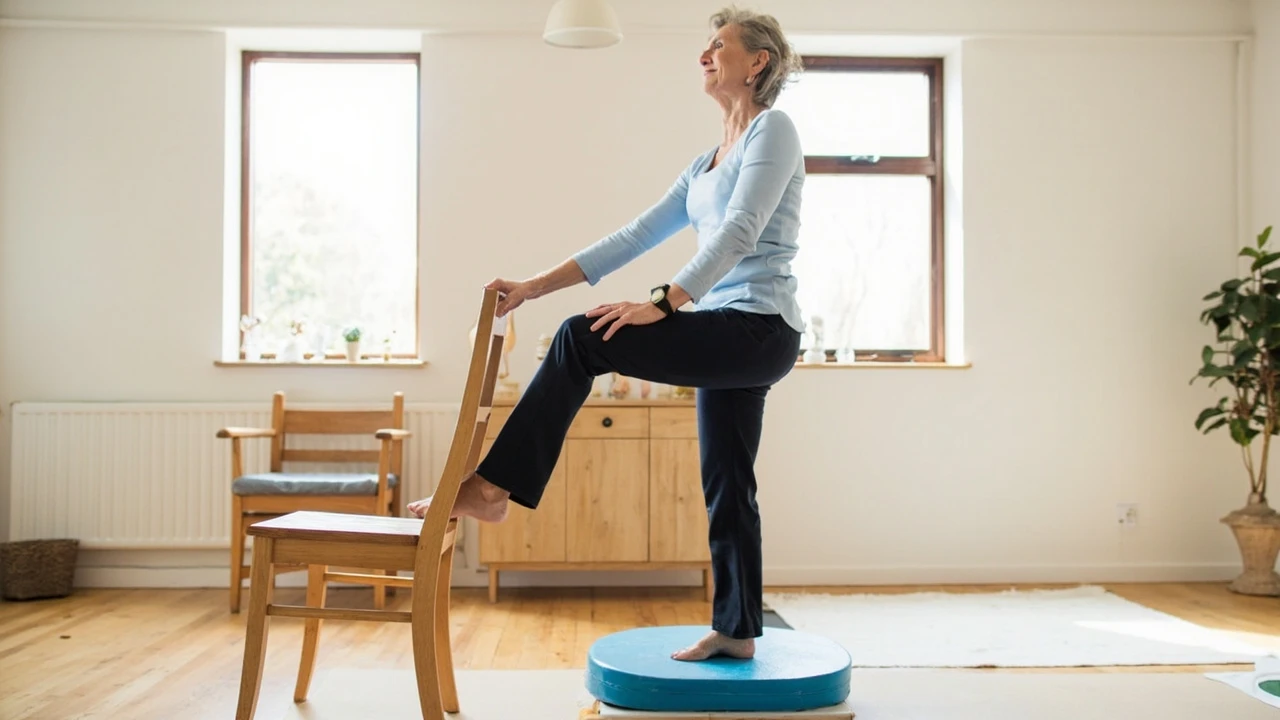
- 5 min balance work (single-leg stand on foam pad, eyes open progressing to eyes closed)
3×/week (45-60 min each):
- Full 6-movement-pattern strength session (see Strength Training After 60 for Beginners)
- Substitute glute bridge or trap-bar deadlift for conventional deadlift
- Avoid any flexion-under-load or rotation-under-load exercises
Weekly total time: ~5-6 hours Weekly equipment cost (amortized over 5 years): ~$0.50
The benefit (per the 2023 Osteoporosis International meta-analysis): roughly 1-2% bone density gain over 6-12 months of consistent training, maintained for as long as training continues. For postmenopausal women specifically, that's the difference between an osteopenic DEXA at 70 and an osteoporotic one.
What If You Already Have Vertebral Compression Fractures?
If you've already had a vertebral compression fracture, the exercise approach changes:
- Absolutely no forward flexion under load. Ever. Even bending to tie shoes can crack adjacent vertebrae.
- Avoid all twisting under load.
- Resistance training must be cleared by your physician and ideally supervised initially by a physical therapist familiar with osteoporosis exercise.
- Walking remains highly beneficial — typically 30 min/day, gradual increase, outdoor or walking pad.
- Specific spinal-extension exercises (cobra hold, prone Y raises) are helpful for some patients and contraindicated for others. Get individualized guidance.
The standard protocol for post-fracture exercise rehabilitation is outpatient PT for 6-12 weeks, then transition to home program with periodic check-ins. Don't skip the PT step.
Common Mistakes
- Treating osteoporosis as a "use weights = okay" condition. It's not. Specific movement patterns matter more than just "doing resistance training."
- Continuing pre-diagnosis exercise habits. If you did Russian twists every workout for 20 years, you have to stop after diagnosis. Old habits cause new fractures.
- Underloading. The 2018 JAMA study showed low-intensity resistance doesn't build bone — you have to progressively load. Don't stay at 5-lb dumbbells forever.
- Skipping balance training. Falls cause most osteoporotic fractures. Bone density without fall prevention is incomplete.
- Ignoring the cardio side. Bone responds to weight-bearing aerobic load too. Daily walking matters as much as the strength sessions.
- Stopping when you don't see DEXA improvements at 12 months. Bone density changes are slow — 24-month DEXA is the right measurement window, not 12-month.
When to See a Specialist
See an endocrinologist or specialist rheumatologist if:
- DEXA T-score is below -2.5 (osteoporotic range).
- You've had any fragility fracture.
- You've had a vertebral compression fracture (even silent ones detected on imaging).
- You have a strong family history and are over 50.
- You're on long-term corticosteroids or other bone-loss-inducing medications.
The combination of exercise + medication (bisphosphonate, denosumab, etc.) produces better outcomes than either alone. Exercise is not a substitute for medication in established osteoporosis — it's an additional intervention with strong independent benefit.
Frequently Asked Questions
Can exercise alone reverse osteoporosis?
For mild osteopenia, sometimes yes. For established osteoporosis (T-score below -2.5), exercise alone usually preserves bone but doesn't fully reverse the condition. Most patients with diagnosed osteoporosis benefit from medication + exercise combined. The 2023 meta-analysis cited above showed roughly 1-2% density gains from exercise alone — meaningful but not a full reversal.
Is walking enough to prevent osteoporosis?
Walking helps but isn't sufficient on its own. Multiple trials have shown that walking alone produces only ~1% bone density gain in postmenopausal women, vs ~3% for combined walking + resistance training. Resistance training is the higher-leverage intervention.
Should osteoporotic patients lift heavy?
This is debated. Conservative guidance (NOF): light-to-moderate resistance, avoid maximal lifts. Newer evidence (2018 JAMA): high-intensity resistance training (LIFTMOR trial) is safe and more effective in supervised settings. The conservative position is appropriate for unsupervised home training. If you have supervised access to a knowledgeable trainer or physical therapist, higher loads may be appropriate.
Are vibration plates effective for osteoporosis?
Mixed evidence. Some studies show small benefits in postmenopausal women; others show none. The current FDA-approved devices are at clinical doses much higher than commercial home plates produce. Skip the commercial home vibration plate as a primary intervention.
What about supplements (calcium, vitamin D)?
Beyond the scope of this article. Talk to your physician. NOF recommends 1,000-1,200 mg calcium/day and 800-1,000 IU vitamin D3/day for most postmenopausal women, but individual needs vary based on diet, sun exposure, and medical history.
Can I do yoga safely?
Yes, with modifications. Avoid forward folds, twisting poses, and inversions. Many "yoga for osteoporosis" classes specifically address this — Sara Meeks' "SAFE Yoga" protocol is the most established. Self-modified general yoga is also fine if you skip the high-risk poses systematically.
Is this advice different for men?
Mostly the same. Men have lower osteoporosis incidence but the same fracture biomechanics. The exercises that build/preserve bone density and the movements to avoid are identical. The medication landscape is slightly different (denosumab use is more common in men) but exercise prescription is broadly the same.
Closing
Osteoporosis is a manageable condition with the right exercise program. The combination of daily walking + 3-weekly resistance training + daily balance work produces measurable bone density gains and reduces fracture risk. The specific exercise selection — and especially the exercises to avoid — matters more than total training volume.
For the underlying strength program that this article references, see Strength Training After 60 for Beginners. For the balance training component, see Best Balance Training Equipment for Seniors. For cardio that supports the walking-weight-bearing requirement, see Best Walking Pads for Seniors. For the broader senior equipment picture, Best Home Gym Equipment for Seniors and Home Gym Equipment for Arthritis cover adjacent considerations. And for the home environment side of fall prevention, Fall-Proof Home Gym Setup covers the safety architecture every senior gym should have.
If you've been told you have osteoporosis or osteopenia, get specialist input on individualized exercise prescription. The exercises in this guide are appropriate for general prevention and for most patients with osteopenia — but established osteoporosis warrants personalized guidance to balance bone-building benefit against fracture risk.
The bones respond to load throughout life. Start with the walks. Add the resistance training. Stay consistent. The DEXA results 18-24 months from now are the reward.
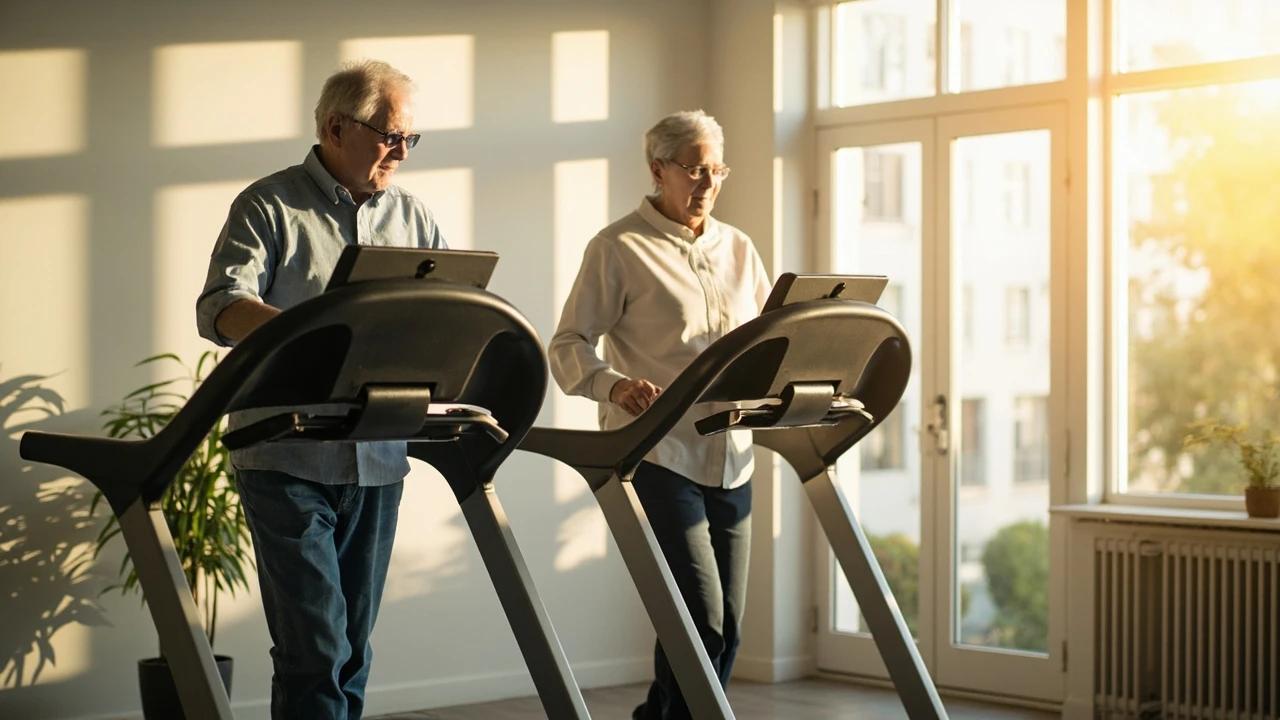
Walking is weight-bearing, which is the point. A treadmill makes that consistent regardless of weather or footing underfoot. See the best treadmills for seniors for models chosen around cushioned decks, sturdy handrails, and slow start speeds.