Table of Contents
Key takeaways
Vibration plates do a few things modestly well, and they are sold on the things they do not do.
- What the trials found: small gains in leg strength, on basic balance tests in older adults, and in bone density at parts of the hip. All of it is modest, and none of it replaces strength or balance training.
- What they don't do: meaningful weight loss. In 23 studies of overweight adults, fat mass fell about 1 kg and body weight did not change. No human trial shows a plate drains lymph.
- The spec that matters is hertz. Most of the bone trials in the newest review ran plates at 20 to 45 Hz. Many listings lead with "99 speed levels" instead, and a speed level is not a unit.
- Some people should not use one without a doctor's OK: anyone pregnant, with a pacemaker or implant, recent surgery, a clotting disorder, or a serious heart condition.
- The picks: the LifePro Rumblex Plus 4D reaches 40 Hz, the LifePro Waver is the compact plate, the LifePro TrimLite has a handlebar, and the Power Plate Personal runs at a fixed 35 Hz.
Vibration plates are having a moment, and the questions people are typing about them are telling. The fastest-rising searches are not "which one" but "does a vibration plate really work" and "can a vibration plate help you lose weight". The listings answer with words like toning, detox and lymphatic drainage. The research answers more quietly, and more usefully.
This guide does both jobs. It sets out what the trials actually found, in plain numbers. Then it picks the plates by the one specification those trials were built on, because a plate that cannot reach the settings the research used cannot be expected to deliver what the research found.
Quick Answer
The best vibration plate for most people who want what the studies measured is the LifePro Rumblex Plus 4D. LifePro rates it at 4 to 40 Hz with 0 to 12 mm of amplitude, so it covers most of the 20 to 45 Hz range the bone trials used, and it takes users up to 500 lb on a 29.5 by 18 inch deck.
If you want a small, simple plate for short, gentle sessions, the LifePro Waver is the compact choice. Go in knowing its limit: LifePro rates it at 4 to 12 Hz, below the range most of the bone trials ran.
If you are unsteady on your feet, buy the LifePro TrimLite, which has a handlebar that adjusts from 26.8 to 37.8 inches. Something solid to hold matters more than any other feature here.
And if you want a fixed, clinic-style setting with nothing to fiddle with, the Power Plate Personal runs at 35 Hz, inside the range most of the bone trials used, with a low or high amplitude. It is by far the most expensive of the four.
Picks checked against their Amazon listings in October 2026.
Do Vibration Plates Work? What the Research Shows
Short answer: for a few specific things, a little, if you use them the way the trials did. Here is the evidence, claim by claim.
Leg strength: yes, modestly
This is the most consistent finding. In a 2021 meta-analysis of 23 studies covering 884 overweight and obese adults, vibration training improved lower-limb strength by a moderate standardized amount (Rubio-Arias et al., 2021). Older adults show it too: a 2011 review of 13 trials found better knee-extension strength and sit-to-stand performance than in people who did nothing (Lau et al., 2011). That makes sense mechanically: many trial protocols had people squat and calf-raise on the plate, so the plate was making a strength workout slightly harder rather than replacing one.
Balance: small gains on basic tests, no proof it prevents falls
A meta-analysis of 13 trials in older adults found improvements on two standard clinical measures, the Tinetti balance score and the Timed Up and Go test, with the frailer participants gaining most (Lam et al., 2012). The same review could not show an effect on falls, which is the outcome that actually matters.
So a plate is not balance training. Standing on a vibrating platform does not challenge your balance the way single-leg work and unstable surfaces do. If balance is your goal, start with the equipment in our balance training guide, which is where the stronger evidence is.
Bone density: small, site-specific gains in older adults
The evidence here is mixed, and the newest of it points to a small effect. A 2011 review found no effect on hip or spine density in older women (Lau et al., 2011). A January 2026 meta-analysis of 14 trials and 1,447 older adults found gains at three regions of the hip, Ward's triangle, the greater trochanter and the femoral neck, and at part of the lower spine. It found no effect on total hip density or the full lumbar spine, and most of the trials carried some risk of bias (Chen et al., 2026).
A separate 2025 review of seven trials in adults over 55 found a small gain in total femur density and nothing significant at the femoral neck or spine, and rated the certainty of that evidence as low (Massini et al., 2025).
The honest summary: a vibration plate may nudge hip bone density in older adults, by amounts measured in hundredths of a gram per square centimeter. It is not a treatment for osteoporosis. Our guide to exercises for osteoporosis prevention covers the training with stronger evidence, and anyone with an osteoporosis diagnosis should plan exercise with their clinician.
Weight loss: not in any way you would notice
The same 2021 meta-analysis found that vibration training reduced fat mass by about 1.07 kg across the trials, which the authors themselves call not clinically significant, and it did not change body weight or BMI (Rubio-Arias et al., 2021). In adults over 60, a 2023 review found no improvement in fat or muscle mass at all (Reis-Silva et al., 2023).
One finding from the 2021 review is worth knowing: systolic blood pressure fell about 7 mmHg in the overweight participants. That is interesting, but it is a research finding, not a reason to treat blood pressure with a plate.
Lymphatic drainage: no human evidence
"Lymphatic drainage" is in the titles of most vibration plate listings on Amazon, about four in five of those we looked at in October 2026. A search of PubMed, the US National Library of Medicine's index of medical research, for whole-body vibration together with lymphedema, lymphatic or lymph flow returned only a handful of papers in October 2026: studies in mice and dogs, and one on military divers. None of them tests whether standing on a plate moves lymph in people. Treat the claim as marketing.
Hertz, Not Speed Levels: The Spec That Matters
Two numbers describe what a plate actually does:
- Frequency, in hertz (Hz): how many times per second the plate moves. In the bone trials pooled by the 2026 review, most plates ran at 20 to 45 Hz (Chen et al., 2026).
- Amplitude, in millimeters: how far it moves each time. Those trials mostly used 2 to 4 mm.
Those trials also had a shape worth copying: about three sessions a week for two to nine months, many with squats and calf raises on the plate rather than simply standing on it. The other reviews do not summarize their trials' settings, so treat these numbers as a guide drawn from the bone research, not a rule for every goal.
Most listing titles print neither number. Many print "99 speed levels" or "120 levels" instead, which tells you how many steps the dial has, not where it starts or stops. A plate that tops out at 12 Hz can still have 99 levels; they are just 99 steps below 12 Hz. Before you buy, look for the frequency in hertz on the maker's own page; if it is not there, assume the plate was not built around the research.
More is not better past a point. The 2025 review warns that frequencies above about 50 Hz can cause acute muscle pain and even bruising in untrained people (Massini et al., 2025).
You will also see two kinds of motion:
- Oscillating (pivotal) plates rock from side to side like a seesaw, so one foot rises as the other drops. Many plates on Amazon, including the Waver and TrimLite, work this way. They tend to run at lower frequencies with more travel.
- Linear (vertical) plates move the whole deck straight up and down. Trials have used both kinds.
Several plates, including the Rumblex Plus, combine more than one motor and motion.
| Plate | Frequency (maker) | Amplitude (maker) | Max user weight | Handlebar | Price |
|---|---|---|---|---|---|
| LifePro Rumblex Plus 4D | 4-40 Hz | 0-12 mm | 500 lb | No | Check price on Amazon |
| Power Plate Personal | 35 Hz, fixed | Low or high | 264 lb | No | Check price on Amazon |
| LifePro Waver | 4-12 Hz | 0-8 mm | 330 lb | No | Check price on Amazon |
| LifePro TrimLite | Not published | 3 mm | 265 lb | Yes, 26.8-37.8 in | Check price on Amazon |
The 4 Best Vibration Plates
1. Best Overall: LifePro Rumblex Plus 4D
The LifePro Rumblex Plus 4D is the only plate here whose published range spans most of the frequencies the bone trials used. LifePro rates it at 4 to 40 Hz with 0 to 12 mm of amplitude, driven by three motors and seven training modes, plus three preset programs and a manual mode.
It is also built for bigger users: 500 lb capacity on a 29.5 by 18 inch deck, which leaves room to squat with your feet at a natural width. It comes with resistance bands and a remote, and it has transport wheels, which matters because it weighs about 40 lb.
Tradeoffs: It takes real floor space and is heavy to move by hand. The wide range is only useful if you use it: set it in the 20s and 30s of hertz, not at the top of the dial.
Buy if: You want the plate that can reach the research settings, or you need a high weight limit. Skip if: You need a handlebar to stay steady; see the TrimLite.
2. Best Compact: LifePro Waver
The LifePro Waver is a simple, compact machine: preset programs plus a manual mode, 99 speed settings, a 200 W motor, a non-slip surface and a 330 lb user limit. It comes with loop bands, resistance bands and a remote.
The limit is the one this guide is built around. LifePro rates the Waver at 4 to 12 Hz with 0 to 8 mm of amplitude. That is a lot of travel at a low frequency, which suits gentle sessions and warm-ups, but it cannot reach the 20 to 45 Hz most of the bone trials used.
Tradeoffs: Below the research frequencies, and no handlebar.
Buy if: You want a small, easy plate for short, gentle sessions and will not miss the higher settings. Skip if: You are buying for the bone findings; get the Rumblex Plus or the Power Plate, which reach the frequencies those trials used.
3. Best With Handles: LifePro TrimLite
The LifePro TrimLite has a height-adjustable handlebar, from 26.8 to 37.8 inches, and for anyone whose balance is not what it was, that is the feature that matters most. Everything else is secondary: nine preset programs plus a manual mode, 99 speeds, a 150 W motor, 3 mm of amplitude, a 1 to 20 minute timer and a 265 lb user limit.
LifePro does not publish the TrimLite's frequency, so there is no way to say whether it reaches the range the bone trials used. It also has magnetic "acupoints" and Bluetooth speakers. Neither is a reason to buy it.
Tradeoffs: No published frequency, and a 265 lb user limit, about half the Rumblex Plus's.
Buy if: You want something solid to hold while the plate moves. Skip if: You are steady on your feet and want the research settings.
4. Closest to the Clinic: Power Plate Personal
The Power Plate Personal does one thing: it vibrates at a set 35 Hz, inside the range most of the bone trials used, with a choice of low or high amplitude. Power Plate supplies a 30 or 60 second timer, a strap set, a rubber mat and a remote. It supports users up to 264 lb on a footprint of 27.5 by 18.7 inches, and Power Plate says it is low enough to store under a bed.
Tradeoffs: It is by far the most expensive plate here, and the fixed frequency means no gentler setting for a first session beyond the low amplitude.
Buy if: You want a research-range setting with nothing to configure, and the budget is there. Skip if: You are buying your first plate to see whether you will use it at all; start with one of the LifePro plates.
How to Use a Vibration Plate Safely
Start low and short. LifePro's own instructions say to begin at a low setting and keep your knees slightly bent. Build up gradually, over weeks rather than sessions.
Copy the trials rather than the advertisements. About three sessions a week, with squats and calf raises on the plate, is closer to how the bone trials ran than standing still for ten minutes.
Some people should not use a vibration plate without a doctor's approval. Power Plate's own medically reviewed guidance lists (Power Plate):
- Pregnancy
- A pacemaker or other implanted medical device
- Cardiovascular disease, uncontrolled high blood pressure or a serious heart condition
- Recent surgery, especially a joint replacement or spinal procedure
- Deep vein thrombosis, blood clots or a clotting disorder
If you are unsteady, use a plate with a handlebar and put it where a fall cannot end against furniture. Our fall-proof home gym guide covers the setup.
What to Skip
- Plates sold on lymphatic drainage, detox or fat burning. No human trial supports the first two, and the third amounts to about 1 kg.
- Listings with speed levels and no hertz. If the maker will not say where the dial ends, assume it is low.
- Standing still for ten minutes and calling it a workout. Many of the trials had people moving on the plate.
- Magnetic acupoints and "magnet therapy" surfaces. They are not a reason to choose one plate over another.
- Unbranded plates from resellers. If the seller is neither Amazon nor the brand, you often get no published specifications and nobody to hold to the warranty.
- A plate instead of strength training. If the goal is stronger legs and bones, our strength training guide for over-60s does more for both.
Where a Vibration Plate Fits in a Home Gym
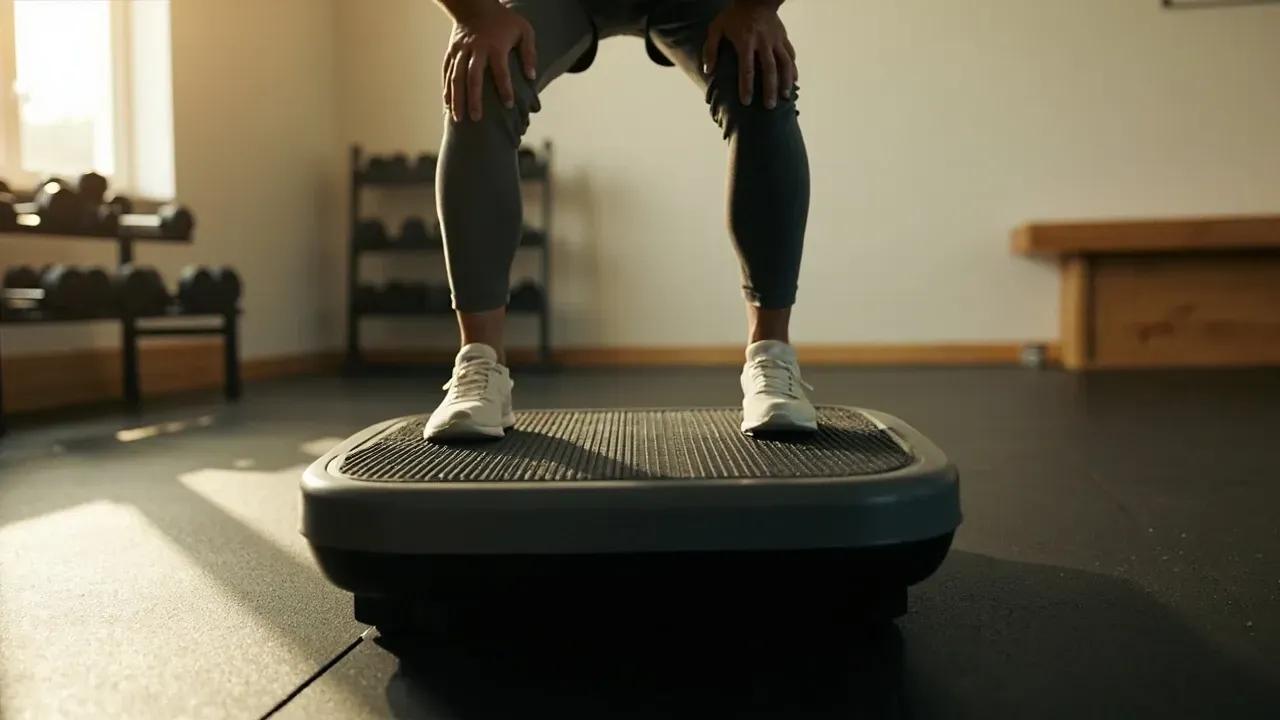
As an addition, not a foundation. A plate makes squats and calf raises a little harder, which is how many of the trials used it, and it takes up about the floor space of a large doormat. That is why it fits rooms where a rack never will.
It sits in the same place as a massage gun: useful, compact, and easy to oversell. Buy the training equipment first, then decide whether a plate earns its corner.
How We Picked
We do not own these plates and we did not test them. Here is what the picks rest on.
Specifications come from the makers. Frequencies and amplitudes are from LifePro's and Power Plate's own product pages, and user-weight limits from the brands' own Amazon listings. Where a maker publishes no frequency, the table says so rather than estimating one.
Every pick was chosen from a listing sold new by Amazon or by the brand, not by a reseller.
Three of the four are LifePro for a reason. LifePro publishes hertz and amplitude for most of its plates, and none of the plate listing titles we looked at on Amazon in October 2026 gave a frequency.
We checked the CPSC. When we checked in October 2026, the Consumer Product Safety Commission listed no recall or warning for any LifePro or Power Plate vibration plate. LifePro's October 2025 recall covered about 78,000 Bioremedy infrared sauna blankets that could overheat, a different product (CPSC).
Evidence comes from systematic reviews. Every research finding above links to a meta-analysis or systematic review rather than a single study. The exception is lymphatic drainage, where there is no human study to cite. The list of who should check with a doctor first is Power Plate's own, and is credited to it.
Frequently Asked Questions
Do vibration plates really work? For a few things, a little. Trials show small gains in leg strength, on basic balance tests in older adults, and in hip bone density in older adults. They do not show meaningful weight loss, and there is no human evidence for lymphatic drainage.
Can a vibration plate help you lose weight? Not noticeably. Across 23 studies of overweight adults, fat mass fell about 1 kg and body weight did not change.
Do vibration plates help with lymphatic drainage? There is no human evidence that they do. In October 2026, PubMed listed only a handful of papers pairing whole-body vibration with lymphatic terms, all in animals except one in divers, and none tests a plate's effect on lymph in people.
Can you use a vibration plate while pregnant? Power Plate's own guidance says to avoid vibration training unless a prenatal provider confirms it is safe. Ask before you start.
How often should you use a vibration plate? The bone trials in the newest review mostly ran three sessions a week for two to nine months, many with exercises on the plate. Start at the lowest setting and build up gradually.
Should you use a vibration plate before or after a workout? Many trials used it as part of the workout, with squats and calf raises done on the plate, rather than as something to stand on before or after.
Is a vibration plate good for seniors? The bone and balance findings come mostly from older adults, so the evidence is most relevant to them, but the gains are small. Choose a plate with a handlebar if balance is a concern, and check with a doctor first if any condition on the list above applies.
What is the difference between oscillating and linear plates? An oscillating plate rocks side to side like a seesaw; a linear plate moves straight up and down. Many plates on Amazon, including the Waver and TrimLite, oscillate. What matters more for matching the research is the frequency, so check the hertz before the motion type.
Buy the plate whose frequency is printed, use it the way the trials did, and keep training the way that does the real work.