Table of Contents
Key takeaways
A 12-minute daily stretching routine, built around 30-second static holds and a 2–3 minute warm-up, measurably improves mobility and flexibility for adults over 60.
- Equipment need not exceed four inexpensive items: a yoga strap, a mat, a foam roller, and a balance pad.
- Never bounce a stretch; sharp pain is a stop signal, not normal discomfort to push through.
- Warm up with 2–3 minutes of gentle movement before any stretch — never work cold muscles.
- Consult a doctor before starting; AAOS and ACSM guidelines inform the routine structure.
If you don't move it, you lose it. That's the brutal truth about mobility as we age. The connective tissues (tendons, ligaments, fascia) tighten when unused. Muscles shrink. Joints stiffen.
But the good news: It's never too late to start.
A daily 12-minute stretching routine can dramatically improve your quality of life—making it easier to reach for items on high shelves, look over your shoulder while driving, and get up from a chair without groaning.
This routine requires zero equipment. Just a sturdy chair and a carpeted floor.
Note: Before starting any new exercise program, consult your doctor. Stop immediately if you feel sharp pain.
The Science of Stretching After 60
As we age:
- Collagen production slows: Tissues become less elastic.
- Hydration decreases: Muscles and fascia become drier and tighter.
- Activity levels drop: We sit more, which shortens the hip flexors.
Stretching counteracts this by:
- Increasing blood flow to tissues
- Maintaining or improving range of motion
- Reducing the risk of falls (by improving balance and flexibility)
The Rule: Hold each stretch for 30 seconds. Never bounce. Breathe deeply.
The 12-Minute Routine
Do this every morning after waking up, or before your workout. Start with 2-3 minutes of marching in place or arm circles, then work through the three 3-minute sections below.
Section 1: Seated Stretches (3 minutes)
1. Neck Tilts (60 seconds)
- Sit tall in a chair.
- Slowly tilt your head toward your right shoulder.
- Hold for 30 seconds.
- Repeat on the left side.
- Benefit: Relieves neck stiffness from sleeping or looking at phones.
2. Shoulder Rolls (60 seconds)
- Sit with arms relaxed.
- Roll shoulders forward in big circles 10 times.
- Roll shoulders backward 10 times.
- Benefit: Loosens the upper back and improves posture.
3. Seated Spinal Twist (60 seconds)
- Sit tall. Place right hand on left knee.
- Gently twist your torso to the left.
- Hold for 30 seconds.
- Repeat on the other side.
- Benefit: Improves thoracic mobility, makes turning easier.
Section 2: Standing/Chair Stretches (3 minutes)
4. Standing Calf Stretch (60 seconds)
- Stand facing a wall, arms length away.
- Place hands on wall.
- Step right foot back, keeping heel on floor.
- Lean into the wall until you feel a stretch in your right calf.
- Hold 30 seconds. Switch legs.
- Benefit: Critical for balance. Tight calves increase fall risk.
5. Hip Flexor Stretch (60 seconds)
- Stand next to a chair for balance.
- Step right foot forward into a lunge position.
- Keep left knee on the floor (or hover if kneeling is hard).
- Push hips forward until you feel a stretch in the front of your left hip.
- Hold 30 seconds. Switch sides.
- Benefit: Sitting shortens hip flexors. This stretch counteracts that.
6. Standing Quad Stretch (60 seconds)
- Stand behind a chair, holding the back for balance.
- Bend right knee, grabbing your right ankle behind you.
- Pull heel toward buttock.
- Keep knees together.
- Hold 30 seconds. Switch legs.
- Benefit: Maintains knee flexibility and quadriceps health.
Section 3: Floor/Chair Stretches (3 minutes)
If getting on the floor is difficult, do these in bed or skip to the modified versions.
7. Supine Knee to Chest (60 seconds)
- Lie on your back (bed or carpet).
- Pull right knee toward your chest.
- Hold for 30 seconds.
- Switch legs.
- Benefit: Stretches the lower back and glutes. Relieves sciatica.
8. Cat-Cow (Floor or Seated) (60 seconds)
- If on floor: On hands and knees, arch back up (cat), then drop belly down (cow).
- If seated: Sit tall, arch back and round back alternately.
- Do 10 slow repetitions.
- Benefit: Keeps the spine mobile and flexible.
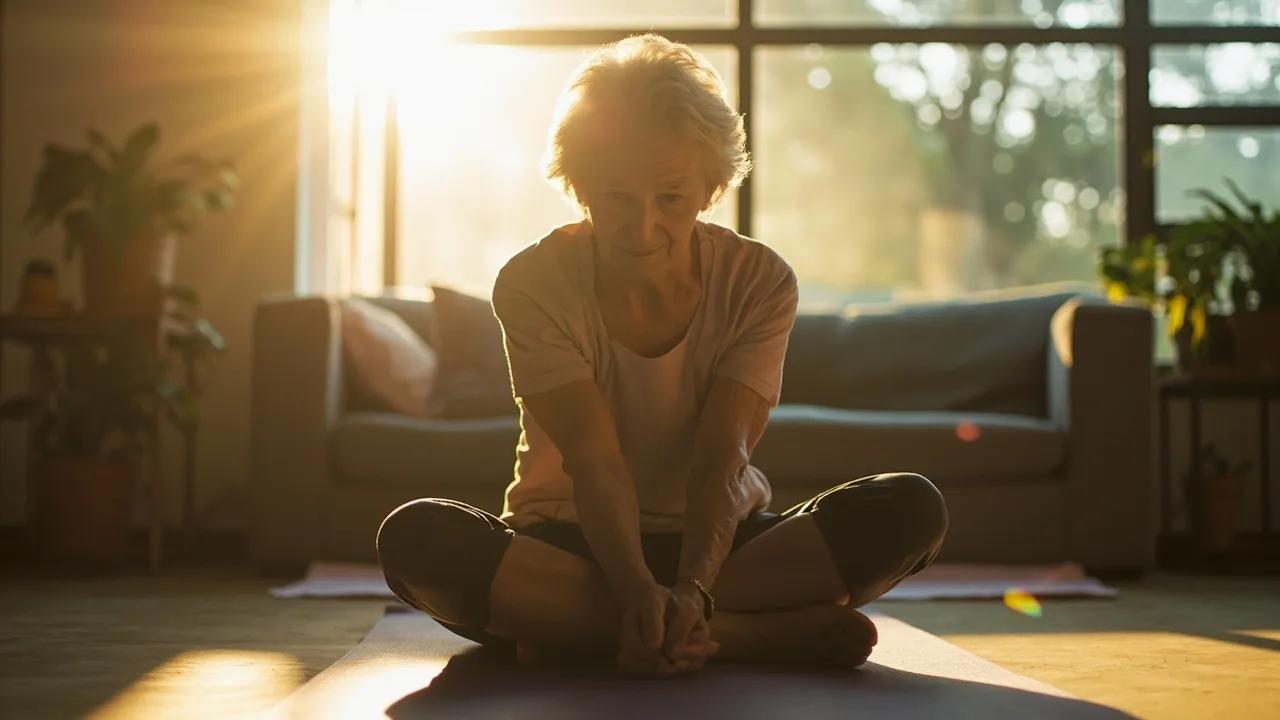
9. Figure-4 Stretch (60 seconds)
- Lie on your back.
- Cross right ankle over left knee (making a "4").
- Pull left thigh toward chest.
- Hold 30 seconds. Switch sides.
- Benefit: The best stretch for the piriformis and outer hip. Critical for walking and balance.
Tips for Success
1. Consistency Over Intensity
- Do this routine every single day for 21 days to form a habit.
- Even 10 minutes is better than 0 minutes.
2. Warm Up First
- Never stretch cold muscles.
- Do 2-3 minutes of marching in place or arm circles before stretching.
3. Breathe
- Exhale as you go into the stretch.
- Don't hold your breath. Deep breathing activates the parasympathetic nervous system, reducing stress.
4. Use Props
- A yoga strap or towel around the feet helps if you can't reach.
- A pillow under the head for floor exercises adds comfort.
- Chair height matters: Avoid low couches. Use a sturdy dining chair.
The "Can't Do That" Modifications
| Exercise | If You Can't |
|---|---|
| Floor stretches | Do seated versions in a chair |
| Standing balance | Hold onto a wall or counter |
| Deep lunge | Do a "half lunge" with both hands on a chair |
| Reaching for foot | Use a strap or towel |
When to See a Professional
If you experience:
- Sharp pain (not gentle stretching discomfort)
- Joint swelling that doesn't go away
- Pain that radiates down the leg
- Balance problems that are getting worse
See a physical therapist. They can create a personalized stretching program.
Equipment That Helps
| Product | Best For | Price Range |
|---|---|---|
| Yoga Strap | Flexibility assistance | Check price on Amazon |
| Yoga Mat | Floor comfort | Check price on Amazon |
| Foam Roller | Myofascial release | Check price on Amazon |
| Balance Pad | Balance training | Check price on Amazon |
Final Thought
Mobility is independence. Every stretch you do today is an investment in your ability to live independently tomorrow. Start small. Stay consistent.
Pair this routine with our senior strength equipment guide for a complete fitness program.
Stretching is the mobility half. Strength is the other half. Strength Training After 60 for Beginners — the 12-week plan that builds the muscle and bone density stretching alone can't.
Pairing mobility work with fall prevention? Best Balance Equipment for Seniors — the 7 balance tools that measurably lower fall risk.
Which massage gun if grip strength is the constraint? Best Massage Guns for Home Gyms: Amplitude & Stall Force — reach matters more than power, and two of the picks are built around using them unaided.