Table of Contents
Key takeaways
The usable zone under most staircases is 25–50 sq ft — enough for bodyweight, kettlebell, and suspension training if ceiling clearance is mapped first.
- Bowflex SelectTech 552 Adjustable Dumbbells ($300–$400) and a TRX All-in-One Suspension Trainer ($100–$170) fit the 3–4 ft width where barbells and power racks cannot.
- The functional workout zone is the first 5–7 ft from the tall end, where standing height typically reaches 6–8 ft.
- Mount pull-up bars to stair stringers, not drywall; the floor load rating is 40 lbs per sq ft.
- Avoid jumping exercises if bedrooms sit directly above, and skip hanging light fixtures that consume critical headroom.
That dead space under your stairs is probably holding a vacuum cleaner, a box of holiday decorations, and three years of guilt. It could be holding a gym.
The under-stairs nook is one of the most underrated spaces in a home. Depending on your staircase, you have anywhere from 25 to 50 square feet of usable area—enough for a surprisingly complete training setup if you plan it right.
Let's break down exactly how to turn this forgotten triangle into a workout zone.
Understanding Your Under-Stairs Dimensions
Before you buy a single kettlebell, you need to measure. Under-stairs spaces are irregular, and that triangular profile is the key constraint.
Standard Staircase Dimensions
Most residential staircases follow these specs:
- Width: 36 inches minimum (code requirement), but many are 40-44 inches
- Total run (horizontal length): 8-12 feet depending on floor-to-floor height
- Height at the tall end: 7-8 feet (full standing room)
- Height at the short end: 2-3 feet (storage only)
- Usable workout zone: The area where ceiling height exceeds 5 feet — typically the first 5-7 feet from the tall end
The critical measurement: Stand at the tall end and walk toward the short end. Mark the point where you can no longer stand upright. That line divides your space into "active training zone" and "storage zone."
Height Zones
Think of the space in three zones:
- Full-height zone (6-8 ft ceiling): Standing exercises — overhead press, pull-ups, kettlebell swings
- Medium-height zone (4-6 ft ceiling): Seated exercises, bench work, rowing
- Low zone (2-4 ft ceiling): Storage for equipment, shoes, towels, and accessories
Layout Ideas by Staircase Type
Straight Staircase Layout
This is the most common type and gives you the longest continuous space.
Dimensions: Typically 3-4 ft wide × 9-11 ft deep
Layout:
- Tall end (back wall): Mount a pull-up bar in the doorframe or on the wall where ceiling height is 7+ feet. This is also where you do standing exercises like kettlebell swings and goblet squats.
- Middle section: Place a foldable weight bench here. When ceiling height drops to 5-6 feet, seated and lying exercises work perfectly.
- Short end: Dedicate this entirely to storage. Stack kettlebells, store resistance bands on wall hooks, and keep your yoga mat rolled up.
Best equipment for this layout:
- Adjustable dumbbells (one pair replaces 15+ individual dumbbells)
- A single kettlebell (35-53 lbs covers most people)
- TRX suspension trainer anchored to the staircase structure
- Resistance bands hung on wall hooks
L-Shaped Staircase Layout
L-shaped stairs give you a bonus: the landing creates a small alcove with full ceiling height at the turn.
Dimensions: Two legs, each roughly 4-6 ft long, with a 3×3 ft landing area
Layout:
- Landing alcove: This is your premium real estate. Full ceiling height means standing exercises, pull-ups (if you mount a bar on the underside of the upper flight), and overhead movements.
- First leg (taller section): Training zone for floor work—pushups, ab work, stretching.
- Second leg (shorter section): Storage and low-clearance exercises like seated curls.
Pro tip: The corner where the two legs meet is perfect for anchoring a TRX or cable system. The structural framing at the turn is usually extra strong.
U-Shaped Staircase Layout
U-shaped stairs are the jackpot. You get two parallel runs with a landing between them, creating a wider space overall.
Dimensions: Often 6-8 ft wide × 4-6 ft deep under each run
Layout:
- Under the upper flight (taller side): Main workout area. You'll have 6-8 feet of headroom here.
- Under the lower flight: Storage and low-impact work.
- Center area beneath the landing: Often has the most consistent ceiling height (6-7 ft). Great for a compact bench station.
Equipment That Fits (And Equipment That Doesn't)
Perfect Fits
| Product | Best For | Price Range |
|---|---|---|
| Bowflex SelectTech 552 Adjustable Dumbbells | Replacing a full dumbbell set in minimal space | $300-$400 |
| TRX All-in-One Suspension Trainer | Full-body training with zero floor footprint | $100-$170 |
| CAP Vinyl-Coated Kettlebell | Swings, goblet squats, Turkish get-ups | $35-$85 |
Equipment That Won't Fit
Let's save you some returns:
- Full barbell and plates: A 7-foot Olympic bar simply won't fit in a 3-4 foot wide space. Not happening.
- Power rack: Even a half rack needs 4×4 feet minimum, plus ceiling clearance for a pull-up bar.
- Treadmill or elliptical: Too tall for the sloped ceiling, too wide for the narrow space.
- Cable machine: Most are 7 feet tall. Unless your tall end is 8+ feet, skip it. Build a DIY cable pulley instead.
The Sweet Spot
The ideal under-stairs gym revolves around adjustable dumbbells, kettlebells, bodyweight training, and resistance bands. These give you hundreds of exercise variations in a footprint smaller than a bathroom.
Clearance Requirements
This is where people mess up. You need more headroom than you think for certain movements.
- Overhead press (standing): Your height + 12-18 inches. A 5'10" person needs at least 82 inches (6'10") of clearance.
- Kettlebell swings: Your height + 6-8 inches. The bell goes to about eye level on a standard Russian swing.
- Standing dumbbell curls: Your height is enough. No overhead component.
- Bench press (flat): Bench height (17-18") + your arm length. Usually 30-36 inches total — works even under the low section.
- Seated exercises: Bench height + seated torso height. Usually about 42-48 inches needed.
- Floor exercises (pushups, planks): Just need enough width to lie down — 24 inches minimum.
Rule of thumb: If you can stand in the spot with your arms fully overhead without touching the ceiling, you can do any exercise there.
Lighting and Ventilation
Under-stairs spaces are dark and stuffy by default. Fix both.
Lighting
- LED strip lights along the underside of the stairs are the best solution. They're thin, bright, and don't eat into your already-limited headroom.
- Puck lights (battery-operated) work if you don't want to run wiring.
- Avoid hanging fixtures — they'll steal ceiling clearance you can't afford to lose.
- Brightness target: 300-500 lumens per square meter. You want to see clearly, not squint.
Ventilation
Under-stairs spaces have zero airflow. You'll be huffing stale air within 5 minutes.
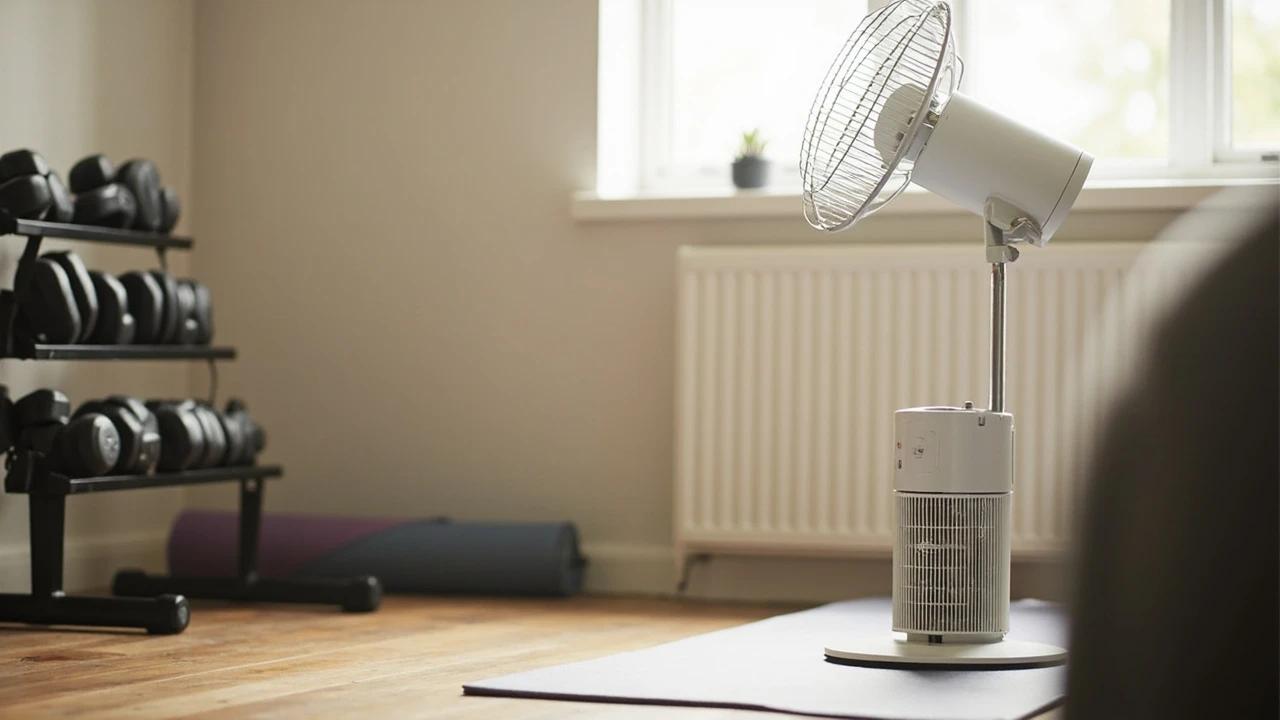
- USB desk fan clipped to a shelf or stair railing. Small, effective, cheap.
- Portable tower fan at the tall end, pointed into the space.
- If the space has a wall to the outside, consider installing a small exhaust fan (bathroom fan style). This is the permanent fix.
- Leave the entry open during workouts. Don't close yourself in with a door.
Flooring
The floor under your stairs is probably hardwood, tile, or carpet. None of these are ideal for training.
| Product | Best For | Price Range |
|---|---|---|
| BalanceFrom Puzzle Exercise Mat | Interlocking foam tiles for cushioning | $20-$40 |
| Rubber-Cal Elephant Bark Flooring | Heavy-duty rubber roll for weight drops | $50-$100 |
| ProsourceFit Tri-Fold Exercise Mat | Foldable mat that stores flat against wall | $30-$60 |
For a deeper dive on budget flooring, check our DIY flooring guide.
Key tip: Cut your mats to match the irregular triangular shape. Don't leave gaps at the edges — that's where dust and sweat collect.
Maximizing Storage in the Low Zone
The short end of the under-stairs space (2-4 ft ceiling) is useless for exercising but perfect for storage. Here's how to use every inch:
- Cube shelving units (the short, 2-cube kind) fit perfectly under the slope.
- Wall-mounted hooks for resistance bands, jump ropes, and TRX straps.
- Small baskets or bins for accessories: chalk, wrist wraps, lifting gloves.
- Shoe rack at the entry for your training shoes.
- Foam roller holder: Mount a horizontal PVC pipe section to the wall. Slide your roller in.
Sample Under-Stairs Workout
No excuses, no equipment swaps, just 30 minutes in your triangle.
Warm-up (3 min):
- Resistance band pull-aparts: 15 reps
- Bodyweight squats: 15 reps
- Arm circles: 30 seconds
Circuit (4 rounds, 45 sec work / 15 sec rest):
- Goblet squats (kettlebell): 12 reps
- TRX rows: 12 reps
- Dumbbell floor press: 12 reps
- Kettlebell swings: 15 reps
- Plank: 45 seconds
Total time: 28 minutes. Total space needed: about 3 × 6 feet.
FAQ
How much weight can the floor under stairs support?
Residential floors are engineered for 40 lbs per square foot of live load. A 300 lb person standing on a 2 sq ft area is 150 psf — well above the rating, but concentrated loads are handled differently than distributed loads. For home gym purposes, your equipment (a few hundred pounds of dumbbells and kettlebells spread across 25+ sq ft) is well within limits. If you're on a concrete slab, weight is essentially a non-issue.
Do I need a building permit to convert under-stairs space?
No. You're not changing the structure, adding plumbing, or modifying electrical systems. You're putting equipment in an existing space. If you add an electrical outlet for lighting, that's a minor electrical permit in some jurisdictions, but most homeowners skip it and use battery-powered or plug-in-from-nearby-outlet solutions.
Can I put a pull-up bar under the stairs?
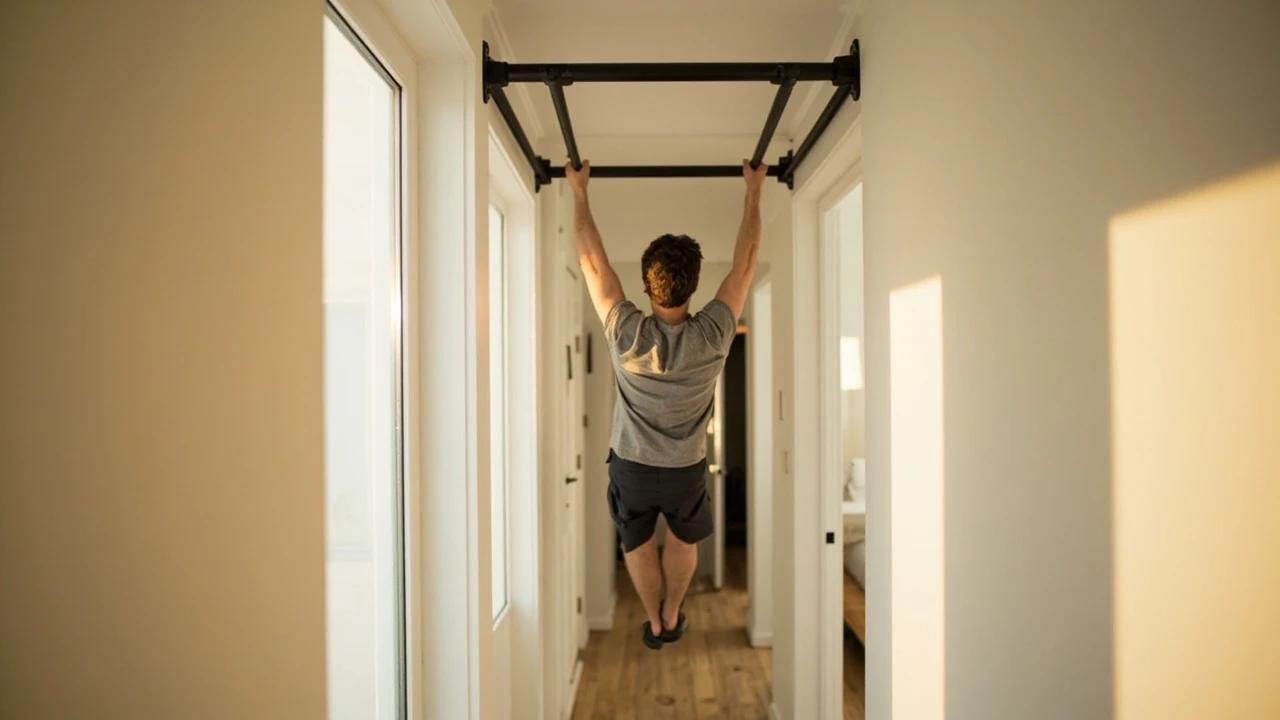
Yes, if the ceiling height at that point is at least your height plus 12-14 inches. Most people can find a spot at the tall end where this works. Mount it to the underside of a stair stringer (the structural beam running along the stairs) — these are load-bearing and can easily handle your body weight. Don't mount to drywall alone.
What's the minimum space needed for a functional under-stairs gym?
You need at least 3 feet wide × 5 feet deep with a ceiling height of 6 feet at the tall end. This gives you enough room for standing dumbbell work, kettlebell swings, and bodyweight exercises. Anything smaller and you're better off with a closet gym setup or a portable kit you bring to another room.
How do I reduce noise from working out under stairs?
The biggest noise issue is vibration traveling through the stair structure. Rubber flooring absorbs impact from dropped weights. For kettlebell swings and jumps, adding a thick rubber mat (3/4 inch minimum) makes a significant difference. Avoid jumping exercises if someone's bedroom is directly above. Stick to controlled movements — nobody upstairs will hear you doing goblet squats.
Working with more than the stair nook? How to Build a Home Gym: The Complete 5-Step Guide — the cornerstone walkthrough for planning a full build, whatever space you end up using.
Have a whole spare room to work with? Best Home Gym Equipment for a Spare Bedroom — the full setup guide once you graduate from the stair nook to a dedicated bedroom.
Need the full small-space equipment rundown? Best Home Gym Equipment for Small Spaces — the 2026 picks for racks, dumbbells, benches, and cardio that fit under 100 sq ft.
Awkward geometry is exactly where wall mounting wins. When the floor plan fights you, hanging equipment off the structure keeps the usable space clear — see the best wall-mounted gym equipment for folding racks and bars rated to 300 lb when anchored into studs.
Awkward footprint? Model it first in the free home gym layout planner — irregular spaces are exactly where a to-scale plan saves you a return shipping fee.
Mounting a bar under the stairs? Best Pull-Up Bars for Home: Doorway, Wall & No-Drill — the stringers make a good anchor; the guide covers which bars mount to wood and how to load-test them.