Table of Contents
- The Challenge: 60 Square Feet
- The All-In-One Solution
- Why Multi-Function Machines Make Sense Here
- Step-by-Step Build Process
- Complete Exercise Library
- Pros and Cons After 6 Months
- Final Thoughts
- DIY Tiny Home Gym Builds at 3 Real Budgets
- 5 Layouts That Actually Work Under 60 sq ft
- Apartment-Safe vs Garage-Only
- Storage System for Tiny Gyms
- Frequently Asked Questions
- What to Read Next
Key takeaways
A fully functional strength and cardio setup fits in 60 square feet or less, with project costs ranging from $300 for a closet build to $4,200 for a stair-nook installation.
- Wall-mounted folding racks (Titan T-3, PRX Profile, Rogue RML-3W) reclaim floor space and require ceiling height of at least 8 ft for overhead work.
- The Inspire Fitness FTX functional trainer fits a 4×7 ft footprint and carries a 1,000+ lb rack rating with 150 lb weight stacks.
- Use 3/4" rubber flooring and a three-zone storage system (wall/under-equipment/door-mounted) to maximize the square footage.
- Avoid dropping weights above 50 lbs on wood subfloors and skip overhead movements if ceiling height is under 8 ft.
When you only have 60 square feet, traditional gym equipment doesn't fit. This guide documents building a fully functional training space using multi-purpose equipment designed for extreme space constraints.
The Challenge: 60 Square Feet
This project started in a 6x10 spare closet that was previously used for storage. The homeowner wanted a complete workout solution—strength training, cardio, and flexibility work—without sacrificing the adjacent living space.
The All-In-One Solution
Modern functional trainers combine multiple stations into a single footprint. The machine chosen for this build—the Inspire Fitness FTX—includes:
- Functional trainer (dual cable columns)
- Smith machine bar
- Pull-up station
- Leg press attachment point
- Preacher curl pad
All within a 4x7 foot footprint.
Why Multi-Function Machines Make Sense Here
While purists prefer separate pieces for maximum strength development, the physics change in tiny spaces:
The Math:
- Power rack: 4x4 ft = 16 sq ft
- Separate cable machine: 3x4 ft = 12 sq ft
- Smith machine: 4x7 ft = 28 sq ft
- Total separate: 56 sq ft (almost entire room)
vs.
- All-in-one unit: 4x7 ft = 28 sq ft
- Remaining space: 32 sq ft (for bench, movement, storage)
Step-by-Step Build Process
Step 1: Room Preparation
The closet needed work before equipment installation:
- Removed carpet - Replaced with 3/4" rubber flooring
- Reinforced ceiling joist - The pull-up station needed solid mounting
- Added ventilation - Cut in a small exhaust fan to manage heat and humidity
- Improved lighting - Installed flush-mount LED panels
Step 2: Equipment Delivery and Assembly
The Inspire FTX arrived in 7 boxes weighing 850 lbs total. Assembly required:
- 2 people minimum
- 8-10 hours total time
- Basic tools plus rubber mallet
- Patience (lots of it)
Pro tip: Assemble the frame in the room, even if the boxes fit through the door. A fully assembled unit won't fit through standard doorways.
Step 3: Accessory Organization
With limited space, every accessory needs a home:
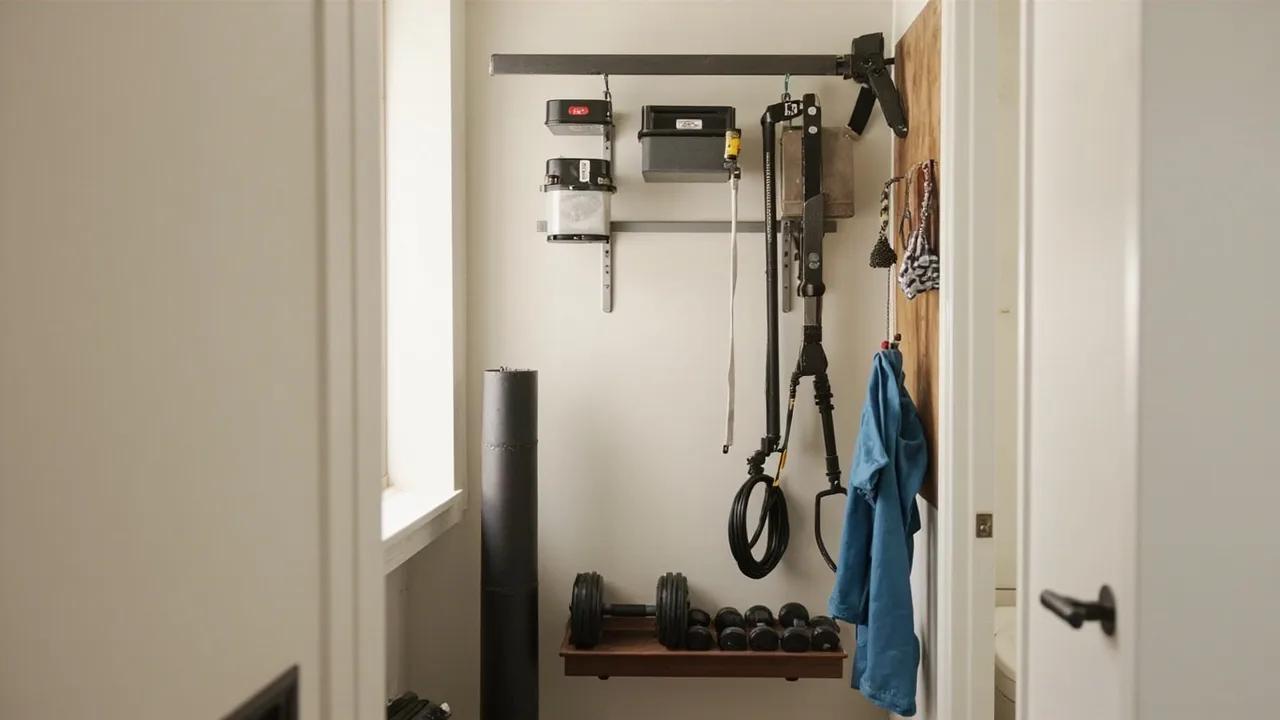
- Wall-mounted bar holder for attachments
- Magnetic strip for smaller cable handles
- Under-machine storage bin for bands and straps
- Door-mounted resistance band anchor for warm-ups
Complete Exercise Library
This 60 sq ft gym enables over 100 exercises:
Chest:
- Cable flyes (high, mid, low)
- Smith machine press
- Cable crossovers
Back:
- Lat pulldowns
- Seated rows
- Pull-ups (multiple grips)
- Straight arm pulldowns
Shoulders:
- Cable lateral raises
- Face pulls
- Overhead press (Smith)
Arms:
- Cable curls
- Tricep pushdowns
- Hammer curls
Legs:
- Smith squats
- Leg press (with attachment)
- Cable kickbacks
- Romanian deadlifts
Pros and Cons After 6 Months
Pros
- Extremely compact - Fits where nothing else would
- Hundreds of exercise variations - Never gets boring
- Built-in storage - Weight stacks don't take floor space
- Quiet operation - No clanging plates disturbing neighbors
- Safe for solo training - Smith machine provides built-in safety
Cons
- Expensive upfront - The FTX costs $3,500
- Assembly nightmare - Budget a full weekend
- Proprietary attachments - Some accessories only fit this brand
- Limited maximum resistance - 150 lb stacks don't challenge advanced lifters on big movements
Final Thoughts
This tiny home gym proves that space constraints don't have to mean fitness compromises. For apartment dwellers, condo owners, or anyone working with minimal square footage, all-in-one functional trainers offer a genuine solution.

The total investment of $4,200 (including flooring, lighting, and accessories) replaces a gym membership forever—and it's always available, always private, and always exactly how you left it.
DIY Tiny Home Gym Builds at 3 Real Budgets
The $4,200 build above is a great commercial all-in-one solution, but most readers searching for a DIY tiny home gym have a different budget. Here are three documented DIY builds that actually fit in 60 sq ft or less.
The $300 closet build
Total footprint: 6×6 ft. Total cost: $295.
- Two adjustable dumbbells (5–50 lb each) — $180 used on marketplace
- One door-mounted pull-up bar — $35
- One yoga mat — $20
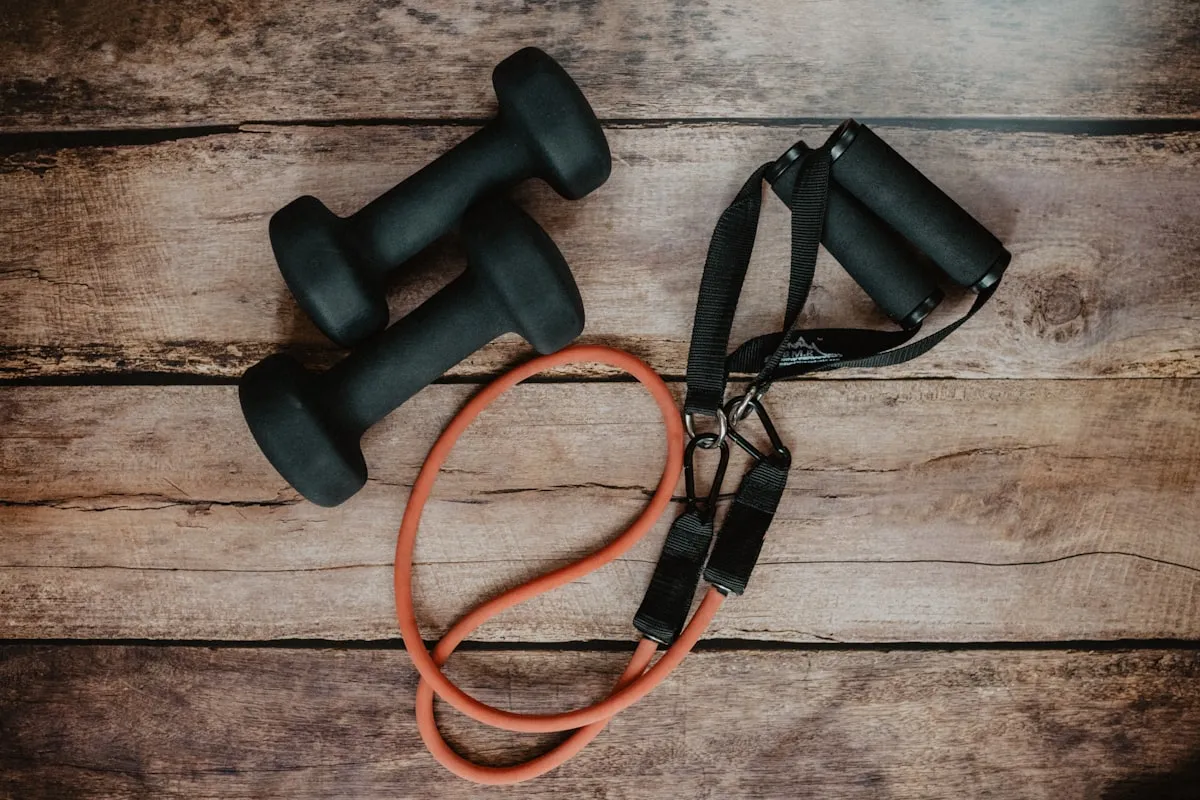
- One resistance band loop set (5 bands) — $25
- One 30" plyo box (DIY plywood, see the DIY plyo box guide) — $35
What you can train: full body. What you can't: heavy barbell movements. For 90% of home exercisers, this is enough for the first 2 years.
The $800 spare-corner build
Total footprint: 5×8 ft. Total cost: $785.
- Used 300-lb Olympic barbell set (45-lb bar + plates) — $250 marketplace
- One folding power rack (PRX, Titan, or Rogue compact) — $400 new
- One flat utility bench — $100 used
- One DIY pull-up bar bolted to the rack — $35
What you can train: every major lift. The folding rack flips against the wall when not in use, freeing the entire footprint.
The $2,000 under-stairs build
Total footprint: 7×4 ft (the awkward space under a basement staircase). Total cost: $1,950.
- Used Olympic set + bumper plates — $600
- Titan T-3 wall-mounted folding rack — $500
- AB-3000 adjustable bench — $350
- 1/2-inch horse stall mat flooring (see horse stall mats guide) — $150
- LED clamp lights + ventilation fan — $100
- DIY cable pulley system attached to rack — $250
What you can train: everything except machine-only exercises. The wall-mount rack is the key — it lets you reclaim the under-stairs dead zone without permanent floor footprint.
5 Layouts That Actually Work Under 60 sq ft
The space you have dictates the gym you can build. Here are five real layouts mapped to the constraint:
| Space Type | Footprint | Best Build Tier | Watch-Outs |
|---|---|---|---|
| Closet (5×6 to 6×8) | 30–48 sq ft | $300 closet | Pull-up bar mounting depth on door |
| Spare-bedroom corner | 40–50 sq ft | $800 spare-corner | Carpet damage from dropped weights |
| Hallway nook | 25–35 sq ft | $300 closet (no rack) | Vertical clearance for overhead movements |
| Under-stairs cavity | 30–50 sq ft | $2,000 under-stairs | Ceiling slope on overhead lifts |
| Half of a 12×12 bedroom | 60+ sq ft | $800 or $2,000 | Sound transmission to adjacent rooms |
Apartment-Safe vs Garage-Only
If you're in an apartment, a few rules cannot be broken:
Apartment-safe (do these):
- Use rubber flooring (3/4-inch minimum)
- Cap dumbbells at 50 lb each — heavier risks slab damage if dropped
- Avoid Olympic plate drops; switch to bumpers
- Do plyo work on rubber mat, not bare floor
Garage-only (skip these in an apartment):
- Heavy deadlifts above 225 lb
- Plate drops from waist height
- Repeated heavy plyometric box jumps directly on flooring
If a movement requires you to apologize to your downstairs neighbor, it's the wrong movement for your space.
Storage System for Tiny Gyms
Every accessory needs a home, because clutter in 60 sq ft compounds fast. The 3-zone system:
- Zone 1 — wall-mounted: olympic bar, attachments, bands. Vertical storage reclaims floor space.
- Zone 2 — under-equipment bin: small plates, clips, straps, lifting belt. One opaque bin under the bench or rack.
- Zone 3 — door-mounted: resistance bands, jump rope, towel. Anything light enough not to stress the door hinges.
If an accessory doesn't fit one of those zones, it doesn't belong in a tiny gym.
Frequently Asked Questions
Can you really build a useful home gym in 60 sq ft? Yes. Every layout above has been documented in real builds. The constraint is movement clearance more than equipment count — you need ~4 ft overhead and ~7 ft of horizontal swing room.
What's the minimum ceiling height for overhead lifts? Add 2 ft to your standing reach. For a 6-ft person, that's roughly 8 ft for clean overhead press. Below that, switch to landmine or seated variations.
Are folding racks actually safe? The Titan T-3, PRX Profile, and Rogue RML-3W are rated for 1,000+ lb with proper anchoring into wall studs. Anchoring quality matters more than the rack model — a $500 rack into drywall is worse than a $200 rack into doubled studs.
Will dropping weights damage the floor? On a slab garage with mats: no. On wood subfloor in an apartment: yes, even with mats. Switch to controlled lowering or use DIY concrete weight plates for the noisiest movements.
Can I use a tiny gym for serious strength training? Up to about a 315-lb deadlift in the $2,000 build. Beyond that, you outgrow tiny-space lifting and need to either move to a garage or accept a hypertrophy-focused (lighter-weight, higher-rep) program.
Is it worth it vs just paying for a gym? At $50/month gym fees, the $800 build pays for itself in 16 months. After that, every month is pure savings, plus you train when you want with no commute. The home gym vs gym membership math covers the break-even in detail.
What to Read Next
- Best Equipment for Small Spaces — broader product picks
- Spare Bedroom Home Gym Equipment — the next-size-up build